

You are using an out of date browser. It may not display this or other websites correctly.
You should upgrade or use an alternative browser.
You should upgrade or use an alternative browser.
Thorens TD160 E no low frequencies - Help needed
- Thread starter ChronoSee
- Start date
-
- Tags
- help needed


As others have said, this is unlike any TD 160 that I've ever seen either! I'm wondering if it isn't maybe a Frankentable, you know, like from Transylvania!!!
 I'm not kidding, actually, as there are many things that just don't look very "right" about it. For one, whoever did the soldering there at the block did a really poor job and I would re-do the whole thing. While doing that, I now see that there is a separate ground wire, the black one in the center post and that, if it is supposed to be a stock 160, is not there on mine. Instead, the ground is soldered over to the green wire and that's it.....nothing else. I don't know if this is responsible for your hum but it would not surprise me. So, if you're feeling adventurous, then remove the black ground wire from that center terminal and then solder the wire that is connected to the screw at the bottom directly to the terminal that your green wire is connected to. This would more resemble what my 160 looks like and, as stock, carry the ground over the left negative lead over to your phonostage. You can try this and see how things work. So after doing so, DO NOT CONNECT ANY GROUND TO YOUR PHONO STAGE as it is already connected over the left channel negative lead. Otherwise, you will create a ground loop and have the kind of issue you are describing. Others more knowledgeable than I might advise differently, but if you do this the worst thing will be an even greater hum, and if that happens, I don't know what else to tell you because of the very strange layout of your table that does not in any way resemble any 160 I have seen. Good luck and let us know how you do.....
tnsilver
Stereo Puppy
Does that happen with the tonearm in the armrest too? Does that happen when the platter is not spinning?Left channel is emitting some kind of mid frequency hum. Something like "boom boom boom" every 0,2 sec.

ChronoSee
New Member
Yes it happens regardless of the platter spinning and position of tonearm.Does that happen with the tonearm in the armrest too? Does that happen when the platter is not spinning?
As others have said, this is unlike any TD 160 that I've ever seen either! I'm wondering if it isn't maybe a Frankentable, you know, like from Transylvania!!!
I'll try to re-solder the whole thing. And follow your instructions concerning the grounding. Unfortunately I'll have to get a new soldiering iron. My usual precise tool had broke. I have a very old but not very precise solder. I don't want to rush and risk doing a poor job. I'm not an expert at this by any means.
And about the turntable, I saw another unit just like mine. I mean the tonearm, headshell and name. Thorens TD 160 E. It sold on ebay few days ago. I tried to find more information on that model but couldn't really find anything. It's weird and I hope someone can say something about that. I'm very curious. It might be that I bought some weird Frankenstein unit.
The link for interested

Thorens TD 160E Plattenspieler - vintage Turntable | eBay
Thorens TD 160E Plattenspieler - vintage Turntable | TV, Video & Audio, Heim-Audio & HiFi, Plattenspieler/Turntables | eBay!
www.ebay.pl
tnsilver
Stereo Puppy
I don't think so. I've googled many identical looking others. It looks serial production. I guess it's a late TD-160 variant. IIRC some Thorens models were made in Lodz, Poland for some time. Perhaps this is one of them. I'm not sure.It's weird and I hope someone can say something about that. I'm very curious. It might be that I bought some weird Frankenstein unit.
Use this if you want to revert to the classic Thorens grounding scheme (naturally, swap the red and green leads first).

The principal is summing all grounds (main chassis, sub-chassis, and tonearm) to the right channel return path (green lead).
I can see the tonearm is summed up, it's not clear in the picture if the sub-chassis is included. Make sure the sub-chassis is grounded properly.
The green lead should fork to the ceiling of the headshell, and to the right channel ground pin on the cart. Ensure it's so.
Yes, @tnsilver, I believe we are both saying exactly the same thing, thanks for chiming in on that one. However, you took it to the next level with the picture and the markups/instructions which deserves extra credit! @ChronoSee, I would not be surprised to see your hum problem disappear. Many have tried to incorporate a ground wire from the turntable to the phono stage but on these Thorens, it only creates problems.
It does seem a bit weird that there is no ground wire to connect to the phono stage since that's what so many turntables have you do, but the Thorens' design causes a ground loop when you do that as previously reported by many. Take your time, amigo.....you are able to listen even as it is and are pretty happy. You'll just be even more happy when all these little glitches get put right.
The soldering is important. I would first take a picture of how it is all hooked up now for reference.....very handy to have......and then just remove all the wires, followed by some liberal flux on each of those terminals, wherever you have old solder and either use a wick to remove it or a device called a "solder sucker," which is kind of like a tiny vacuum and works pretty well. You have likely seen this tool. Use flux liberally, at least I do, because it can be cleaned off with some isopropyl alcohol very easily using a small, medium soft brush(think old toothbrush). Then after cleaning everything with the IPA, attach each wire by fluxing and then soldering. A fine tip on your soldering iron can be helpful here. Once done, use the IPA to clean everything up again and you should have some really nice, shiny silver solder joints that look way better than those original ones and will better carry a signal because the contact will be as it should be.
It's not the top of the turntable that I was talking about, it's the layout of the inside of it and that is very strange indeed. But I have to hasten to say there are probably variants that might have been exported to different countries that we over here wouldn't necessarily really be aware of. No matter, you have what you have and you will make the very best of it that you can! Carry on amigo.....
It does seem a bit weird that there is no ground wire to connect to the phono stage since that's what so many turntables have you do, but the Thorens' design causes a ground loop when you do that as previously reported by many. Take your time, amigo.....you are able to listen even as it is and are pretty happy. You'll just be even more happy when all these little glitches get put right.
The soldering is important. I would first take a picture of how it is all hooked up now for reference.....very handy to have......and then just remove all the wires, followed by some liberal flux on each of those terminals, wherever you have old solder and either use a wick to remove it or a device called a "solder sucker," which is kind of like a tiny vacuum and works pretty well. You have likely seen this tool. Use flux liberally, at least I do, because it can be cleaned off with some isopropyl alcohol very easily using a small, medium soft brush(think old toothbrush). Then after cleaning everything with the IPA, attach each wire by fluxing and then soldering. A fine tip on your soldering iron can be helpful here. Once done, use the IPA to clean everything up again and you should have some really nice, shiny silver solder joints that look way better than those original ones and will better carry a signal because the contact will be as it should be.
And about the turntable, I saw another unit just like mine. I mean the tonearm, headshell and name. Thorens TD 160 E. It sold on ebay few days ago. I tried to find more information on that model but couldn't really find anything. It's weird and I hope someone can say something about that. I'm very curious. It might be that I bought some weird Frankenstein unit.
It's not the top of the turntable that I was talking about, it's the layout of the inside of it and that is very strange indeed. But I have to hasten to say there are probably variants that might have been exported to different countries that we over here wouldn't necessarily really be aware of. No matter, you have what you have and you will make the very best of it that you can! Carry on amigo.....
Okay, this bugged me to the point of having to do something about it because my memory failed me and I needed a refresher course on the innards of the TD-160 I have, along with being reminded that my soldering skills weren't so great 12 years ago either so now I'm going to have to "walk the talk" and do some cleaning up on my own job! In any case, here is the way my table is wired, and you will notice that the ground goes to the RIGHT CHANNEL NEGATIVE, not the left channel negative. I hope these pictures will explain things better. This is how it looks with the bottom panel removed. The plastic housing over the terminal block has been removed to expose the block:
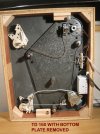
.....and then an expanded view of the wiring:
.....and finally a close-up of the terminal block and the wires. You will note that the ground wire to the chassis goes to the right channel negative terminal, as does the ground wire coming from the tonearm:

Man that is some ugly soldering!!! But, I do believe it shows very clearly where everything should go and I think if you wire yours the same, you should be good to go and "hummless!"
Hope this helps and sorry for the previous lack of clarity.....
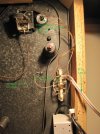
.....and then an expanded view of the wiring:
.....and finally a close-up of the terminal block and the wires. You will note that the ground wire to the chassis goes to the right channel negative terminal, as does the ground wire coming from the tonearm:
Man that is some ugly soldering!!! But, I do believe it shows very clearly where everything should go and I think if you wire yours the same, you should be good to go and "hummless!"
Hope this helps and sorry for the previous lack of clarity.....

lini
just me...
Thorens TD 160 E.
No worries - it was an official model. Basically a variant of the 2nd gen. TD160 MkII (= with TP16III rather than TP16II) with additional auto-stop & -lift (as already offered in the TD146 & 147 variants) - iirc, introduced in 1984 and only available for a rather short time.
IIRC some Thorens models were made in Lodz, Poland for some time. Perhaps this is one of them. I'm not sure.
No, it's not - which of course is not much of a surprise, as the TD 160 (MkII) E had already been introduced several years before the fall of the Iron Curtain. Whereas Thorens' Poland episode followed not quite a decade later (ca. 1993) and only lasted for roundabout two years.
Greetings from Munich!
Manfred / lini
ChronoSee
New Member
Thanks for an amazing instruction! I hope you'll have fun doing the clean up. For now I have to order new soldering kit, I'll make sure to make an update after doing the job.Okay, this bugged me to the point of having to do something about it because my memory failed me and I needed a refresher course on the innards of the TD-160 I have, along with being reminded that my soldering skills weren't so great 12 years ago either so now I'm going to have to "walk the talk" and do some cleaning up on my own job! In any case, here is the way my table is wired, and you will notice that the ground goes to the RIGHT CHANNEL NEGATIVE, not the left channel negative. I hope these pictures will explain things better. This is how it looks with the bottom panel removed. The plastic housing over the terminal block has been removed to expose the block:
View attachment 3088955
.....and then an expanded view of the wiring:
View attachment 3088956
.....and finally a close-up of the terminal block and the wires. You will note that the ground wire to the chassis goes to the right channel negative terminal, as does the ground wire coming from the tonearm:
View attachment 3088957
Man that is some ugly soldering!!! But, I do believe it shows very clearly where everything should go and I think if you wire yours the same, you should be good to go and "hummless!"
Hope this helps and sorry for the previous lack of clarity.....
It's great to know more about that table, so thank you for thatNo worries - it was an official model. Basically a variant of the 2nd gen. TD160 MkII (= with TP16III rather than TP16II) with additional auto-stop & -lift (as already offered in the TD146 & 147 variants) - iirc, introduced in 1984 and only available for a rather short time.
No, it's not - which of course is not much of a surprise, as the TD 160 (MkII) E had already been introduced several years before the fall of the Iron Curtain. Whereas Thorens' Poland episode followed not quite a decade later (ca. 1993) and only lasted for roundabout two years.
Greetings from Munich!
Manfred / lini
 .
. Is there any way to know where it was manufactured? I know it doesn't change anything, but I like to be informed.
lini
just me...
Is there any way to know where it was manufactured?
Should have been made in Lahr, I'd assume. Or at least I'm not aware, that Thorens would have produced elsewhere at that time.
Greetings from Munich!
Manfred / lini
For now I have to order new soldering kit
Check this one out:
It's the one I'm using and I have no complaints. Comes with T18D16 tip which should be OK for most jobs. Not sure what your Amazon in Poland looks like but hopefully you will be able to score something similar. This soldering station has made a big difference in the quality of my work.....
Is it possible that the phono preamp might be the reason for low bass output?Hi there. This isn't a 'Thorens' issue per-se. It sounds more like a cart/tonearm setup related problem to me, or for some reason, either of the wiring (TA or RCA) is acting up as a filter. The Green 1 is a rather dull cart IMO, but it lacks any designed features to make the low-end 'disappear'. This isn't right!
Try to use a protractor to properly align the cart in the headshell, verify the magnetic anti-skate mechanism does its job (float the arm and see if it pulls in/out). Use contact cleaner on the pins of the TP-63 wand, headshell pins, and on the RCA terminals. If none of this helps, start considering TT cable replacement - and/or using a different cart.
ChronoSee
New Member
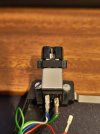
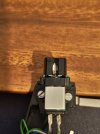
Hello there! While cleaning the lead plugs I took a look at the cart stylus. It appears to be badly bent. Can this be the main issue of distortion coming from left channel?
Is there a way to fix the stylus? If not, what do you recommend to buy. I've heard the cart for this tonearm should have compliance higher then 19. And it has to be bottom mounted. I very much enjoyed AT VM95E and was considering Nagaoka MP-110 on previous TT. Right now I have no idea what would fit my headshell and tonearm.
Is there a way to fix the stylus? If not, what do you recommend to buy. I've heard the cart for this tonearm should have compliance higher then 19. And it has to be bottom mounted. I very much enjoyed AT VM95E and was considering Nagaoka MP-110 on previous TT. Right now I have no idea what would fit my headshell and tonearm.
Attachments
tnsilver
Stereo Puppy
I've seen worst w/o consequences. I don't think the stylus is to blame. If you find and download the TP-63 wand manual and cart mounting instructions, you're likely to learn you are not restricted by any cart mounting form. I actually find it easier to to mount a cart on, and align, than the regular 'Technics' style headshell. The only restriction is the mounting screws length, but you can flip them over with the head in the headshell, and the nuts accessible from underneath, and use any cart you'd like.
tnsilver
Stereo Puppy
TP-63:
Once you attache the cart to the finger lift and plastic bar, you slide the cart into the TP-63 headshell slots. You can then tighten the screws just lightly enough to perform cart alignment, and when done, secure the screws. You can also flip the screws over, and control the nuts, so you can practically use most mounting screws lengths.

Since the wand is detachable, and access to the bottom is a walk in the park, there's really no restriction with any appropriate cart.
Once you attache the cart to the finger lift and plastic bar, you slide the cart into the TP-63 headshell slots. You can then tighten the screws just lightly enough to perform cart alignment, and when done, secure the screws. You can also flip the screws over, and control the nuts, so you can practically use most mounting screws lengths.
Since the wand is detachable, and access to the bottom is a walk in the park, there's really no restriction with any appropriate cart.
ChronoSee
New Member
Thanks! I have a loose AT-3600L, so I'll check this out. But what about compliance? I've read that low mass tonearms need high compliance carts. But I don't know how it affects sound. Any high compliance carts you can recommend? I only found Grado and Ortofon 2M series.I've seen worst w/o consequences. I don't think the stylus is to blame. If you find and download the TP-63 wand manual and cart mounting instructions, you're likely to learn you are not restricted by any cart mounting form. I actually find it easier to to mount a cart on, and align, than the regular 'Technics' style headshell. The only restriction is the mounting screws length, but you can flip them over with the head in the headshell, and the nuts accessible from underneath, and use any cart you'd like.
tnsilver
Stereo Puppy
I don't know any currently in production, good, high compliance carts except for the Naga MP series and the higher end O'fon M2's (not red). However, there's an online abundance of vintage, reasonably priced carts, such as Shure M95ED/M75ED Mk-II/M91, or any of the sterodynetic series. You can look for an Ortofon VMS series cart (20E,30E) with a good OEM stylus, or a Thakker replacement (that says 'Ortofon' on the front), and there's the goto Stanton 681eee, 881S, or the Pickering XSV equivalents. You're gonna have to pay attention to the stylus. Most of these vintage carts are only as good as the stylus - but many after market replacements will just kill the fun.
ChronoSee
New Member
Availability of vintage carts in Poland is rather week. I hoped to find something new. Grado seems like a natural choice, but vocals on this cart seems to be toned back to much for my taste. I wonder if Prestige Grado Red 3 would make a difference compared to Grado Green 1. The price for the stylus is reasonable here. (about 140$). Whole new Nagaoka MP-110 is about 200$ and would be my cart of choice if it's a good fit for my tonearm/tt.I don't know any currently in production, good, high compliance carts except for the Naga MP series and the higher end O'fon M2's (not red). However, there's an online abundance of vintage, reasonably priced carts, such as Shure M95ED/M75ED Mk-II/M91, or any of the sterodynetic series. You can look for an Ortofon VMS series cart (20E,30E) with a good OEM stylus, or a Thakker replacement (that says 'Ortofon' on the front), and there's the goto Stanton 681eee, 881S, or the Pickering XSV equivalents. You're gonna have to pay attention to the stylus. Most of these vintage carts are only as good as the stylus - but many after market replacements will just kill the fun.
In other news, I've cleaned the lead wires pins, it seems to help a bit with left channel distortion, but I might have imagine that
 .
.