• Please note that Audiokarma will be offline briefly for updates early on Monday morning, September 28th.

To Equalize or Not to Equalize

Tune to a dead spot is exactly what I would have done.:thumbsup:

In the late 70's I used a microphone, an LP with test tones and an ADC Sound Shaper MKII to flatten my in room response. I was impressed with the results. Since then my impetus for using any kind of equalization has been directed toward flattening in room response.
 
Last edited:
I have a question about getting speakers near flat in a room.

If measurements show, for example, a 6db peak at 800 HZ, should I reduce that frequency 6 db on the EQ and all is good? Or are the 6 db on the EQ not equal to 6 db in room?
 
I have a question about getting speakers near flat in a room.

If measurements show, for example, a 6db peak at 800 HZ, should I reduce that frequency 6 db on the EQ and all is good? Or are the 6 db on the EQ not equal to 6 db in room?

You should measure each speaker separatly, apply correction to each speakers and then re-measure with both.

You have to find which speaker cause the dip.

Don't forget that frequency cancellation can't be corrected by EQ, un other word you'll crank a particular frequency, and the other around and nothing will improve and maybe get worst
 
An acoustic guitar from one manufacturer sounds different than one from other manufacturer; people buy the one that sounds good to them. Period.

Then you record two different guitars being played. When you play them back on your stereo, should guitar "a" sound like recording "b"?

:)
 
You should measure each speaker separatly, apply correction to each speakers and then re-measure with both.

Don't forget that frequency cancellation can't be corrected by EQ, un other word you'll crank a particular frequency, and the other around and nothing will improve and maybe get worst

Interesting..., so how does one address such a problem?

I have some of these frequency spots. I have a 61-band RTA, 31-band auto eq (Behringer DEQ 2496). I don't use it "in" the system as an eq, but only to optimize the system's settings (e.g., examine the effects of crossover settings).

As you turn up the volume of the source (pink noise) and watch the 61-band RTA, some bands just don't get louder and you can preceive them as "suck out." And these frequencies are all over the place rather than restricted to one band/range.
 
Tone generator link from that other thread would be great here. In the 250000k open baffle thread towards the end.

You could find the nulls and try speaker, listening position changes.
 
Finding the nulls is easy with a 61-band RTA and pink noise..., and I do have a tone generator. Getting rid of them (and the peaks) is another matter.


It's impossible to get rid of them all passively, sometime we have to get a proper balance. For a no cost project and with proper equipment it's still possible, since recording studios are goods. How far can you go on this path is up to you.
 
Last edited:
I use an EQ because without one the music is not in the proper key, like the person that mastered the recording is tone def....but then again, who says we all hear things the same ??
 
Adjust tone controls, move speakers to optimal position, manufacture some acoustic panels in the garage, adjust the EQ for each song/album; heaven forbid you're a vinyl listener (clean stylus, clean, de-static record). ALRIGHT, You have exactly 3 minutes of listening time till the end of day! I'm not saying an EQ can't be beneficial, I'm saying there's a ton of AK'ers who fart around to the point that listening to actual music becomes secondary. I think the EQ, on both sides, has been positive and instructional (won't disagree with either)....but for Christ's sake, just listen and enjoy!!!! I will receive "hate mail" from a bunch of folks, but much like hoarding, once you release and just focus on the tunes it's a GD life changer!
 
Adjust tone controls, move speakers to optimal position, manufacture some acoustic panels in the garage, adjust the EQ for each song/album; heaven forbid you're a vinyl listener (clean stylus, clean, de-static record). ALRIGHT, You have exactly 3 minutes of listening time till the end of day! I'm not saying an EQ can't be beneficial, I'm saying there's a ton of AK'ers who fart around to the point that listening to actual music becomes secondary. I think the EQ, on both sides, has been positive and instructional (won't disagree with either)....but for Christ's sake, just listen and enjoy!!!! I will receive "hate mail" from a bunch of folks, but much like hoarding, once you release and just focus on the tunes it's a GD life changer!

We are in total agreement. That's why I rarely change my gear or the settings.
 
Then you record two different guitars being played. When you play them back on your stereo, should guitar "a" sound like recording "b"?

:)
it all depends on the cables, the mic used the recording media and so forth. I only know what it sounds like if I am there; even then it probably sounds different to me as it does to you. Sound is only pure once then is introduced into something that Perceives what it is.
 
Get one of these, and sit in your sweet spot, while a friend operates your EQ controls. This way, you EQ your setup and room for what your ears do. It works well with a Pioneer SG-9500 as well as Soundcraftsman EQs (10-band per channel):

R-8385432-1473902383-6509.jpeg.jpg


Enjoy,
Rich P
 
My first and only experience with an EQ is with my new Yamaha Dolby Atmos AVR. There is a HUGE improvement in overall SQ both in stereo and SS modes when I activate the EQ. When I use Pure Direct mode, which bypasses all audio processing and the EQ, It doesn't sound nearly as good.

That said, My living room Onkyo AVR has no EQ, And I must say, It sounds Really Good too. I think different speakers, Room, Placement, and more all play a role in the importance of an EQ. Sometimes we just stumble onto a combo that needs nothing more than tweaking tone controls, and using loudness at low volume (which can also be tweaked with the tone controls).

I never had the patience to manually adjust an EQ, But Yamaha makes it so easy to set their parametric EQ, In 2 minutes once the mic is set it is done. And I can tweak the settings if I choose.
 
Last edited:
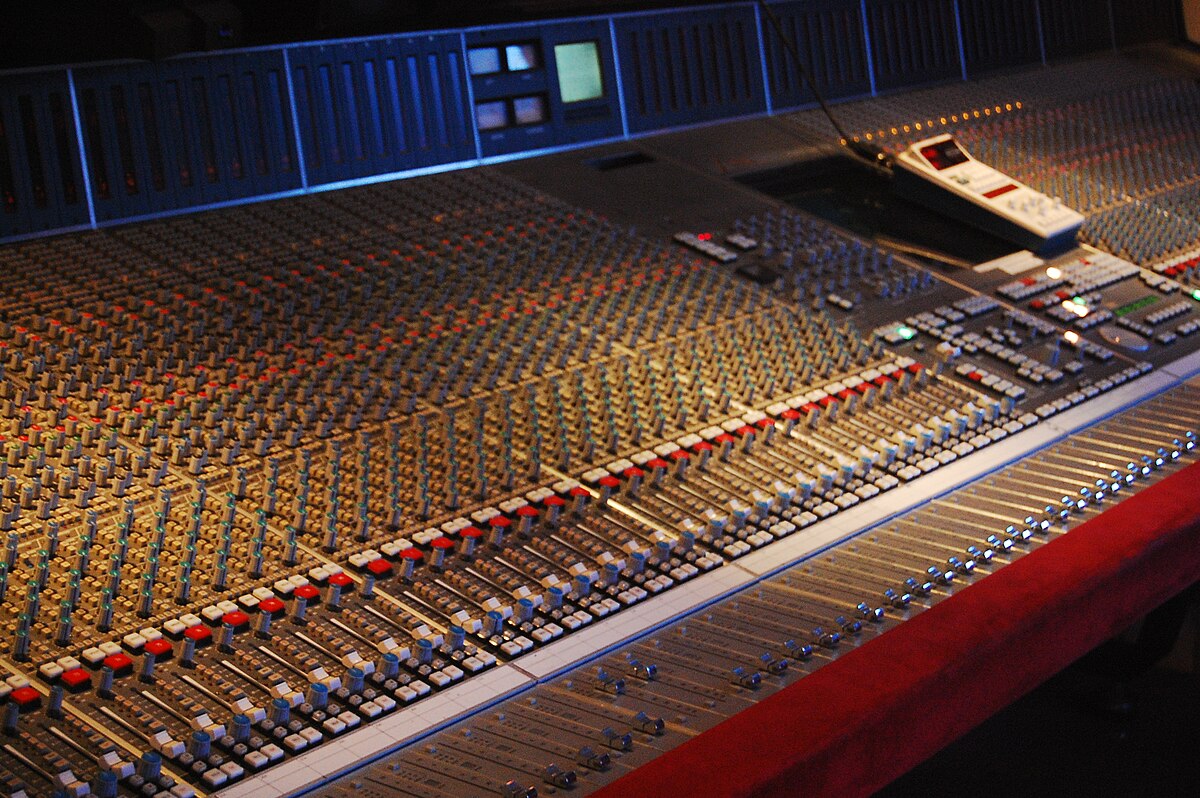
What one should realize in making a determination of whether or not an equalizer is good or bad, is that probably 99% of the recordings you listen to went through one of these:
1200px-SSL_SL9000J_%2872ch%29_%40_The_Cutting_Room_Recording_Studios%2C_NYC.jpg


which was controlled by someone's ears and hands other than yours.
 
What one should realize in making a determination of whether or not an equalizer is good or bad, is that probably 99% of the recordings you listen to went through one of these:
1200px-SSL_SL9000J_%2872ch%29_%40_The_Cutting_Room_Recording_Studios%2C_NYC.jpg


which was controlled by someone's ears and hands other than yours.

True. One should also realize each instrument and voice might be controlled by a separate channel. You don not have that option. If the recording engineer choose to record the lead guitar to loud for your tastes, And you back off the freq for the lead guitar, You also back off every other instrument and voice in the recording.

The EQ in my Yamaha AVR is there to compensate for different room and speaker configurations. If you want more, by all means feel free to experiment. But a properly calibrated EQ at least gives you a baseline.
 
Last edited:
Back
Top Bottom