• The move to the new server is done. There are some software and database maintenance updates in process. This has us passing the hat around to help out. We appreciate any donations. Seriously, even a dollar helps. The payment page may be found here - https://www.audiokarma.org/support.html

Tried and true crossover upgrade: Tobin Mods for Bozak B302a

It appears I have located four B200Yc in very nice condition..tested with printed frequency response graph and resistance numbers...all read great. I'll keep you all posted ...
My newer B200Yc tweeters are installed and all the "clipping" or "crackling" distortion in vocals and drums are cleared up for the most part. The whole system sounds amazing at low volume levels and now I only encounter distortion at higher db levels..can't resist trying the Bogen DB130 amps out at 11 o'clock gain..usually they're idling at about 25% on the dial...super quiet. I have never heard a clearer bass sound from every type of music, and as a bass player, I can hear every note distinct from the kick drum and other competing tones...incredible. I still have my mid drivers to change eventually...the paper cones there might be holding me back. I am aware that my 60+ year old inner ear isn't even close to what it used to be...the "ting" sound of a triangle for me is a distant memory I'm afraid. Thanks everyone for walking me through this!
 
Upgrading the midrange drivers to the aluminum cone version (again, B, Bc, or C) will deliver impressive results. It truly is one of the more accurate and clean midranges ever fabricated. You should be able to do that upgrade for $100 plus shipping. Well worth it.

Only 8 Ω midrange drivers will work. While the 16 Ω variant is uncommon, it is out there (used in the B-305 and some OEM configurations sold by Bozak or assembled by integrators) and some sellers do not clearly state the impedance. I won't speculate about the motives, other than to say that 16 Ω drivers are generally unusable by Boak owners. 'Nuff said on that. Mismatched impedances will not work, because the driver overlap at the transitions will alter the system's impedance, so such a purchase will be a total loss. Always verify the midrange impedance.

B is alnico, while Bc and C are ferrite. The B and Bc are rear mount, C is front or rear mount.
 
Update....have a nice set (hopefully) of B209B 8ohm drivers with alnico magnets on the way. Now I need to revisit the crossovers just to make sure I have the best version of Tobin mod and that it's done correctly. My hearing keeps changing day to day...frustrating. I hope to play some rock and soul instead of just jazz and classical through these giant cherrywood boat anchors :)
 
...by the way...the coating over the aluminum cones on the tweeters and the new mids are good, but not perfect. Doesn't a flaky coating alter the sound? Does anyone address the condition of this coating, any repairs possible, or should they be left alone?
 
...by the way...the coating over the aluminum cones on the tweeters and the new mids are good, but not perfect. Doesn't a flaky coating alter the sound? Does anyone address the condition of this coating, any repairs possible, or should they be left alone?
Just read your comment about cone mass Retrovert....thanks!
 
So you have a Bogen DB130? Tell me more about it. I bought two to make a stereo sistem and loved how strong and well built they are. Thanks
Alexandre Freddi
 
Yes I love my Bogen DB130 amps...power tubes are easy to find, built like a tank, loud, clean and quiet between programs...here is a temporary setup in my dry basement :)
 

Attachments

  • IMG_20181123_2129140_rewind.jpg
    IMG_20181123_2129140_rewind.jpg
    62.6 KB · Views: 31
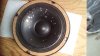
Here are my new used mid drivers....smooth to the touch now....not pretty though. I got all the loose coating material off with no damage...hope they rock...going in the cabs Monday...thanks for all the help Bozakers!
 

Attachments

  • IMG_20181123_2107486_rewind.jpg
    IMG_20181123_2107486_rewind.jpg
    59.7 KB · Views: 36
  • IMG_20181123_2107323_rewind_kindlephoto-228232.jpg
    IMG_20181123_2107323_rewind_kindlephoto-228232.jpg
    66 KB · Views: 37
Doesn't a flaky coating alter the sound? Does anyone address the condition of this coating, any repairs possible, or should they be left alone?

I suggest leaving it alone.

The coating damps out ringing which creates distortion. The coating is flexible, so it converts the mechanical energy of the annular wave into heat. If it were stiff the losses would be smaller because the coating would not flex and absorb the mechanical energy. That's why spraying a cone with a stiffening material will create ringing problems.

In short, don't worry about the flaking. Enough damping likely remains to keep the cone from ringing.
 
I guess I will check them periodically to make sure the bubbling hasn't returned...can't see why it would, clean warm and dehumidified where they're going. The aluminium is as thin as radiator fins...wrinkled just from the stamping press..bet they were a nightmare to fabricate. I'll know Monday if they helped. Lots of travel in the voice coil....not like the paper version. I probably overpaid for these but ....we shall see.
 
I guess I will check them periodically to make sure the bubbling hasn't returned...can't see why it would, clean warm and dehumidified where they're going. The aluminium is as thin as radiator fins...wrinkled just from the stamping press..bet they were a nightmare to fabricate. I'll know Monday if they helped. Lots of travel in the voice coil....not like the paper version. I probably overpaid for these but ....we shall see.

Latex oxidizes and degrades over time, particularly in thin layers with a great deal of surface area and thus many sites to oxidize. This is a common problem with old rubber, which hardens and turns to dust. Tools often have gaskets disintegrate. Because the degradation is oxygen driven it never improves. The normal tricks with hardened and degrading rubber are to expand the bonds using a volatile solvent (typically toluene) combined with a plasticizing agent (typically methyl salicyliate), so when the solvent evaporates the plasticizing agent remains trapped in the rubber matrix. That's all that "rubber rejuvenator" is, plus a label and a premium price. This solution is not possible for this application because the driver cannot be overnight soaked in the rejuvenator. Just to say it is a common problem.

The aluminum cone is very thin and easily damaged. I think those cones were likely spun, not stamped, as this would create a uniform thickness without tearing.

Sometimes it is better to pay a little more and avoid a lot of hassle factor.
 
Definitely not spun...way too thin for that. Check the two photos...clear light wrinkling at the edge and the cone plus stiffening ring and lip up are all one stamped piece. Installed now...kinda still distort on almost everything I listen to...jazz trio sounds ok. No complaints ever with the 100 Hz and below performance of those B199a woofers. Stepping back for a bit...all my other speakers sound better...including my $49 Polk bookshelf speakers and a small subwoofer I've had for 20 years
 
Definitely not spun...way too thin for that. Check the two photos...clear light wrinkling at the edge and the cone plus stiffening ring and lip up are all one stamped piece.

Speaker cones are typically spun, not stamped. At least the better ones are. I can't speak for the current crop of drivers manufactured in China.

Installed now...kinda still distort on almost everything I listen to...jazz trio sounds ok. No complaints ever with the 100 Hz and below performance of those B199a woofers. Stepping back for a bit...all my other speakers sound better...including my $49 Polk bookshelf speakers and a small subwoofer I've had for 20 years

Two things to check:
(1) Verify that the speaker polarity is correct with respect to the other drivers. If the midrange is reversed wired, i.e. polarity of + and – are swapped, it will sound peculiar, too emphasized. This is part of what the Tobin modification undoes.

(2) Verify the midrange's impedance is correct: it must be state 8 Ω and measure about 8 Ω. If you have a 16 Ω driver the crossover points will be way off. Unscrupulous dealers have been known to sell the otherwise useless 16 Ω drivers as 8 Ω.​
 
Speaker cones are typically spun, not stamped. At least the better ones are. I can't speak for the current crop of drivers manufactured in China.

Thanks Retrovert ....one read 7.4 and one 7.3 checked before I installed them. Polarity is marked on the driver backs too....will triple check crossover wiring again and try a different amp. None of the drivers in either cabinet read far from their correct impedances. My hearing is an issue to begin with but it may just not be the loudspeaker for me. I'll have some younger ears listen and will ask them questions

Two things to check:
(1) Verify that the speaker polarity is correct with respect to the other drivers. If the midrange is reversed wired, i.e. polarity of + and – are swapped, it will sound peculiar, too emphasized. This is part of what the Tobin modification undoes.

(2) Verify the midrange's impedance is correct: it must be state 8 Ω and measure about 8 Ω. If you have a 16 Ω driver the crossover points will be way off. Unscrupulous dealers have been known to sell the otherwise useless 16 Ω drivers as 8 Ω.​
 
Speaker cones are typically spun, not stamped. At least the better ones are. I can't speak for the current crop of drivers manufactured in China.


Two things to check:
(1) Verify that the speaker polarity is correct with respect to the other drivers. If the midrange is reversed wired, i.e. polarity of + and – are swapped, it will sound peculiar, too emphasized. This is part of what the Tobin modification undoes.

(2) Verify the midrange's impedance is correct: it must be state 8 Ω and measure about 8 Ω. If you have a 16 Ω driver the crossover points will be way off. Unscrupulous dealers have been known to sell the otherwise useless 16 Ω drivers as 8 Ω.​
Are you saying the cones in my photos look like Bozak speakers or Chinese speakers? They are stamped aluminum formed in a press. Hope someone weighs in on the cone fabrication technique of the Bozak B209 b midrange driver. Mine aren't Chinese forgeries and aren't spun aluminum.
 
Are you saying the cones in my photos look like Bozak speakers or Chinese speakers? They are stamped aluminum formed in a press. Hope someone weighs in on the cone fabrication technique of the Bozak B209 b midrange driver. Mine aren't Chinese forgeries and aren't spun aluminum.

Sigh. I never wrote your drivers are forgeries or made in China. That's your straw man which you set it on fire, and I suggest you extinguish the blaze before the fire department arrives. What I wrote was, "Speaker cones are typically spun, not stamped. At least the better ones are. I can't speak for the current crop of drivers manufactured in China."

Spinning a cone is a fast, simple, and readily automated process using a lathe and it provides great control over the shape, particularly if the thickness is to be non-linear or annular ridges are required, and the work-hardening ensures greater rigidity. Easily trimmed, too. All without the flaws or cracks from forcing metal to rapidly stretch during stamping into a form. Spinning is an easy way to make all manner of incredible shapes, and the cams used to drive lathes in a repetitive process were well-worked out over a century ago.

I'll ask an ex-Bozak employee how Bozak fabbed its cones.
 
Not sure about straw men...thought you could see those cones were stamped and not sure how you thought aluminum foil could be spun...being a tech guy and all. Patent drawing from 1963 state the maximum material thickness as 0.015 inches. Thanks again...cheers!
 
Last edited:
Not sure about straw men...thought you could see those cones were stamped and not sure how you thought aluminum foil could be spun...being a tech guy and all. Patent drawing from 1963 state the maximum material thickness as 0.015 inches.

An aluminum cone for a loudspeaker may be formed in two ways: spinning or pressing into a form.

Modern cones are typically spun, as I above described for the reasons I above set forth. Spinning does not always mean free-air spinning; in this case, the metal foil is pressed against a form during fabrication to provide the necessary support. Bright and shiny on one side and dull on the other, which the Bozak cones are, suggests formation using high pressure against a wide, smooth roller. Spinning also work hardens the metal, which stiffens the material, a desirable feature for a speaker cone where rigidity is a goal. Hence my supposition that it was spun against a form.

I have read the Bozak patents—long, long before you ever heard the name Bozak, I might add—but none of the patents describe how the cone is actually made.
 
Chinese Bozak knock-offs huh.

If there's any sort of driver issue, as Retrovert stated, verify the impedance. Not unheard of to get a 16 sold as an 8.

A properly setup aluminum cone 302 array should sound pretty good. The midrange is the secret sauce. Once sorted and enjoyed some opt to lose the Y tweeters and externally mount a more responsive modern type.

They do respond when given the right amount of drive. At least 60 vintage solid state watts.
 
Back
Top Bottom