Follow along with the video below to see how to install our site as a web app on your home screen.
Note: This feature may not be available in some browsers.
The move to the new server is done. There are some software and database maintenance updates in process. This has us passing the hat around to help out. We appreciate any donations. Seriously, even a dollar helps. The payment page may be found here - https://www.audiokarma.org/support.html
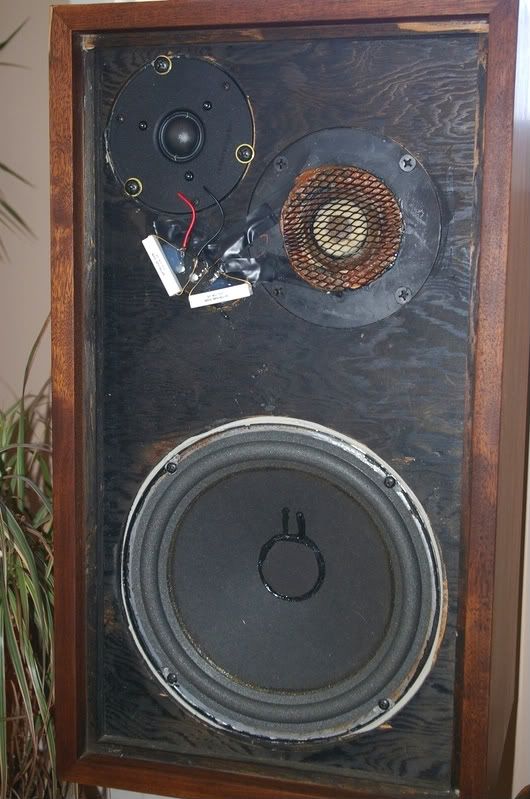
Aside from the scratchy pots, absolutely great. The woofers are out for refoamimg, & I'm waiting for the new pots to arrive. I was just curious why they all seem to be "upside down".
Here are some pics of one speaker. All three have the same orientation. It looks like one box was opened at one time, but the other two were unmolested.
I assume that when the speakers are vertical, the woofer should be on the bottom.
In this orientation, the labeling of the rear speaker leads is upside down.
How come?
Aside from the scratchy pots, absolutely great. The woofers are out for refoamimg, & I'm waiting for the new pots to arrive. I was just curious why they all seem to be "upside down".
Which pots are you going to use? If standard 8 ohm L-Pads like AR place out of Albany area sells you ought to read the AR 3a resto guide on classicspeakerpages.net
By adding resistors you can make them very close to the original 15 ohm reostats which are a different animal than L-Pads. Here's a picture of my AR 5's with the resistors mounted on outside in conjunction with the L-Pads.
I must be missing something. As I said in my original post, confirmed from the posted pics, I am talking about the labeling of the Speaker Leads.
See pics. When the speaker is vertical, with woofer on the bottom, the T, 1, and 2 leads are upside down.
I do see that, now. It's the "leaning over the top" thing, then.
OR, we may presume that the graphic artist who laid out the silk screen was either stupid or very smart, as there is no orientation from which it reads "right...."
yeah, most of the period literature i've seen has had those bad boys on the horizontal - it just seems so perverse to our modern sensibilities. you've just got to look at some of those monster recievers to get an inkling of where their mind was at...
We tend to think of speakers aligned vertically because it seems to be the easiest way to get good imaging, but George Augsberger had an article several years ago in Speaker Builder or AudioXpress suggesting that sometimes sideways orientation can give better phase relationships.
But I'm not suggesting that this was AR's (and every other bookshelf speaker maker's) design philosophy. Phase linearity was not on most people's radar back then and what was paid attention to was how far apart book shelves were -- people used to put books on shelves, and shelves used for books used to be closer to each other than vertical orientation would allow.
We are less literate now, but perhaps better imaged.
I do see that, now. It's the "leaning over the top" thing, then.
OR, we may presume that the graphic artist who laid out the silk screen was either stupid or very smart, as there is no orientation from which it reads "right...."
Classic ARs were originally designed to be horizontal. In this position, having "MID" and "HI" oriented for easiest viewing, "1," "2" and "3" oriented from left to right and "INCREASE" and "DECREASE" clockwise around their controls was thought to maximize readability. As far as how they look when vertical, AR in the classic days was not the sort of company that would change its product designs just because the consumer happened to prefer placing them in a way other than how they were designed to be placed. And then they never changed the silkscreening until the classics were replaced by the designed-to-be-vertical ADDs.