• The move to the new server is done. There are some software and database maintenance updates in process. This has us passing the hat around to help out. We appreciate any donations. Seriously, even a dollar helps. The payment page may be found here - https://www.audiokarma.org/support.html

uxcell Film Capacitor can't find any info

I can't win!! What were the solen? What I have now are not nearly as bright and do sound greatly proved. Aren't these similar to what came with the stock speaker?
 
Last edited:

I can't win!! What were the solen? What I have now are not nearly as bright and do sound greatly proved. Aren't these similar to what came with the stock speaker?
You wrote, "A pair of sprague atom 8uf 150v Electrolyticc sounds world's worlds better without any burn in yet."

The Sprague Atom is an electrolytic capacitor. Better than average, and consequently somewhat more expensive than average, but, nonetheless, still an electrolytic.

Solen manufactures multiple types of capacitors: polypropylene film, teflon film, polyester film, and electrolytic.

The original speaker used electrolytics to reduce manufacturing cost, because electrolytics cost far less than a comparable film capacitor.
 
How much of a improvement are we talking? These sound so much better than the solen 8.2uf 450v etc. That was in before.

Are the atoms "good enough" for the human ear?
 
Those switching to film find improvements in the sound, and bypassing sounds even better.

Here's what I previously wrote on the subject of electrolytic:

Electrolytic capacitors more slowly respond as frequency increases because charge on the plates is matched by ion movement through the electrolyte. Every electron on the plate is matched by an ion on the other side. That's a physical migration so it is slow. This low speed substantially limits electrolytic performance as frequency increases. The manufacturer's charts will show substantial degradation in performance as frequency upwards moves, and above 1 kHz is terrible. Film does not have that issue.

For those who do not understand, or disbelieve, the issue of electrolytic capacitor's properties versus frequency, here is a brief explanation and various charts taken from Cornell-Dublier's guide. This took a fair bit of time to assemble, and as I am not being paid for my pedagogical efforts I will keep this brief and restricted to a single vendor. One may trivially verify the truth across the major manufacturers:
http://www.cde.com/resources/catalogs/AEappGUIDE.pdf
Aluminum Electrolytic Capacitor Application Guide
Cornell-Dublier

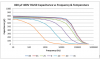
Above a certain temperature-dependent frequency, the capacitance drops rapidly with increasing frequency. This behavior is most dramatic at very cold temperatures and is related to the distributed RC nature of the electrolyte-filled etch tunnels, and also to the viscosity of the electrolyte, which directly affects its ionic conductivity. See Figure 6 for a typical plot of Cs versus frequency and temperature.


Capacitance vs. Frequency - Aluminum Electrolytic Capacitor Application Guide - Cornell-Dubilier.png

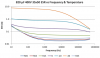
In all cases the ESR decreases monotonically with increasing frequency until the onset of skin effect of the metallic components, typically at 100 kHz or greater. Figure 7 shows typical behavior of Rs versus frequency and temperature.


ESR vs. Frequency - Aluminum Electrolytic Capacitor Application Guide - Cornell-Dubilier.png

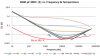
Cs, Rs and Ls together with their variations with frequency and temperature impart a device input impedance magnitude seen in Figure 9. At low frequency the capacitive reactance dominates, and at very high frequency the inductive reactance dominates. In between, the reactances fully or partially offset each other, and Rs constitutes the main component of the impedance. At the self-resonant frequency (SRF) the impedance magnitude and ESR curves touch, as seen in the figure.


Impedance vs. Frequency - Aluminum Electrolytic Capacitor Application Guide - Cornell-Dubilier.png
 
I accept everything you say. Infant I can see how the most tiny detail in not as noticable vs my horn tweeters.

What are the advantages of me having a better Electrolytic than a cheap one?
 
I accept everything you say. Infant I can see how the most tiny detail in not as noticable vs my horn tweeters.

Bypassing will help to improve the characteristics of the electrolytic, but that's really putting lipstick on a pig.

What are the advantages of me having a better Electrolytic than a cheap one?

Lower distortion, maybe. Electrolytics are terrible capacitors with short lifespans, particularly when higher frequencies are involved as these act like ripple current and cause ohmic heating. The only advantage is the low price and greater density of capacitance per unit volume, hence smaller package size. Don't use electrolytics unless no other option exists.

An 8.2 µF polypropylene capacitor from parts express is under $4. The two bypassing capacitors (0.1 µF and 0.01 µF) add about $1 apiece. So for about $12 for both speakers you can solve this problem and have undistorted and accurate tweeter sound.

Done. Stop agonizing. Just solve the problem and move on. Treat this as paying $1 per month for the next year, which is a trivial expense for better sound.

Oh, yeah, and purchase two L-pads so you may properly balance the tweeters against the other drivers. Again, amortize it across a year. Total cost is maybe three dollars a month for one year. Well worth doing.
 
If you prefer the sound of the speakers with the electrolytics why not just leave them and enjoy? A film cap is a better choice on paper and I generally replace electrolytics in tweeter circuits with an inexpensive film cap, but good on paper doesn’t always sound good. I own a pair of PSB Status Minis which was PSBs top bookshelf speaker in the late 90s and even though it used a non polar electrolytic in the tweeter crossover they sounded great! Of course I replaced the electrolytics in mine with some RelCap film caps that I had in my parts bin and was expecting a huge improvement and instead got a barely noticeable upgrade in treble clarity on a few recordings. I guess my point is don’t go to crazy worrying about a single capacitor some very good sounding speakers have had the dreaded electrolytic and still managed to sound very good.
 
I can't win!! What were the solen? What I have now are not nearly as bright and do sound greatly proved. Aren't these similar to what came with the stock speaker?
The Solens should have letters on them like PB-MKP or PA-MKP. Since you mentioned 400V I’m guessing you have the Solen PB series which is a metallized polypropylene film cap and is fine for crossover use.
 
If you prefer the sound of the speakers with the electrolytics why not just leave them and enjoy? A film cap is a better choice on paper and I generally replace electrolytics in tweeter circuits with an inexpensive film cap, but good on paper doesn’t always sound good. I own a pair of PSB Status Minis which was PSBs top bookshelf speaker in the late 90s and even though it used a non polar electrolytic in the tweeter crossover they sounded great! Of course I replaced the electrolytics in mine with some RelCap film caps that I had in my parts bin and was expecting a huge improvement and instead got a barely noticeable upgrade in treble clarity on a few recordings. I guess my point is don’t go to crazy worrying about a single capacitor some very good sounding speakers have had the dreaded electrolytic and still managed to sound very good.


I keep listening and it's really nice sounding now.

I found a pair of JBL L77 and to pairs of large advents.. my focus has moved from the Jennings right now.
 
They are a mixed pair 5002 and the new loudspeaker" , and I have to think that is what they have been doing in their past life. I ordered the foams, but after this, I hope I can just find a simple "BUY THIS" for the advents when I recap them.
 
I actually prefer the Jensen era 5002’s over the early Advents, to me the dome tweeters is much better. Just a decent Poly cap from Parts Express will be fine. I’ve done many pairs of Advents and never had an issue. You will be surprised at the lowend response on the 5002’s, at least I was.
 
I actually prefer the Jensen era 5002’s over the early Advents, to me the dome tweeters is much better. Just a decent Poly cap from Parts Express will be fine. I’ve done many pairs of Advents and never had an issue. You will be surprised at the lowend response on the 5002’s, at least I was.
What is your take on mixing pairs in a stack? I've heard it's the best if both worlds and I've also heard the 5002 " is the best speaker Advent ever made".
 
I never heard a mixed stack pair so no opinion either way. I don’t see why you wouldn’t give it a try. After having many different pairs of various Advents the 5002 is the only pair I was genuinely surprised at how good it sounded.
 
If you prefer the sound of the speakers with the electrolytics why not just leave them and enjoy? A film cap is a better choice on paper and I generally replace electrolytics in tweeter circuits with an inexpensive film cap, but good on paper doesn’t always sound good. I own a pair of PSB Status Minis which was PSBs top bookshelf speaker in the late 90s and even though it used a non polar electrolytic in the tweeter crossover they sounded great! Of course I replaced the electrolytics in mine with some RelCap film caps that I had in my parts bin and was expecting a huge improvement and instead got a barely noticeable upgrade in treble clarity on a few recordings. I guess my point is don’t go to crazy worrying about a single capacitor some very good sounding speakers have had the dreaded electrolytic and still managed to sound very good.

Because good enough is the enemy of great. Because electrolytics ruin the sound and will never have properties even approaching those of an inexpensive PP film capacitor.

Replacing a degraded electrolytic capacitor with a new electrolytic capacitor will naturally sound better, but it's not as good as the sound can be. The OP noted that other speakers had greater midrange clarity, which, of course, is a consequence of electrolytics.

Read the information I posted about electrolytics. Look at the charts. This information is from Cornell-Dubilier! That's just basic crossover design. The only reason to use electrolytics is when no affordable equivalent exists.
 
You’re preaching to the choir Retrovert I already said I prefer to use a film cap in the OPs case but he tried a film cap and didn’t like the sound then tried a new electrolytic and liked the sound. If he’s happy with the sound isn’t that all that matters?
 
You’re preaching to the choir Retrovert I already said I prefer to use a film cap in the OPs case but he tried a film cap and didn’t like the sound then tried a new electrolytic and liked the sound. If he’s happy with the sound isn’t that all that matters?

Cheerleading people into a sub-optimal solution you admit you know is sub-optimal isn't helpful. It just wastes everyone's time.

Any new capacitor will sound better than a degraded one. That does not mean this is the best solution, or that the speaker sounds as good as it possibly can.

Again, this isn't some millenial competition where every choice, no matter how poor it turns out to be, gets a First Prize in some made-up category.

Some component selections are optimal, some are not. Why are you muddying the waters with nonsense when genuine knowledge and truth exists and was set forth.
 
Cheerleading people into a sub-optimal solution you admit you know is sub-optimal isn't helpful. It just wastes everyone's time.

Any new capacitor will sound better than a degraded one. That does not mean this is the best solution, or that the speaker sounds as good as it possibly can.

Again, this isn't some millenial competition where every choice, no matter how poor it turns out to be, gets a First Prize in some made-up category.

Some component selections are optimal, some are not. Why are you muddying the waters with nonsense when genuine knowledge and truth exists and was set forth.
So cheerleading people into an optimal solution that they don’t like the sound of is a better idea?
 
So cheerleading people into an optimal solution that they don’t like the sound of is a better idea?

Not true. Why don't you ask the OP if he's happy with the commentary I've given him. He has clearly stated he is happy with the advice and suggestions for improvement.

I have explained that for a few dollars more he could have far better sound. You, however, are saying the speakers are as good as they'll get and to stop tweaking. That's bad advice.
 
Back
Top Bottom