• The move to the new server is done. There are some software and database maintenance updates in process. This has us passing the hat around to help out. We appreciate any donations. Seriously, even a dollar helps. The payment page may be found here - https://www.audiokarma.org/support.html

Vintage Sony Turntables

I recently found a $30 Sony PS-LX410. It was pretty clean but needed a stylus for the Sony VL-45G. It seems to run fine, sounds great (to my aging ears) and has a place of honor in my system. Any views on this TT?

Thanks!

Congratulation on your new acquisition, it is a very technically advance turn table.
https://www.vinylengine.com/library/sony/ps-lx410.shtml

Replacement stylus for the Sony VL-45G is still available on line. :music:
 
I bought a PS-LX2 in 1981, when introduced while working at Tech Hi-fi -long gone-. It replaced a belt-drive Technics SL-B2 at that time with the Sony, I moved the AT-112sx-shibata- cartridge from the Technics to the Sony. In 1985 I bought a PS-LX510
 
The PS-LX510 was a full-auto linear-tracking model, I purchased the accessory remote control kit for it in 1986, I could Start, Stop and cue the TT with my remote control. About three years ago, I got back into my record collection and decided that the one thing I didn't like about the LX510, was the "THUDD" that was now audible in a 7.1 surround system [with a powered sub-woofer]. The "THUDD" was a resonance that occurred whenever the stepper motor of the linear tonearm moved, to keep up with the groove keeping the stylus in motion. I then searched for a Sony, with a pivotal arm, that was compatible with my old RM-44 remote kit. I found the PS-LX5, made in 1981, BACK when I first got the LX2. This model has exceed all of my expectations. It has the same Wow-and-Flutter, Signal-to-Noise Ratio [Rumble] and Speed accuracy specs of all the models above it made by Sony in 1981, including the PS-X800[.025%/-78dB/>.0003%-respectively].
The PS-LX510 is still in operation, handed down to my son in "like-new" condition, re-lubed and with a new tonearm belt, he doesn't experience the "THUDD" that I did, his is a 2-channel system, with no subwoofer.

In my office, I have a rebuilt Sony PS-350 [an alternate model of the PS-LX3, the PS-350 was sold in a pre-packaged system with a matched Receiver and Loudspeakers, it doesn't have synchro-record and remote control jacks of the PS-LX3 or PS-LX5].
I rebuilt the PS-350 with a motor/board assembly from a Sony PS-LX5.
When I got this turntable, I was able to get all of the auto functions performing perfectly [by removing all the -hardened/ear wax- factory applied brown lithium grease and replacing it with Super Lube -PTFE/Teflon grease], after trying for a week, the speed couldn't be stabilized so I bought a replacement motor for the PS-350 and chose a used motor from a PS-LX5. Though the circuit boards are different, the replacement dropped right in! This turntable is now outperforming it's original design. By replacing the faulty original motor with one from a PS-LX5, Quartz-Lock and Electromagnetic Braking are new features, not present in the original PS-350. The servo "locked" light now comes on and is steady, and speed is dead-on. Now, this TT is virtually the same as my LX5, only lacking the "Quartz Lock", "SPEED" and "REPEAT" indicator Light/LEDs [less "bling"].
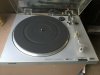
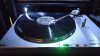
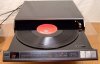
Sony PS-LX2.jpg PS-LX5.jpg PS-350.jpg
 
The first image is of a PS-LX2, not mine -but like one I owned -currently for sale, the second is my Remote controlled PS-LX5 in my living room cabinet [it lives on a slide-out shelf], and the third is the PS-350 rebuilt/upgraded, in my office [at the top of a Sony cabinet, with a lift top for vinyl access -a roadside find, originally wood grain vinyl, repainted glossy-black so the wife would accept it in the office!]
-GRD
 
I’ve recently picked up this http://www.thevintageknob.org/sony-PS-LX5.html and love it. Having never seen a Somy turntable before I had some reservations, but after a thorough cleaning it sounds incredible. It does not, however, have the original cart, and I’m having a hard time balancing the arm during setup, the one on it is too heavy, and mine did not come with the extra counter weight.
Any suggestions?

Jim
 
TTS-3000 and TTS-4000, PS-X9. None of these are very common in the USA, especially so the first two. Sony's HiFi dealer network was very sparse until the 1979-1980 period.
 
For a long time I did not hold Sony in much esteem. Never considered getting one. Fate intervened to alter my perception. This happened in the form of a derelict PS-X4 that was given to me because "it was fried". After a couple attempts I was able to return it to good working condition. I ended up liking it so much that when my daughter asked me to help her get into vinyl I gave her another table I had spent way more on, rather then part with the Sony.

So I would say the best Sony is the one you already have.
 
Howdy, I have a Sony PS LX410. can anyone explain how to adjust the tone arm? I'm not familiar with this particular design.
I have searched for user manuals but only found the service manual available, that does not address tone arm adjustment.

The Hornet
 
Howdy, I have a Sony PS LX410. can anyone explain how to adjust the tone arm? I'm not familiar with this particular design.
I have searched for user manuals but only found the service manual available, that does not address tone arm adjustment.

The Hornet
The Sony PS-LX410 is a 1984 model which suffered from a limited analog turntable budget do to the dawn of CD [Sony's creation]. It adopted the "T4P" cartridge mounting system, invented by Technics primarily for linear-tracking tonearms in their turntables and also to attempt to standardize all tonearms to one type of cartridge mount, instead of the traditional 1/2" mount of most turntables ever made. Most turntables that utilize the T4P mount are pre-calibrated to apply a VTF of 1.25 grams using any brand of cartridge you could plug into the connector. Most of the T4P compatible turntables do offer a slight adjustment for Vertical Tracking Force, to add or subtract 0.25 grams [so you could track at 1 gram through 1.5 grams, if desired.] The PS-LX410 has this slight adjustment, towards the rear of the arm, there is a small trapped weight, moving it all-the-way forward means your VTF is 1.5 grams, center it and it is at 1.25 grams, and push it all the way back and your VTF should be at 1 gram. The PS-LX410 also does have an anti-skate adjustment, in the middle, it's at 1.25 grams, move it to the "+" position, it's at 1.5g and at the "-" it'll be at 1.0 gram. No other adjustments are available or needed, "Zero" balance is impossible, and unnecessary due to T4P compliance.
I hope this helps!
-GRD
 
Hello PS-2250 lovers,

Thought you might like an original price comparison between the Sony and some other high-end vintage turntables.

According to a review (see links below) that I have tentatively dated to 1969 the prices for the following flagship turntables were (see approximate inflation adjusted equivalents in square brackets):

Golding/Lenco G99: £24, 14s, 4d [£410; USD$511]
Garrard 401: £31, 14s, 2d [£526; USD$656]
Thorens TD124 ii: £46, 15s, 10d [£762; USD$951]
Sony TSS-3000: £81, 8s [£1350; USD$1685]

Okay, I know, this only prices the model directly before the Sony PS-2250, which was the belt-driven Sony TSS-3000 (which the PS-2250 effectively replaced as Sony shifted its TOTL models to direct drive).

However, you can see the huge premium on even that particular Sony compared to the Goldring, Garrard and Thorens flagship units.

Further, Radiomuseum lists the 'Price on the first year of sale' for the PS-2250 itself (1971) as being 1'190 DM (Deutsch marks).

In 1971, there were around 8.8 DM to the Pound Stirling and 3.6 to the USD. So, the PS-2250 would have cost around £135 and USD$330, respectively, or £1920 and $2122-2396 in today's money ($2122 when one converts GBP to USD by 2020 exchange or $2396 when using a US inflation adjustment calculator from 1971-2020).

So... on this basis the pricing gradation between the Goldring, Garrard, Thorens and Sony PS-2250 would be:

Golding/Lenco G99: £24, 14s, 4d [£410; USD$511]
Garrard 401: £31, 14s, 2d [£526; USD$656]
Thorens TD124 ii: £46, 15s, 10d [£762; USD$951]
Sony PS-2250: £135 (USD$330) [£1920; $2122-2396].

Alright, price inflation on the first three tables from c.1969 to 1971 may have closed the gap *very* slightly. But we can see the massive price premium on the Sony PS-2250 compared to these other legendary tables.

In fact, a Sony PS-2250 in 1971 could have bought you all three of the other tables combined plus an extra Garrard 401 - with some change left over for tea.
evil.gif


Any thoughts?

Links:
https://www.lencoheaven.net/forum/index.php?topic=1160.0
https://www.radiomuseum.org/r/sony_stereo_plattenspieler_ps_3.html
http://marcuse.faculty.history.ucsb.edu/projects/currency.htm
https://www.in2013dollars.com/UK-inflation
https://www.inflationtool.com/us-dollar/1971-to-present-value?amount=330

 
Last edited:
Nice. IRCC, I paid $350US (mail order!) for my 2251 (no arm) around 1972-3, so those numbers look about right.
Weirdly, no recollection at all what I paid for the SME arm and V15.
 
Back
Top Bottom