• The move to the new server is done. There are some software and database maintenance updates in process. This has us passing the hat around to help out. We appreciate any donations. Seriously, even a dollar helps. The payment page may be found here - https://www.audiokarma.org/support.html

Vinyl cleaning with enzymes

Hey Rip, I have the same question.....don't know if you read it, but in my post I stated what the A.I. guy told me but I would like to hear more about it as well.
Yes, I read it. In my experience (I used to brew beer) enzymes don't work that quickly. I doubt 2-3 minutes is enough to affect real breakdown in the soils. Impatience is possibly one reason I found no success with them. Virtually all commercial preparations include surfactants to improve water penetration into soils, which I think is the real reason enzymes seem to work at all.

Anyway, I use phantomrebel's recipe and scrub. It is so far the most effective treatment I've tried, short of a glue peel. Polishing with a UCM is nice, but not absolutely necessary.
 
Hey Tobasco, I found your post very interesting and thought-provoking!

Before I ventured into the world of ultrasonic cleaning, my method was in fact using an enzyme cleaner from a company called Audio Intelligent Vinyl Solutions. I spoke with one of the proprietors there who confirmed that the "Down With Dirty Concentrate" was indeed an enzyme based cleaner that, when mixed in proper ratio with distilled water, was very reliable in breaking up detritus on the record surface as well as in the grooves. Followed by a thorough distilled water rinse and vacuum, this was my principle manner of record cleaning for about 7 years until, as mentioned, I got my ultrasonic setup.

Some of the factors that influenced me towards ultrasonic cleaning were the amount of time it took (far less per record) as well as ultimate effectiveness pertaining to ridding the grooves of foreign matter, allowing for a far more quiet playback in my experience. The enzyme solution, I was told, needed to stay on the record surface at very least 2-3 minutes in order for the enzymes to do their job. This meant applying the solution and then waiting for the requisite time to pass until vacuuming it off, followed by a distilled rinse cycle to suspend any particles that were left by the enzyme action and subsequently that required a vacuuming as well to leave the record as clean (and dry) as possible.

This method worked quite well and I was pretty pleased with things until I arranged for my ultrasonic setup, which in my opinion takes things to an entirely different level. However, that might be at least in part due to my own ignorance as far as how to properly use an enzyme cleaner is concerned. I was just going by what the guy at A.I. had told me as I believed that the manufacturer would likely know the best practices to use their product.

In any case, this entire discussion has had me intrigued from the beginning, wondering why the OP had elected to clean this huge (by my standards anyway) collection using this particular method? Why not clean it ultrasonically? Using a turning machine, such as ETLS's that does at least 8 records at a time it would be possible to make a lot of progress very quickly, ostensibly getting through the entire collection in a very short period of time compared to doing one by one using an enzyme cleaning method. Would the OP perhaps like to comment on their perspectives please? I.e., why not use the ultrasonic method?

I perceive and assume any record cleaner, regardless of the manufacturer, and its composition make-up does require an amount of time given to effectively work. And just like US Cleaning as well, there's nothing that will give instant desired results and gratification. Common sense dictates that.

So, may I ask, after the US method that you use, then what? Are you air drying the record, wiping it dry, or still using a vacuum removal method as one of your final steps-processes?

In regards to the original poster, there's still a number of unknowns as to what methods will be used, or if any tools? Manual, the aid of an RCM, or ? There's been no mention of such.

All of our comments are no doubt meant as well intended help and advice, so there is that, and I'm sorry if I have stepped on other's toes in this thread.

Until we perhaps know some more, it's difficult to determine what the OP's intentions, and hoped for final results are? And to what degree of investment, time, money that have either been spent, or will be spent?
 
Well stated, Mark. I distinctly remember the guy at A.I. telling me that beyond 2 or 3 minutes, there would not be any appreciable gains but I have always wondered about that.....and Rip pretty much makes that case.

So, may I ask, after the US method that you use, then what? Are you air drying the record, wiping it dry, or still using a vacuum removal method as one of your final steps-processes?

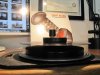
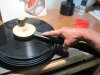
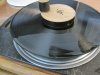
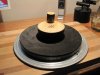
Certainly! After the records come out of the tank, they are placed on the VinylStack drying rack that I purchased with the kit (great investment, by the way) and each one is then placed on my DIY turntable device for a final douse with copious amounts of distilled water and a scrub with a painter's edger brush followed by vacuuming....see below:
IMG_3986.JPG

IMG_4087.JPG

IMG_4088.JPG

IMG_4089.JPG

IMG_4091.JPG

IMG_4092.JPG

IMG_4093.JPG

IMG_4096.JPG

These pictures were taken with an uncleaned record just to give an idea of what I do (with exception of the last picture, which shows the record after it has been US cleaned and rinsed/vacuumed). I would first place the ultrasonically cleaned record on the hub of the turntable (lazy susan with mods), apply the distilled water and then, with the painter's edger brush, swirl it all around while turning the turntable to, as I was saying in the previous post, distribute the water and get whatever might still be on the record into suspension. Then, the vacuum tool is used to completely dry the record.

I'm pretty sure that there are better ways to do things but so far, this is working well for me. Some of the negatives have to do with keeping both the painter's edger brush AND the vacuuming tool meticulously clean and that can be a bit of a challenge. I find myself taking these to the sink and using small amounts of Dawn to scrub them with to maintain cleanliness.....just haven't found a better way yet. Or, perhaps do as @MRL_Audio suggests and don't rinse at all, just let them air dry! He's pretty convincing that this works extremely well for him given the formula he's using and that may be the real key here. I tried the air-dry method but always found stuff still stuck to the record afterward but maybe our solution formulas are enough different to explain the outcomes? I dunno.

Hope that explains things a bit more, still waiting to hear from the OP!

No worries, Mark, your comments are taken in good measure as the intent of everything here is to help us all get better at what we're trying to accomplish. And I agree, we need the OP to weigh in a bit more about their intentions and goals, as you say, so as to better understand the selection of the particular (enzyme cleaning) process being considered.

 
Ripblade, this response is to your post above without linking to it, I hope this doesn't sound rude, but it sounds like a quite time investive process you use.

I'd suspect there are many who would not at all like such time being spent. My multiple step processes and products used at the RCM again take time as well.

Honestly, it wasn't something I was that fond of when I switched to an RCM.
I cannot place an exact amount of time, but had noted minutes turning to hours, and seemingly little headway with just a mere handful of records cleaned it seemed.

Maybe that was exasperated by my end goals to weedle through my entire 800-850 or so LP collection start to finish, and after a few uses of my RCM (VPI 16.5) I said to myself "Yeah, this is going to take some time!" LOL

But I as well told myself to not let impatience and the worry about time negatively effect my end results. The end results I was/am getting were very pleasing and have been unquestionable proof of my efforts.

As you mention, and about what the gentleman at AVIS mentioned about the required time for his products to properly act-work. I'll add as well that I followed his, and other's very wise recommendations to do a multi-step process with a pure water rinse as the final step.

What I have often found very pleasanty surprising, is the quality of sonics on records that are almost as old or as old as I am. Just regular pressings, not 180g-200g, not half speed masters, etc.

And to think really, who back then possessed the system quality to extract the beautiful sound that what was in those Grooves all along?
 
Thank you for your great input and views.
I’m a “reasonable” audiophile and the collection is in good condition, but really needs cleaning (dust, small stains, greese etc). It’s all classical music, so too much noise is a problem. I go for the best possible cleaning, but of course due to the quantity I have to go by a time-efficient strategy. I enjoy sorting the vinyls and the proces of getting a great collection, so I will do it bit by bit. The cleaning by woodglue will be too demanding for me.
I’m interessted in enzymes because I think that if it is done properly it could be very effective. The cleaning substance is actually a new formula from Miele for laundry (Miele Ultraphase 1 sensitive “WA UPS1 1401 L”). I don’t know about concentration, dosing or optimal temperature and time.
Ultrasonic cleaning sounds like a good choice. Maybe adding the cleaning fluid, if it’s not damaging the device?
It’s difficult to get a quick overview of acceptable equipment and a lot is written on the subject. There are some equipment from Wish with 40 Hz and ability to heat. Any suggestions of acceptable specs or fairly priced device I could go for? Also suggestions for spinning device and drying rack or vacumdevice would be a great help. Some mentioned 8 piece rotation device, would that be to much or go for 4 and what is the name of the device?
I live in Europe(Denmark) so delivery could be a issue.
Thank you again for helping me on my way.
 
I'm pretty sure I've read a bigger crock of sh1t. The wood glue method of cleaning is pretty widely adopted.

And with this "widely adopted" wood glue method, and not delving into what residues are being left behind for one, there's a factor of time? Let's bypass and ignore such discussions of residues for the moment.

But, do you want clean a 100 LP collection with such? How about 500? How about a 1000?
I'm game (to a point) for the investment of "time", and the investment of costs, but I'm a firm proponent for being realistic, and taking the safest most logical approach for my record cleaning needs.
 
Last edited:
And with this adopted wood glue method, and not delving into what residues are being left behind for one, there's a factor of time? Let's bypass and ignore such discussions of residues for the moment.

But, do you want clean a 100 LP collection with such? How about 500? How about a 1000?
I'm game (to a point) for the investment of "time", and the investment of costs, but I'm a firm proponent for being realistic, and taking the safest most logical approach for my record cleaning needs.
The wood glue method may not be to your liking, but I wouldn't call it a crock of sh1t.
 
I don't think I ever read a bigger crock of sh&t in my life! LOL

They have to have some really good stuff to smoke up there in canuckistan.


Sigh.

I have approx 7K lps, 99% used, all require a bit of cleaning.

Yes, wood glue works well.

It's too labour intensive, I built an ultrasonic cleaner.
 
I have used AI #15 (which includes enzyme) for years now as my primary cleaning LP cleaning solution with a vac-based RCM. I buy a lot of used records and this stuff, IME, does a much better job than weaker cleaners, one step cleaners, homebrew crap, etc. I have never once damaged a record with it.

I do think soaking time is key and I usually leave the record to soak for 4-5 minutes. For very dirty records, I will also do longer soaks while refreshing with distilled water in a spray bottle so the fluid doesn't dry out on the record. As long as the fluid doesn't dry on the record you can soak it for as long as you want.

I've had ultrasonically cleaned records and IME, just like anything else, it depends who did the cleaning and the method used. I've had records that came stunningly quiet and others that had visible filth still on them. I think some folks are lazy and cheap about changing the fluid in the their tank or the brushes if they use one of those KL type machines or whatever. Putting a clean record back into a dirty inner sleeve is also stupid. Yeah, some people do that.

Bulk ultrasonic cleaning makes a lot of sense if you have a large amount of records to clean though.

Before cleaning anything, I would sort through the records. Anything damaged or low-end crap pressings I would offload. That 4,000 LP collection might shrink down substantially after that.
 
US cleaning alone is insufficient for classical LPs unless they are not very old and only lightly used. As I stated earlier, scrubbing is necessary. Wood glue is a viable alternative as the lengthy drying time does not require any investment in labour, and the application of the glue itself is fairly quick... less than what is required for a thorough scrubbing. There is no residue, but it does create a considerable static charge when the glue is peeled off. This needs remediation of some sort, at least a few shots from a Milty gun.
 
According to Phantom Rebel it's not a good idea to use wood glue on your LP's. Yes, it gets contaminants off the LP, but it has a low PH which can damage the LP. There are also chemicals in wood glue which can leach plasticizers. Here's his quote (phantomrebel) about wood glue from Record Cleaning; The Best Possible Methods. You guys have been here a long time so are probably familiar with that thread as well as Record Cleaning, A Comprehensive Resource which is here on the site.

" Many enthusiasts have discovered that a film of wood glue can lift away grime and actually restore the playing surface on badly soiled records. While this is true (I have tried it), it comes at a cost to the integrity of the vinyl. Titebond II wood glue is typically the product of choice in this method. This product is primarily polyvinyl acetate and people erroneously believe that since it is a “vinyl” polymer, everything is OK. Firstly, vinyl acetate leaches out the protective plasticizers embed in the vinyl record during manufacture. These plasticizers contribute to the vinyl’s pliability, strength, and frictional properties. Second, PVA glues contain a high amount (5g/l) of salt, in the form of Ammonium Chloride. This can leave mineral deposits in the grooves. Thirdly, and most importantly, this glue formula is an acid. It has a pH of 3. Acid is a great cleaner, but it does so by “etching” surfaces, particularly plastics. In fact, artists often use acids like vinegar (also an acetate with pH 3) to produce designs on plastic. Worse yet, in the glue cleaning method, this acid is left on the record overnight. Do you really want to do this to your records? Do you think an etched surface will play well as the needle passes across it?"

Regarding enzymes, I've noticed Amazon sell Tergazyme which is a blend of tergitol and enzymes. Doesn't say which type of tergitol or enzymes though. I have seen that some people use Tergazyme in their US machines though
 
Last edited:
Phantomrebel also thought the Zerostat is a useless waste of money. My experience going back over 40yrs says otherwise. It's not a miracle cure for static, but a useful tool when the need arises.

Everything has its purpose: the PVA peel is good for recovering records that are beyond gentle cleansing. It's a case of the lesser of two evils. Besides, I'd wager the peel is less harmful to the record and stylus than playing it as is without the peel.
 
I agree with you that the Zerostat can be helpful for a time. I Just think the $100 they charge for them now is excessive. As far as the wood glue, I suppose if there's no other way to clean the LP, rather than not playing it, the glue might be the way to go, but it wouldn't be my first thing to try.
 
I frequently acquire classical records from old collections. Because of the close spacing of the grooves and the unusually quiet content therein, these records MUST be scrubbed. There is no elixir that will magically restore them otherwise. The simplest way to clean them is to apply white wood glue (PVA) which, once dry and peeled away, will remove any and all contaminants. However, the glue will leave the record with a static charge which can be relieved by applying a clean wipe moistened with pure alcohol.

I've done hundreds of records with the wood glue method and have found nothing better. But because I'm impatient I normally scrub them using the cleaning solution prescribed in the link above, in part with a submersion in an ultrasonic cleaning tank. This comes a very close second to the glue method but takes more effort. If enzymes are desired, the Sporicidin I mentioned earlier is not expensive if you live in the States, and comes with its own surfactants which in my experience are safe on vinyl. Dilute in clean water to the percentage described on the label and use within the prescribed 2 hour period before the enzymes naturally expire. Any diluted solution that has not been used within that period should be discarded as it will no longer contain any active enzymes.

Good luck and happy listening.

I recently got into vinyl specifically to be able to listen to these old classical performances, and I'm still trying to figure out a cleaning process. The most widely agreed upon advice here and elsewhere often doesn't get the job done, I assume for the reasons you mentioned. I asked for advice on old classical vinyl on another forum but didn't get any useful info, and a few people even seem allergic to the idea that classical reproduction on vinyl has its own challenges that don't arise very often in other genres. Would you consider starting a thread with your classical vinyl restoration procedures (hopefully with great specificity)?
 
I recently got into vinyl specifically to be able to listen to these old classical performances, and I'm still trying to figure out a cleaning process. The most widely agreed upon advice here and elsewhere often doesn't get the job done, I assume for the reasons you mentioned. I asked for advice on old classical vinyl on another forum but didn't get any useful info, and a few people even seem allergic to the idea that classical reproduction on vinyl has its own challenges that don't arise very often in other genres. Would you consider starting a thread with your classical vinyl restoration procedures (hopefully with great specificity)?

It won't matter the genre when it comes to record cleaning. Unless you are speaking of Shellacs, then one must use a cleaner that is alcohol-free.
 
It won't matter the genre when it comes to record cleaning. Unless you are speaking of Shellacs, then one must use a cleaner that is alcohol-free.

There's a ton of great methods people here have developed, and I've lost pretty much all my weekends over the last couple months to trying them. In fact, these are so well developed I probably would have stuck with the first one I tried if I listened to much of anything else. The issue I'm having is that even pretty great methods fall down on recordings that include multiple-bar rests, or passages where a single instrument is playing just at the edge of audibility. These are very, very common in many of my favorite recordings and account for a significant proportion of the overall runtime on almost any disc I grab. During any long diminuendo (again, very, very common) you can hear the 'gunk' overtake the music. How long it takes varies according to how clean I've managed to get a groove, but nothing yet has been totally effective. I think that a guide from someone with extensive experience restoring these types recordings would be invaluable.
 
As for cleaning, it comes down to 3 basics that can all determine quality of cleanliness. Tools, Chemicals, and Techniques used. None will have much luck removing, or reversing physical damage, or damage caused by other things, like molds-fungus-mildews-moisture that have literally eaten away the information in the groove.

And then as well, the playback system has influences upon aspects like signal to noise ratio, both positive, and negative.

What all vinylphiles would like to strive for, and/or hope to achieve, is an inky black dead quiet background. Free of hiss, hum, very low groove noise, absent, or at least not objectionable pops and clicks.

Way back in the day, sometimes the background noise when you dropped the needle upon the record, the noise seemed almost as loud as the music!

Now today with many of the state of the Art Tables, Cartridges, Arms, Phono Stages, Quality Built Cabling, and good Components downline, one almost hears nothing when the Stylus touches down. Pops and clicks, sure, no amount of record cleaning can reverse and eliminate such physical damage to the record surface.

But as someone once mentioned many years ago, it seems like some of these exotic, ultra skinny Stylus profiles on many of the very best MC Cartridges do a much better, and much 'faster" job of "getting through these issues, making them much less objectionable.

The way to the end of this tunnel I reckon comes down to addressing the weakest links first, and go down the line.
 
I recently got into vinyl specifically to be able to listen to these old classical performances, and I'm still trying to figure out a cleaning process. The most widely agreed upon advice here and elsewhere often doesn't get the job done, I assume for the reasons you mentioned. I asked for advice on old classical vinyl on another forum but didn't get any useful info, and a few people even seem allergic to the idea that classical reproduction on vinyl has its own challenges that don't arise very often in other genres. Would you consider starting a thread with your classical vinyl restoration procedures (hopefully with great specificity)?
I hate to disappoint you, but no, I won't be starting a thread. Mostly because the topic has been covered so many times there's nothing more to contribute, but also any input I have is bound to attract negative opinions and I can't be bothered wasting my time defending my position.

There are so many variables when evaluating the condition of a record it's hard to come up with any one size fits all solution that suits all of them. A few days ago I had one record that needed one side cleaned normally, but the other had 2 small but deep scratches and a skip towards the end. I decided to clean the better side conventionally and apply glue to the worse side. The glue peel reduced both the severity and duration of both scratches, and removed the skip. After the peel, I put the record through my standard cleaning protocol which involves two 5min rotations in a heated ultrasonic tank followed by a scrub and rinse in my DIY version of the GEM Dandy.

If you want to get the most out your records with the least amount of effort and cost I suggest the glue peel on records that have deeper scuffs and problem scratches, and use the Gem Dandy for everything else. A vacuum wand of some type to dry the records (preferably in a single rotation) is recommended but many ppl claim good results by simply letting them air dry. Do not use a cloth.


Lastly, noise is part and parcel of the vinyl experience. It helps to build up some tolerance for it. Some records left the pressing plant rather noisy to begin with, but the recordings and very often the performances are well worth it regardless.

index.php
 
I reckon Ripblade, that we can offer a good number of options to any user that asks, and in the end, we all have different methods, tools, desires of such various degrees of tools and methods, but as you can imagine, there's other issues withstanding.

And that can be costs. We can say go buy this or that, and don't look back, but in no rude way meant, it can be like leading a Horse to water, but he will not drink.

Not many folks can yank out $1,000 to $2,000 to get all that is basically needed to get well started with a quality record cleaning system. Such is hard for many of us, myself included.
And often, it's not what money is in the bank, but other priorities take precedence in life.

Hard to address the many unknowns, of what a user is using, and is needed to achieve some certain rung up the ladder, how to improve in a relative manner. And hopefully stay within that person's means.

Costs can add up, but one way to look at such things, and if you want to have them, "Rome wasn't built in a Day". Hold a yard sale to acquire needed funds, do odd jbs to save some spare cash.

My investment-cost outlay wasn't too bad on the pocket. $500 for a new VPI 16.5 RCM, a few dollars ($85) for some mods, and add some money for the cleaners, brushes, sleeves.
 
Back
Top Bottom