petehall347
the brandy coffee man
another way is add i light bulb in series with the speakers .


"I understand what you are trying to do and why you are trying to do it. But I believe your execution is a little off"I understand what you are trying to do and why you are trying to do it. But I believe your execution is a little off.
Power meters are a way to get a ROUGH IDEA as to amp output and they are eye candy to boot. They are not a tool to avoid clipping. Music is too dynamic and fast for a meter to pick it all up. They are NOT "clip detectors"....not by any stretch. By the time you see clipping, or output beyond the amps rated output on an analog power meter it is way too late.
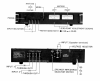
The best way to stay away from clipping is to use an amp that is rated at twice the speakers continuous power handeling rating. Most jbl alnico speakers are rated at 75w, so I use 150wpc to power them. Then I use the Simpson 260 as a power meter to watch amp output to help avoid overpowering. And I like the eye candy.
It's far more practical to avoid overpowering with a big amp than to avoid clipping with a small amp.
I suddenly have Marantz envy! Been contemplating getting a big Marantz, love my 2215B (baby) Marantz. Can only imagine what the baby's big brother can do. I don't recall the exact model but my cousin in Arizona has one, I spotted it in the background in a photo he posted on Facebook. I asked him about it and he said he's not using it because the controls are scratchy, I suggested he either get it gone through and cleaned up or sell it to me. Haven't heard anything back about him being willing to sell yet.This is true. I have to worry about the Marantz 2385 Cornwall 3 combo I have launching me out through the front windows into the street before I would have to worry about clipping. This receiver does have peak LEDs. Although I would really like to listen at about 90dB, I try to keep it to 80, and that's only 20% of the volume dial. It's like driving a muscle car with crappy tires.
This is true, however I still like to know if an idea will work. Whether I use it or not is irrelevant, just wanted to know what others had to say about it. From what I have gathered, a meter can be a tool to help visualize what's going on between the amp and speakers. Bottom line though it seems, is that there is no substitute for what's going on between the ears and the brainThe best advice has been given. Use your ears.
Sure, one can get a big amp and push clipping down the road or try other means but if one still has their head up their arse one can still damage stuff.
Amps don't damage speakers, people do, when they don't yield to the signs of distress whether it be of the speaker or of the amp.

Fuses won't tell you how much headroom the amplifier has left before clipping the waveform. And that's the info the op wants to have available to him while blasting away.Ever heard of fuses? Usually 2 amp fast-blo for bookshelf, maybe 4 amp for towers.
Got pics? This sounds interesting.another way is add i light bulb in series with the speakers .

Fuses won't tell you how much headroom the amplifier has left before clipping the waveform. And that's the info the op wants to have available to him while blasting away.

Got pics? This sounds interesting.
Last I checked the voice coil will go open to protect the fuse about 1/2 the time.A low value fuse will stop that before that happens. Speakers don't blow because they produce distortion, they blow because they received too much current, causing voice coils to get hot, warp and die.
I'm sure some people use slo-blo or the wrong value to keep themselves from hurting....themselves.
Self control is still the best. As others have pointed to- if something sounds distorted at a particular volume, something in the chain has gone beyond its peak.

Yes, that's certainly one failure mechanism, but it isn't the only one. Wires can also break. Also, the voice coil can get slammed into the magnet and bent.Speakers don't blow because they produce distortion, they blow because they received too much current, causing voice coils to get hot, warp and die.


I'm sure some people use slo-blo or the wrong value to keep themselves from hurting....themselves.
Self control is still the best. As others have pointed to- if something sounds distorted at a particular volume, something in the chain has gone beyond its peak.
Exactly.
A little common sense and self control go a long ways.
Let's just say the OP decides he can control his volume levels and turn it down if it sounds distorted or his receiver/amp is running hot.
I suppose he could still install some sort of kludge for any situations where alcohol, guests, or a combination of both might cause possible speaker damage.

I've read about a number of instances where lamps have been used as limiters by OEMs. Some models of Bose, as I recall off hand, others too but I don't remember all the brands.
Yeah, in practice it's not as simple a form of speaker insurance as I was hoping for. The power meter I think, if used with the power output capacity of the amp and the power handling capabilities of the speakers in mind would give a reasonable ball park visualization of when you are getting close.
...
 But like I said, once you hear it, you will know it and then you will stop obsessing about meters for any purpose other than their real one...which is eye candy.
I don't think anyone is really arguing against common sense.Yes, that makes sense. other people like to "invent" reasons why the common sense mode doesn't work, "or lets use gum wrapper" to replace a fuse. I guess bad decisions are made daily......