

You are using an out of date browser. It may not display this or other websites correctly.
You should upgrade or use an alternative browser.
You should upgrade or use an alternative browser.
walsh tweeter design/rebuild
- Thread starter loquatious
- Start date

James Comer
New Member
Jimbo, I got the tweeters in and installed them. Began running a frequency check with the new speakers. The rolloff at the bottoms is dramatic at 25-27 hz so the woofer does not go down to 22hz . There was a noticeable gain at around 30,50,100hz. Everything then remained fairly flat to 10K, at 11K to 12 K a noticeable decline although I can't hear it . I took the capacitors out of the Walsh circuit. Understand that I am using 50wattRMS drivers for the Walsh. This brought them well into the audible range for me, as things really began to ring. I will need to protect them above 50 watts, which a switch would work best. I will probably mount a spst miniature switch in the plastic base of the walsh tweeters that turns them off if I feel the need to crank em up. I have 450 watts per channel but that's for overhead not pissing off the neighbors. You probably already know this but you can take 2 Electrolytics of equal value and twice the value of the Non-Polar Capacitor you need and hook the Plusez or the minusez together to create an NP capacitor. this doubles the rated voltage. regards..
James Comer
New Member
At higher levels these become "bright". Also the polyfile has a dramatic influence. they must be full and packed but not hard packed. I will install a switch that installs a 3.5uf 100 volt capacitor to attenuate for higher levels. . As configured the Modified Infinity speakers are 4.2 ohms, not 8 ohms. The walsh tweeters add a dimension which I don't believe is possible with other designs. Because of the 360 degree dispersion, is likely. It adds an explosive ambience to the music through the entire frequency range. A realism. I understand and share your passion for the Walsh Jimbo.

Jimbo40
Super Member
I see that you do, your explanation is very similar to mine.
You seem to be working towards a whole nother level.
Bringing it from the super tweeters down a bit to the tweeter level.
I really like the idea of a stand alone super tweeter.
I'm going to choose a new tweeter motor maybe mid grade, 1in. Dome and create a piece of art that's functional as the super tweeter with the 360 radiator walsh cone.
In the mids of 2 restores right now .
Concept 5.5 and a soundcraftsmen sp4002 preamp.
So the art project takes the back seat for now.
But I enjoy hearing your progress.
You seem to be working towards a whole nother level.
Bringing it from the super tweeters down a bit to the tweeter level.
I really like the idea of a stand alone super tweeter.
I'm going to choose a new tweeter motor maybe mid grade, 1in. Dome and create a piece of art that's functional as the super tweeter with the 360 radiator walsh cone.
In the mids of 2 restores right now .
Concept 5.5 and a soundcraftsmen sp4002 preamp.
So the art project takes the back seat for now.
But I enjoy hearing your progress.
James Comer
New Member
It adds a depth that could be applied to any speaker system. In the walsh circuit it's a 3.6 mfd 250v cap and the speaker. sitting atop an 8 ohm 3 way speaker system even without the cap the impedance drops to 4 ohms. With my current design the walshes cost maybe 60 bucks. Maybe a protective cage.
James Comer
New Member

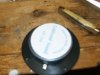


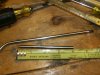
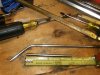
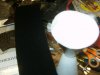
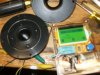 I am going to try to post pictures and narrate the process of making a walsh tweeter. This is neither difficult nor time consuming. First remove the speaker from the box and remove the flange from the speaker. 2. Check the speaker to see that it is good. 3. remove the silk dome 4. hot glue the 4 inch rod to the center of the magnet. I used stainless steel straws. Cut to length with a hacksaw. A pack of 4 from walmart is 3 bucks. 5. Glue the cone to the voice coil Clear Gorilla glue, be careful not to get too much glue on the driver.I use a 3 inch ring of foam pushed down the center to hold it in place while it dries You can carefully add glue to the base after it initially dries 6. fill the cone with poly fil. 7. cut a 3.5 inch ring of speaker grill foam from any source for the top, and glue in place. Procedure to make the cone. a. Get the pdf cutout from Jimbo. b. make a copy and cut it out. c. put a sheet of aluminum foil on the self adhesive laminating sheets from walmart. d. trace the cone onto the adhesive lamination sheets with the foil glued on it. e. cut it out with scissors. Tape the inside and outside to form a 1 inch hole at the bottom. f. paint it gold. I used gilding paint from Michaels. The laminated cone will have air pockets. I punch them with a needle and force the air out. You won't get them perfect. The paint covers that to some degree. If you figure a way to get them perfect please post it here.
Attachments

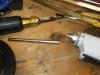
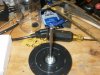
Last edited:
James Comer
New Member

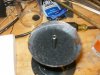
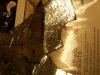

James Comer
New Member
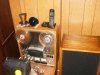
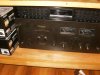
Installed the second set as stand alone on my rear speakers. Because of the 4 ohm impedance of my backups I had to install a second amp that would drive the 3 ohm resistance. I picked up the ability to adjust the volume separately also.(Technics SE-9600) Tested with Mercury Living Presence CD #432 016-2. Morton Gould and Samuel Barber pieces by Howard Hanson conducting the Eastman-Rochester Orchestra, recordings 1959 and 1960. These are very special recordings. With some fine tuning at low level, sounded like I was setting in the orchestra. Tellin' ya, these are really nice and cheap at less than 60 bucks a pair to make. Not just for Infinity anymore.


That's just too cool. Very neat, @James Comer
Regarding the type of foam used in the original Infinity Walsh tweeters, does anyone know anything about the type of foam mentioned in the patent for these tweeters?
Here is the relevant quote:
'To supplement the absorption by the surrounding ring 7, the means 8 is bonded to the diaphragm at the outer edge and for a distance radially inward, which means 8 can be a ring of material of high vibratory energy absorption. This can be an elastorner of solid or foam texture, or a combination of the two. An example of the foam material is polyurethane foam Nopco No. F302. To obtain optimum absorption will require careful analysis of available materials considering the frequency range desired, and the temperature range that will probably be encountered in service.'
(I assume elastorner is a typo and should have been elastomer?)
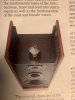
I thought it was interesting to observe the photo of the tweeter that is in the original manual I have of the Infinity Monitor II's. See attached. The foam here looks very solid and beautifully rounded, not flat.
Here is the relevant quote:
'To supplement the absorption by the surrounding ring 7, the means 8 is bonded to the diaphragm at the outer edge and for a distance radially inward, which means 8 can be a ring of material of high vibratory energy absorption. This can be an elastorner of solid or foam texture, or a combination of the two. An example of the foam material is polyurethane foam Nopco No. F302. To obtain optimum absorption will require careful analysis of available materials considering the frequency range desired, and the temperature range that will probably be encountered in service.'
(I assume elastorner is a typo and should have been elastomer?)
I thought it was interesting to observe the photo of the tweeter that is in the original manual I have of the Infinity Monitor II's. See attached. The foam here looks very solid and beautifully rounded, not flat.
Attachments
James Comer
New Member
I would love to be able to produce a uniform cone that perfectly conforms to your photo. If you figure out how to make one please post. Until then I am enjoying my imperfect 4 Walsh knockoffs. They add a realism to the sound not just in the high frequencies but through the entire range. Sounds they affect Snare drums, any percussion metallic device, all horns, all woodwinds, all stringed instrument, including Harpsichord and piano. My wife doesn't appreciate higher listening levels. I get the ambiance and range at lower listening levels with these, she even admits sounds good. I have removed the 3.3uf cap from the circuit which in theory extends the range downward, somewhere even I can hear.
James Comer
New Member
All I can say is try it. I showed you how I made them. Make a set of stand alones and try 'em. Max investment is 60 bucks. You had mentioned you have a way to stamp or emboss the foil, did that work?I wouldn't play a tweeter "full range". You need a capacitor to protect it from the lower freqs, choosing the right crossover freq, a couple of octaves far from the Fs freq.

elnaldo
Lunatic Member
All I can say is try it. I showed you how I made them. Make a set of stand alones and try 'em. Max investment is 60 bucks. You had mentioned you have a way to stamp or emboss the foil, did that work?
I mean you should always connect a proper capacitor in series with a tweeter to avoid damaging the VC.
It wasn't me who had a way to emboss the foil. I have 2 spare large magnets from damaged 1 1/4" dome tweeters, 2 raw textile domes, and the idea of building this. But I have to hand wind 2 voice coils and then manage to build a lightweight cone, and then find a way to center and assemble the Voice Coils-domes to the magnets. I don't have the plastic supports or face-plates, just the magnets.

rayivers
New Member
Here's a link to my diyAudio Walsh tweeter rebuild thread.

elnaldo
Lunatic Member
Hello. I have a question for those who have seen the original VC. Do you remember if is it a small VC, a tall VC, thin or thick wire, or do you have a pict and DC resistance of the original coil? I want to hand wind some VCs, but I need to know approx sizes and resistance. I can wind a VC using a thin wire with a few turns (I've made 2 or 3 mm height VCs), or I can use a thicker wire, which will end in a higher VC to reach the same DC resistance.
Any info will be appreciated. Thanks in advance.
Any info will be appreciated. Thanks in advance.
James Comer
New Member
Remembering back 30+ years. The original walsh tweeters had a very thin wire. I tried what you are trying but they just burned out again. The ones I made to placat my desire to have walsh tweeters, do work and are holding up..