• The move to the new server is done. There are some software and database maintenance updates in process. This has us passing the hat around to help out. We appreciate any donations. Seriously, even a dollar helps. The payment page may be found here - https://www.audiokarma.org/support.html

walsh tweeter design/rebuild

I have both versions, the external support version on the 2000AXT and the rod support version on the WTlC. Here is a picture of my freshly refoamed rod version. I missed that auction as I would have paid that for a working replacement for the blown one in my 2000axt

I did buy one of those two for sale, to replace a blown one in my 2000AXT. :)
I thought about going for the 2nd one as a spare but once the price started to climb I decided to let someone else fix their speakers (I hope). I also have a pair of WTLC awaiting restoration, with the later gold foil/center post design Walsh tweeters. Naturally, one of those is also open circuit.

Where did you source the foam?
 
Thanks for the background jay!, glad to have you aboard , and excited to hear more.

Congrats on getting the tweeter Frank, how did it work for you? I actually had some foam I'd been looking at for a while that something was packed in and reading this thread tod gave me a bug to finally cut it out and glue it in, but I will be getting more soon to do my one working axt walsh, it was about 1/4-5/16 thick and medium-light density I would say.
I'll let you know when I find some.
 
Last night I wrote for about two hours on the history and construction of the tweeter, and when I went to post, AK asked me to log on. I had already done so, but did again. When I was redirected back to his thread, my post had vanished. Rats!
So, I will have to do it again, but I first have to find out what is going on with my PC (I am on a friend's laptop).
I suspect it has something to do with my security settings not accepting a cookie from AK. I'll work on this tonight and re-post in the next day or two. Sorries-
J
 
damn, thats got to be frustrating.

i've had similar experiences and have started composing my posts in a word processing program, then doing a cut and paste for posting. it saves having to type the post a second time if there is a glitch, and a decent spell checker is an added plus.

no need to say sorry, jay. looking forward to the next installment!


.
 
Hi Jay and welcome,

I have never heard a walsh tweeter or seen one up close, other than pictures, but your historical information is awesome and I am enthralled just reading about it.

Sorry to hear about the posting troubles, I've had it happen to me. Sometimes I just write it out on a word program and just copy and paste when I'm ready to post.

Please keep it coming, this is really cool!

Mark K.
 
Last night I wrote for about two hours on the history and construction of the tweeter, and when I went to post, AK asked me to log on. I had already done so, but did again. When I was redirected back to his thread, my post had vanished. Rats!
So, I will have to do it again, but I first have to find out what is going on with my PC (I am on a friend's laptop).
I suspect it has something to do with my security settings not accepting a cookie from AK. I'll work on this tonight and re-post in the next day or two. Sorries-
J

First of all, welcome to AK. I'm quite interested in this subject, more on that later.

I learned the hard way using forums over the years, if you have something significant to write, write it in Notepad or Word, then copy and paste it into the forum. That way, when the forums misbehave, you won't lose it.

On to the tweeters. I've got a pair of Ohm F's. Love them. I'm gradually whittling down my audio collection to settle on one main system built around the F's.

When Ohm went to the newer style cans, they added a directional tweeter for brightness. It's a conventional tweeter in a can with a somewhat conventional driver facing downwards. I understand the packaging and cost savings over building the traditional drivers.

But I've always wondered what a traditional F would sound like with an Infinity style Walsh tweeter, installed on top. Seems like a natural combination.

Anything you can offer in DIY would be appreciated. I've been looking for Infinity Walsh's for a while, have been outbid many times. I'd love to have something that I could stick on top of the F's, but which would not be permanent.

It would be great if you could expand on the damping, resonances, etc.

Again, welcome to AK!

bs
 
Congrats on getting the tweeter Frank, how did it work for you? I actually had some foam I'd been looking at for a while that something was packed in and reading this thread tod gave me a bug to finally cut it out and glue it in, but I will be getting more soon to do my one working axt walsh, it was about 1/4-5/16 thick and medium-light density I would say.
I'll let you know when I find some.

Thanks, I haven't received the tweeter yet. The seller offerred to sell me the 2nd one for the same price as I paid for the first, since the buyer of the 2nd one backed out when he didn't win the first. Karma is quick, after letting it go so someone else could get their speakers whole I not only got a spare without having to pay more than for the 1st one but ended up saving on shipping. I did exchanging info on packaging with the seller and I'm fairly confident they will arrive intact (UPS willing). As long as I've waited to find one, I'm fine with the seller taking the time he needs to do it right. I'm looking forward to finally hearing the 2000AXT's with both tweeters working. The next step will be to redo the crossovers.

I can also use the spare initially in the WTLC's until I come across a 2nd working gold Walsh.

None of the packing foam I've come across seems to be the proper stiffness. Though maybe it isn't critical, since it's primary function is to absorbe the wave at the top so it doesn't reflect back down off the edge. Or so I understand. 1/4"-5/16" is thinner than I thought. The originals I have look like they were 3/8", judging by the remnants/glue line. Now that I look again the foam seems to be the same stuff as the anti-refraction foam on the baffle of my Advent Maestros. That foam is melting away too.
 
Ooooo, frank I hate you! LOl, jk, congrats, I wonder why the buyer backed out. I am pretty sure the foam is just for centering, I chose the 1/4 cause it was available and I thought it would be easier to glue in than the 3/8 foam
 
...since it's primary function is to absorbe the wave at the top so it doesn't reflect back down off the edge. Or so I understand...

this has been my understanding as well. well, more honestly, my speculation. the foam cap stops the wave from propagating past the cone's edge. in addition, because of its flexibility and connection to both the edge of the cone and the center tube (or the center support of the exoskeleton on so equipped models), i would suspect the foam acts as a restoring force to the voice coil (as the surround on a conventional cone driver does) so stiffness or resiliency would be a factor. the polyfill beneath the foam cap acts as dampening material to absorb any reflected wave energy trying to return down the cone interior. the foam and the polyfill would also both help keep the cone centered, but i would think that function would be secondary. this is something jay would likely be able to expound on more.


i've been looking for some spec's on the variants of the speakers the tweeter was used on. here is what i have so far. can't swear to the accuracy of the dates, as they came from the "infinity" tech sheets published by harmon kardon after-the-fact, and they are notoriously hit and miss in terms of correctness. still missing any spec's for the monitor II, but the rest is falling into place. if any of you can fill in the blanks, please chime in.


monitor 1973-? 22hz–21,000hz

monitor II ???

monitor IIa 1975-1979 22hz–28,000hz

2000 II 1975-? 30hz–28,000hz

2000 axt 1973-1978 30hz–21,000hz

WTLC 1976-1981 35hz–28,000hz


.
 
Well, I'm back. Some things came up back there that invite comment.
I was not aware until recently the the Infinity Walsh ended up as a super tweeter. I find it ironic the Infinity ended up crossing into a Walsh from a dome, yet Ohm crosses from it's current line crosses into a dome and out of their flagship driver. At about the same frequency, which we will discuss.
BShorsey made a very interesing suggestion that Ohm incorporate a Walsh tweeter instead of a dome. That to me would be elegance, but as you read further, you'll see why it is probably not feasible money-wise. (did I mention cheap?)
At the end of my Walsh period, the last project Bill and I did was a two way speaker we called the "X". A two way Walsh based loudspeaker.
Back to the tweeter-
The original tweeter was built around a Seas 1-1 1/2" domed mid-tweeter. Dynaco was using them in a two-way kit they offered that was quite listenable.
They were electrically very robust and available, but they cost $10-15 ea. back then.
Part of the selection criteria was that they were able to operate safely down to 1.5 KHz.
The target highpass for the Walsh tweeter was 2-2.5 Khz at the time.
Construction-
The dome tweeter is taken apart so you separate the mounting plate from the magnet assy. The mounting plate should have the dome and the voice coil as a single component.
Immediately cover the voicecoil gap in the magnet with masking or similar easily removable tape, and set aside.
Now, you must remove the dome. This is best accomplished by gently pushing a new, sharp Exacto knife through the dome near the center and slowly moving the cut spirally to the voice-coil former. The blade is then carefully moved around the voice-coil former , using it as a guide for the blade until the dome is cut away.
You MUST be mindful that you do not disturb the glue bead that is keeping the voice-coil former attached to the surround.
Now, the cone. The original "cone" was made of thin styrene sheet, and later acetate. The material was obtained from stationary stores as "document protectors". This served as a "stiffener". Newer stuff may not work it seems too supple.
The actual"cone" was made using a heavy-duty diamond embossed foil that was marketed by Alcoa. This exterior foil was bonded to the acetate with 3-M 33 spray adhesive.
I'll continue tomorrow-
j
 
hi jay,

thanks for another interesting post. glad you got past the posting glitch. i know i'm not the only one anxiously waiting to hear your story.

since this is an infinity specific forum, i'd like to focus on the history of the prototypes and infinity's involvement before we venture to the subject of the construction of new units. in that vein, i would respectfully like to ask if you can please clarify a couple of things for me. nit-picky maybe, but for the sake of historical accuracy, as i expect the info you provide will be referred back to for many years to come by those restoring walsh equipped infinitys.

The actual"cone" was made using a heavy-duty diamond embossed foil that was marketed by Alcoa. This exterior foil was bonded to the acetate with 3-M 33 spray adhesive.


from your diyaudio thread:

glorocks; said:
" The cone was made of a layer of 1 mil acetate that was cut using a pattern. There was no particular science involved- we just arbitrarily selected a size, about 6" tall, and the angle. The acetate was then smeared with clear silicone except where the end met for cementing. We used 5 minute epoxy.
Now over the coated acetate was placed a layer of heavy duty aluminum foil that conformed to the shape of the thing, and the laminate was rolled into a cone shape and epoxied. I think we used invisible Scotch tape to hold the seam while the epoxy set.

The clear silicone we used was clear silicone grease- Not the RTV adhesive!!!! "


from your audiogon thread:

glorocks; said:
" If the cone was silver with a diamond "crosshatch" pattern (very early models) it was probably built on my kitchen table. That material was Reynolds "Diamond" aluminum foil that is probably no longer available. It was supported by 1 or so mil acetate, which thinking back was a bad idea. "


ok, so here are my questions:

1. was it reynolds or alcoa foil the prototypes used? reynolds is now owned by alcoa (reynolds was acquired by alcoa in 2000). in the 70s they were two separate manufacturers. reynolds marketed a foil sold as "diamond" brand as early as 1947. neither reynolds nor alcoa markets diamond embossed foil today, (it can be sourced from china, but only in bulk).

2. was it clear silicone grease between the foil and acetate, or 3M 33 spray adhesive? if it was grease, to what purpose?

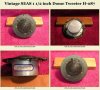
3. is the attached photo the model of seas tweeter you used for the prototypes? i captured it from an ebay auction for a pair dynaco tweeters.


.
 

Attachments

  • dynaco tweeters.jpg
    dynaco tweeters.jpg
    107.4 KB · Views: 114
Ooooo, frank I hate you! LOl, jk, congrats, I wonder why the buyer backed out. I am pretty sure the foam is just for centering, I chose the 1/4 cause it was available and I thought it would be easier to glue in than the 3/8 foam

Don't be so quick to hate! They arrived today - ruined. :(

The seller chose to "mount" them in small, rigid double-wall boxes instead of the 4" hardboard shipping tubes I suggested. This worked well for the Walshes for the WTLC's I bought (too bad one was open circuit).

The small boxes most likely would have worked, except he fastened them with 2-per lag screws through the cardboard, past the magnet and through the mounting plate holes. They pulled off the threads and bounced around in the boxes. One cone broke off, the other just got crushed. His method might have worked if he'd used 4-per machine screws with washers and jamnuts, especially if the machine screws had been long enough to go through the "top" of the box.

The seller was very apologetic, but that's 2 less functioning Walsh tweters in the world.
 

Attachments

  • Walsh_tiny.JPG
    Walsh_tiny.JPG
    16.6 KB · Views: 130
ouch!!! now that is just plain sad. :tears:

and after you discussed it with the seller!?

hope you got a full refund.

and get to keep the corpses...


.
 
Don't be so quick to hate! They arrived today - ruined. :(

The seller chose to "mount" them in small, rigid double-wall boxes instead of the 4" hardboard shipping tubes I suggested. This worked well for the Walshes for the WTLC's I bought (too bad one was open circuit).

The small boxes most likely would have worked, except he fastened them with 2-per lag screws through the cardboard, past the magnet and through the mounting plate holes. They pulled off the threads and bounced around in the boxes. One cone broke off, the other just got crushed. His method might have worked if he'd used 4-per machine screws with washers and jamnuts, especially if the machine screws had been long enough to go through the "top" of the box.

The seller was very apologetic, but that's 2 less functioning Walsh tweters in the world.

My heartfelt condolences.

I had a similar experience with just a single Walsh. The seller did a good job with the box, making one out of wood, but then used wood screws (2) which did not penetrate the wood base of the box far enough so that the driver broke loose and bounced around during shipment, similar to your experience. I contacted him as soon as it arrived after I took photos and he requested that I try to pop out the cone which I was able to do leaving just a few small indents in the cone, BUT, when I checked out the VC it was open. He tried to blame me for that but since I hadn't even taken it out of the box before I contacted him, he relented and refunded my money. I returned the Walsh properly attached.

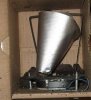
I've had a number of other Walsh's successfully transported but in every case I described to the sellers how I wanted them packed and even offered to pay more if necessary. The second photo is one of the better packing jobs - custom made and double boxed with air between the drivers and lots of padding between the boxes. But I also got a pair once sent loose in a box with packing peanuts all around. Go figure.
 

Attachments

  • damaged_walsh 005.jpg
    damaged_walsh 005.jpg
    46.6 KB · Views: 128
  • Walsh_packing_2.jpg
    Walsh_packing_2.jpg
    52 KB · Views: 134
Last edited:
Wow guys your breakin my heart hear with those pictures, So guys, when the universe closes a window it sort of opens a door..., do the broken ones still have impedance? If so this could be a good chance to experiment. Between us we have good cones bad VCs, good VCs bad cones, we could try re-attaching the cone, or removing a good cone from a bad voice coil and reattaching it to a good voice coil if there are any, thoughts?
 
Wow guys your breakin my heart hear with those pictures, So guys, when the universe closes a window it sort of opens a door..., do the broken ones still have impedance? If so this could be a good chance to experiment. Between us we have good cones bad VCs, good VCs bad cones, we could try re-attaching the cone, or removing a good cone from a bad voice coil and reattaching it to a good voice coil if there are any, thoughts?

No damaged cones here - just open VC's, a couple of them at least that I haven't destroyed yet. I'd have to check my spares closet to be sure. I know I haven't thrown any of them away.

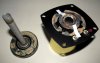
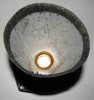
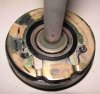
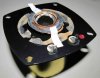
EDIT: I thought some photos of one of the non-working Walsh's I trashed might add to the dialog. They are pretty self explanatory I think and show why they are difficult to get apart without causing additional damage, especially the remains of the double sided sticky paper gasket. The leads are under this gasket and are easily broken when the magnet is removed.
 

Attachments

  • everything.jpg
    everything.jpg
    50.7 KB · Views: 161
  • Inside_cone.jpg
    Inside_cone.jpg
    80.1 KB · Views: 162
  • Magnet_Post.jpg
    Magnet_Post.jpg
    100.6 KB · Views: 154
  • Underside_VC.jpg
    Underside_VC.jpg
    65.9 KB · Views: 346
Last edited:
I haven't taken them apart. Still measure 7.6 ohms. I started to take the mounting plate off the one with no cone but decided to hold off when it looked like that would require disconnecting the vc wires from the solder tabs.

I may try again after studying Coastsider's pics. Maybe I can manage to join the good vc with the cone from my dead tweeter. Nothing to lose really. I just want to be sure I know what's required before destroying a good vc. Most likely I'll only get one chance at it.
 
Back
Top Bottom