• The move to the new server is done. There are some software and database maintenance updates in process. This has us passing the hat around to help out. We appreciate any donations. Seriously, even a dollar helps. The payment page may be found here - https://www.audiokarma.org/support.html

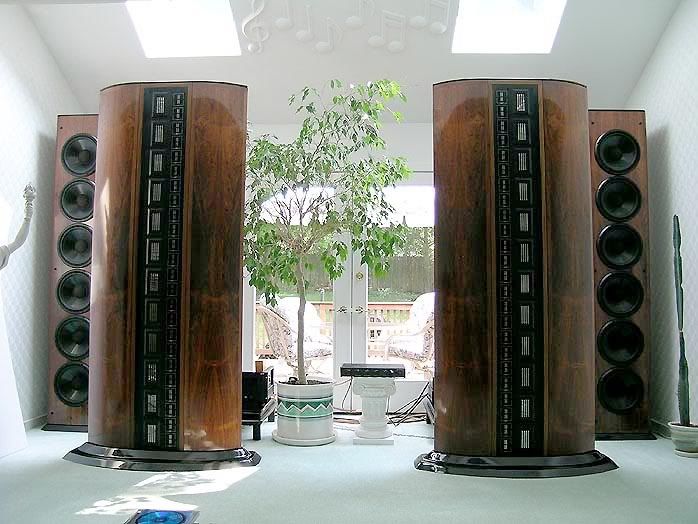
Were Renaissance 90s the best Infinity?

Just bought a nice pair of REN 90's (black standard). The previous owner said the foam on the rear vent was brittle and thus removed it for shipping. I need to replace this, so does anyone know the type of material used for this vent?

This is my 3rd set of vintage Infinity's. I've had QLS-1's for 30 years and a pair of RSIIIb's a while now. Can't wait to hear the Ren 90's but don't want to power them until I replace the foam, since I'm sure it was there for a reason. If I recall from a previous thread here (or somewhere) this was used to relieve pressure on the backside of the EMIM. Would you agree?

Thanks.
 
PS sorry to chime in with my basic question about "foam" amidst all this high tech discussion (that I don't understand). But I do hope you can offer some advice to my simple problem. But FYI all the early comments in this thread did inspire me to seek out a pair of these speakers.
 
PS sorry to chime in with my basic question about "foam" amidst all this high tech discussion (that I don't understand). But I do hope you can offer some advice to my simple problem. But FYI all the early comments in this thread did inspire me to seek out a pair of these speakers.

There are 2 sections of foam, the first one is outside the speaker box underneath the black metal plate behind the EMIM and the other is inside the EMIM enclosure. If only the outside foam on the back has deteriorated then performance should be fine because it's mostly cosmetic but if the bigger internal foam block has really deteriorated or has been removed then you will need to replace it. Standard mattress foam should be fine. Just cut it to the same shape and size but make sure that it's not too tight a fit. The foam is designed to absorb the back wave and to create a lossy transmission line loading. Different foams will alter performance slightly but IMO this is a design aspect that doesn't quite come off anyway and you need to pay some attention to speaker positioning and amplifier selection to get it right.
 
I replaced mine with egg crate foam, both the inner and outer layers. Wasn't too hard, just a bit time consuming to make it look original.
 
Early 1990's Infinity Brochure Comment

In my brochure, Infinity notes their "...massive 7.5 foot, $60k IRS V..." as "...the best speaker ever made."

IRS-V.jpg


Great as these IRS V's are, I still want a pair of black Renaissance 90's in my home :D
 
no there are many models better than the renaissance 90`s

it`s suppossed to be IRS V but some people prefer the beta because of the LEMIM.
 
Last edited:
Melbguy,

I tried manipulating values in LTS and found that it's possible to improve the low frequency response by decreasing the Q of the 2 ohm BP. It might actually be possibe to improve efficiency too because the use of a larger cap and a smaller inductor will reduce DCR / ESR. Using the steel laminate inductors (Madisound) as a reference it was possible to improve efficiency by 1.5dB by lowering the Q. This is possible because the lower value inductor has a lower DCR. I've checked the resulting impedance and there's a slight change but it's still just above 2.5 ohms at 40Hz. The good news is that the revised values also fix the 2dB dip at 60Hz and reduce the peak at 90Hz. The bass should sound more even and will have a bit more punch, and the -3dB point is a few Hz lower too.

Subset of all changes to the woofer X/O

L11 > change from 18mH to 12mH Steel laminate 15WG
C12 > Change from 840uF to 1600uF (use at least 2 caps in parallel)
L9 > change from 12.7mH to 11mH Steel laminate 15WG
C9 > change from 250uF to 300uF
C11 > change from 100uF to 110uF (add 10uf polyp in parallel with existing)


I will mod all as above within the next 2 weeks and will report back. Nothing ventured nothing gained. :music:

any update to the woofer x/o?
 
any update to the woofer x/o?

After a long time > I tried various combos but this worked best.

L11 > leave the existing 18mH
C12 > Change from existing 840uF to 940uF (2X 470uF - Erse low DF 3%)
L9 > change existing 12.7mH to 12mH (Erse Super Q 16wg)
C9 > change from existing 250uF/ 265uF to 300uF (2x Erse 150uF low DF 3%)
C11 > replace existing 100uF with Erse low DF 3%
C10 > Change existing 280uF with 290uF (Use a combo of Erse low DF 3%)
C13 > Replace 300uF with 2x 150uF Erse low DF 3%
L10 > Change to Erse Super Q 6.5mH 14wg


After the mods the bass was much punchier, tighter and cleaner than before and way better than the speaker was even when brand new. The slightly revised values also lower the -3dB point a little. The main improvement comes from the use of better quality caps and the use of parallel devices to further lower esr.

I was really stunned by the amount of improvement.
 
timpani, i'm a little confused about your modeling/measurements. are your comments about lowering the -3dB point and smoothing out some of the other response issues coming from SPL measurements or circuit modeling? if they're coming only from modeling, do you feel that you adequately input all of the TS parameters for each driver? as i understand it, modeling is more of a suggestion of the way things will turn out than anything else. for example, seems like it would be tricky to model the response of the EMIM in the damped transmission line, unless the program is very sophisticated.
 
Some guy just had a pair of Ren 90s in Florida with pictures on Cl FOR 600 bucks a few months ago. I was surprised that they lasted the entire week that it seemed like they did. Unless he just didnt get around to removing the post. I would love a pair as well
 
timpani, i'm a little confused about your modeling/measurements. are your comments about lowering the -3dB point and smoothing out some of the other response issues coming from SPL measurements or circuit modeling? if they're coming only from modeling, do you feel that you adequately input all of the TS parameters for each driver? as i understand it, modeling is more of a suggestion of the way things will turn out than anything else. for example, seems like it would be tricky to model the response of the EMIM in the damped transmission line, unless the program is very sophisticated.

The above comments / values refer only to the woofer crossover, but yes I did perform an impedance sweep to determine the cabinet driver f0. The small changes to component values will not alter the frequency response by > 1dB so the audible improvements are almost purely due to the capacitors being new and superior to those originally supplied.

I agree, the EMIM response is difficult to model, so I didn't attempt to do so. However, FWIW I'm not particularly happy with the audible behavior of the MB to EMIM transition and I'm not convinced that the attempt to augment the emim response with a transmission line loading actually works. Part of the problem with the approach is that the acoustic wavelength at 600Hz is only about 70cm which makes it almost impossible for any of the rear energy to be phase coherent - even without considering the effects of room boudaries.
The crossover from EMIM to EMIT is also unusual in that the crossover response is vastly different between the Ren 90, Ren 80 and IRS sigma, which all use the same EMIM's and EMIT's. Since I'm using a RAAL pure ribbon tweeter and not the EMIT I've thoroughly redesigned the crossover so that the amplitude response is essentially flat and the end result is vastly better - from a subjective pov.
BTW, rather than make major changes to the MB crossover, all I've done is to tweak a cap and an inductor value to extend the MB response slightly - thus reducing the 4dB dip at 600Hz to about 2dB. I also replaced the two NPO electros with Solen film caps and the 3.5mH inductor with an Erse super Q (3.3mH). There was more than a subtle improvement after this mod and the end result was not only subjectively better in terms of neutrality but also resolution.
Having already replaced all of the EMIM NPO electro crossover caps with Solen film caps I now have very little left in terms of component improvements, but I am extremely satisfied with the results.
 
audible improvements are almost purely due to the capacitors being new and superior to those originally supplied.

I have nowhere near the knowledge or gear to analyze the 90 crossovers as timpani has done, but I can wholeheartedly second his statement above.

A few months back, something went awry in the crossover and I lost the Emim in one of my 90's. Due to their age, I figured that if I was going to delve into the crossover I may as well replace all of the old NPE caps, and ultimately decided to upgrade the Solen film caps as well.

Armed with a new LCR meter, I spent many, many days getting to the correct combinations of paralleled Erse NP caps and Erse and Claritycap film caps for both the woofer and upper crossovers. Most of the inductors were also replaced with the Erse Super Q coils that had their values fine-tuned to the exact design spec. Interestingly, I found that all of the original coils over 1mh were way out of spec.

Going to the physically much larger inductors and paralleling all of those caps meant that it was a real pain to get everything arranged on the upper crossover, and that I had to start over with a much larger base for the woofer crossover, but it did get accomplished.

The results were worth every hour of labor (and several hundred dollars of parts). The low end is improved- deeper and more full, but still the precise clarity that is somewhat the trademark for this Infinity/Watkins combo. And the improved film caps seem to have taken that slight bit of edge off of the midrange- still the startlingly life-like quality of the vocals, but no longer any of what someone referred to as "honkiness" in the mids. Just a transparent, smooth solidity from bottom to top, that gets better and better the more you turn them up.

Herb
 
guys anybody have picturew of the crossovers?i wonder how much space is available in there.

Here's a couple-

attachment.php


attachment.php


In re-doing my crossovers, the original low end board, seen through the woofer opening, became an inch or so wider and probably 4 inches longer and fit with no problem. The high end assembly stayed the same in size, but the larger inductors were a bit of a problem to fit on the lower level. On the upper level, even though the new caps ended up stacking quite a bit higher, there was still no clearance problem with the woofer basket.

Herb
 

Attachments

  • DSCN0543.jpg
    DSCN0543.jpg
    140.6 KB · Views: 263
  • DSCN0544.jpg
    DSCN0544.jpg
    131.4 KB · Views: 258
I am still learning a lot about these Infinity's. I didn't realize that the Ren 90's were some of the best Infinity's out there. I thought the IRS Beta's, IRS Gamma's RS-1's, RS 2.5, RS 4.5 and the Quantum Source Lines were the better units of the Infinity drivers.

no there are many models better than the renaissance 90`s

it`s suppossed to be IRS V but some people prefer the beta because of the LEMIM.


Some people prefer the Beta to the IRS Vs? :screwy:

Unless they mean that they prefer a speaker that they can actually fit inside their average-sized living room, I'd bet money that the people who say that have never actually HEARD the IRS Vs, properly powered. I can understand the theoretical advantages of the LEMIM as a single driver, but the difference those line-array wavefronts from the EMITs+EMIMs of the IRS Vs make so outweighs the sound radiating from the smaller areas of the Beta's LEMIM panels, it isn't even funny. I've heard both of these speakers in good set-ups, and there really isn't any comparison. The IRS Vs trounce all other Infinities, and ARE the best speakers Infinity ever made. Infinity wasn't exaggerating when they called them the best speakers in the world. They were when they were made, and very probably remain so. Do I sound dogmatic, opinionated, etc... YOU BET! Because I've heard both of these speakers, and speak from firsthand experience.

That said, I won't complain if someone wants to give me their old Betas... :D
 
Some people prefer the Beta to the IRS Vs? :screwy:

Unless they mean that they prefer a speaker that they can actually fit inside their average-sized living room, I'd bet money that the people who say that have never actually HEARD the IRS Vs, properly powered. I can understand the theoretical advantages of the LEMIM as a single driver, but the difference those line-array wavefronts from the EMITs+EMIMs of the IRS Vs make so outweighs the sound radiating from the smaller areas of the Beta's LEMIM panels, it isn't even funny. I've heard both of these speakers in good set-ups, and there really isn't any comparison. The IRS Vs trounce all other Infinities, and ARE the best speakers Infinity ever made. Infinity wasn't exaggerating when they called them the best speakers in the world. They were when they were made, and very probably remain so. Do I sound dogmatic, opinionated, etc... YOU BET! Because I've heard both of these speakers, and speak from firsthand experience.

That said, I won't complain if someone wants to give me their old Betas... :D

my reading was about the LEMIM.

i never heard either but i beleive you.
 
Here's a couple-

attachment.php


attachment.php


In re-doing my crossovers, the original low end board, seen through the woofer opening, became an inch or so wider and probably 4 inches longer and fit with no problem. The high end assembly stayed the same in size, but the larger inductors were a bit of a problem to fit on the lower level. On the upper level, even though the new caps ended up stacking quite a bit higher, there was still no clearance problem with the woofer basket.

Herb

thanks.

is the mid high in separate chamber and the low in the speaker?
 
is the mid high in separate chamber and the low in the speaker?

The upper range crossover is actually integral with the bottom panel of the speaker cabinet, with the pcb mounted on standoffs above the mdf bottom panel. It is attached with 6 or 8 screws and is rabbeted into the side panels. There are three inductors mounted directly on the mdf panel, with their leads wired up to the bottom of the pcb. The threaded inserts for the front two spikes are in this panel also- the rear spike is on a separate metal fitting that houses the binding posts.

IIRCC there is only one truly separate chamber in the cabinet, that for the Emim, which is open to the foam baffle on the rear of the cabinet. Everything else is open internally.

Herb
 
i see.so there is access only from the woofer opening or is the bottom renovable?

thanks for answering all those questions.

george.
 
Back
Top Bottom