• The move to the new server is done. There are some software and database maintenance updates in process. This has us passing the hat around to help out. We appreciate any donations. Seriously, even a dollar helps. The payment page may be found here - https://www.audiokarma.org/support.html

Were Renaissance 90s the best Infinity?

The bottom panel/crossover pcb comes out.

The driver leads and the leads from the binding posts somewhat limit how far away you can get it from the cabinet. This wasn't really an issue for me, since I unsoldered them all anyway. On mine, there was a lot of corrosion on the first 1/2" of the leads (under the insulation) from the original solder.

Herb
 
I see this thread has quite a life. This post addresses the OP only, not anything that follows.

Best is quite a judgment. The best sounding Infinity speaker systems were, without any competition, the Servo-Statik I and Servo-Statik Ia. They were also among the most unreliable. So it is a double edged sword. The IRS were probably next.

But your speakers probably sound very good and are reliable since they were made after the original crew was elsewhere. It seems reliability wasn't a high priority with the original crew.

PLEASE do not misunderstand me, I own a SS-1 system, still broken. And repaired them back in the 70s for Infinity. But I know first hand, personally how unreliable those high performance, early "High End" systems were.
 
you make this sound as if fact, it seems. perhaps in a given frequency range the SS's sound best, given that they are electrostatics, but as i understand it there are at least a handful of others with better sounding bass, if nothing else.
 
You make this sound as if [it is] fact, it seems. Perhaps in a given frequency range the SS's sound best, given that they are electrostatics. But as I understand it, there are at least a handful of others with better sounding bass, if nothing else.

Do you know, or have ever heard a "full range" electrostatic system???? The SS-I is dynamic to 100 Hz. So I guess my statement stands from 100 Hz up. Not a small range of sound.

Did you read my first point about this being a value judgment?

I understand that anyone who has not experienced these can not know.

BTW, I loved the WTLCs. An amazing speaker for the selling price. And I sold them.

And AMEN BROTHER to understanding wives.
 
yes i read the first part of your statement, but the rest seemed to imply a fact, which is why i asked for clarification.

no i haven't heard a pair of full-range electrostats, though i'd like to. within certain limitations (bass and dynamic range especially), i can imagine them being among the best infinities. obviously the constraints muddy the case for an overall best Infinity, though i still would've expected a properly amplified IRSV to be king.

anyone else with impressions of the Servo Statik compared to the rest? i'm very curious now.
 
i wonder how good are those pulse-x polypropylene erse caps.

are they better than solens?

should i go with them for mid-midbass and something better for the tweeter?
 
IIRCC there is only one truly separate chamber in the cabinet, that for the Emim, which is open to the foam baffle on the rear of the cabinet. Everything else is open internally.

Herb

Actually, the mid bass driver is also mounted in its own internal enclosure. This driver's crossover is located on the main pcb at the bottom of the speaker and the 3 associated iron core inductors are all mounted underneath on the bottom removable panel.
 
i wonder how good are those pulse-x polypropylene erse caps.

are they better than solens?

should i go with them for mid-midbass and something better for the tweeter?

Go for broke on the tweeter. I'm using the silver in oil Mudorf's and they sound sublime. However, it would be a waste to use expensive film caps on the EMIM or mid bass - imo. If you replace the 33uF NPE in the EMIM XO with a Solen film cap you will hear a big improvement but be sure to add 0.33R in series to reduce the Q, otherwise you will end up with a big peak at approx 2.5 kHz. I have also reduced this value to 30uF + 0.33R for an even smoother response.
 
Go for broke on the tweeter. I'm using the silver in oil Mudorf's and they sound sublime. However, it would be a waste to use expensive film caps on the EMIM or mid bass - imo. If you replace the 33uF NPE in the EMIM XO with a Solen film cap you will hear a big improvement but be sure to add 0.33R in series to reduce the Q, otherwise you will end up with a big peak at approx 2.5 kHz. I have also reduced this value to 30uF + 0.33R for an even smoother response.

silver gold oil are much more expensive than silver oil.

the solens of the EMIM stay?
 
silver gold oil are much more expensive than silver oil.

the solens of the EMIM stay?

Yes, the Solen's are just fine for the EMIM's. The major sonic differences between the Solens and the Mudorfs are only audible above 3000Hz
I personally can hear almost no diff between the Mundorf SGO's and the SO's, so I would go with the SO's for the tweeter xo.
 
Actually, the mid bass driver is also mounted in its own internal enclosure.

My mistake on that one. I was thinking that the mid-bass section was open at the rear, but it has been several months and many projects since I was in there.

Yes, the Solen's are just fine for the EMIM's.

I would respectfully disagree with Timpani on this one. In the case of my 90's, replacing the Solens definitely improved the character of the mids- still the crystal clear EMIM sound, but lost that little bit of grainy edge that could intrude.

I don't recall the exact combination of Pulse-X and ClarityCap values that I used, but I believe that the monster 72uf Solen was replaced with a 68uf Erse and 3.9uf Clarity. The other mid and tweeter film caps were also all replaced with some combination of Erse and Clarity.

I'm sure, as Timpani states, that going for broke with Mundorf or some other cap of that grade would be worthwile, it was just too much of stretch for the budget for me, since I was doing a wholesale replacement of inductors as well as caps.

Herb
 
i have almost deside.

nobody mention c6 3.1uf npe.

isn`t it important?

if replaced with mkp it needs a resistor in series too?

and one more question for tympani.

what is the 35volt bias doing?

is it worth the trouble?
 
i have almost deside.

nobody mention c6 3.1uf npe.

isn`t it important?

if replaced with mkp it needs a resistor in series too?

and one more question for tympani.

what is the 35volt bias doing?

is it worth the trouble?

Definitely replace C6 with a polypropylene film type cap (without a resistor) but this cap does not have a huge impact on SQ so imo anything expensive is wasted. The two most important caps in the EMIM crossover are actually the Solen 40uF and the 33uF npe.


Yes, my DC bias of the caps in the tweeter crossover is implemented a bit differently to the way that Infinity have done in the IRS Epsilon but the end result is similar. It allows the caps to work in an area where they introduce less distortion - although it should be noted that the better quality the cap the less the improvement. You can download the Epsilon crossover schematic if you want to see how Infinity have done this.
 
I would respectfully disagree with Timpani on this one. In the case of my 90's, replacing the Solens definitely improved the character of the mids- still the crystal clear EMIM sound, but lost that little bit of grainy edge that could intrude.

I don't recall the exact combination of Pulse-X and ClarityCap values that I used, but I believe that the monster 72uf Solen was replaced with a 68uf Erse and 3.9uf Clarity. The other mid and tweeter film caps were also all replaced with some combination of Erse and Clarity.

I'm sure, as Timpani states, that going for broke with Mundorf or some other cap of that grade would be worthwile, it was just too much of stretch for the budget for me, since I was doing a wholesale replacement of inductors as well as caps.

Herb

Herb,

If you replaced the inductors in the EMIM you will need to make sure that L4 has a DCR of about 0.4 ohms. If you have replaced L4 with a larger cap you should add a small series resistance to achieve the desired total DCR. A low DCR will result in a peak in the response at 900Hz.

Thanks for the other comments too. I will replace C3 with a clarity cap and will report back here on the subjective impact.
 
If you replaced the inductors in the EMIM you will need to make sure that L4 has a DCR of about 0.4 ohms.

With my crossovers, L1-5 all tested precisely to spec, so they were not replaced.

L-6 and above were all at least 20-30% under their specs, so they were replaced with new Erse (I believe Super Q) inductors which were individually unwound to match them to the exact spec.

If I recall, the DCR on the new Erse coils was a good match for the originals.

C1 and C2 were replaced with Clarity 3.9 and 5.6 respectively, while C3 and C5 were each built up from paralleled Erse and Clarity Caps. Even in the world of boutique caps, there was very little choice for that C5 72uf value, so there was really no choice but to build up the proper value.

Herb
 
Thanks for the other comments too. I will replace C3 with a clarity cap and will report back here on the subjective impact.

OK, I can now confirm that upgrading C3 did yeild a small but audible improvement as did upgrading C3 to a clarity cap.
 
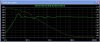
crossover response before and after mods
The original plot has been updated due to a value typo. The original response is +/- 2 dB. The response dip at 600Hz is designed to take into account the transmission line loading of the EMIM while the dip at 200Hz is largely corrected by an impedance rise at that frequency. The irregularities between 2 - 5 KHz are designed to slightly correct the EMIM and EMIT responses at 30 degrees - the designed listening angle.
 

Attachments

  • ren-90 mod.JPG
    ren-90 mod.JPG
    50.7 KB · Views: 69
  • ren-90 original.JPG
    ren-90 original.JPG
    60.1 KB · Views: 65
Last edited:
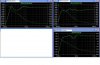
Finally a comparison of the EMIM - EMIT crossover response of 3 different speakers

Renaissance 80
Renaissance 90
IRS Sigma

These speakers are using the same EMIM / EMIT drivers, although the Sigma is also using a rear facing EMIT @ -3dBr. The Ren 80 and 90 are both using the same component values in the EMIT HPF but the response is much different due to the different EMIM BPF. One of the possible reasons for the difference is the smaller baffle width but it's hard to fathom why the EMIT HPF values - which are really designed for a 8 ohm load are being used on a 4- 5 ohm EMIT. I note that the IRS Epsilon also uses the same values for the 2x EMIT's, but that's reasonable because the effective impedance is close to 8 ohms.
 

Attachments

  • COMPARISON.jpg
    COMPARISON.jpg
    84.7 KB · Views: 59
these are just simulated voltages and not actual SPL output, right?

Correct.

Only the driver impedance is taken into account so the anechoic frequency response will look different - particularly at lower frequencies. However, the different crossover transitions that exist between the EMIM's and EMIT's in the 3 different models is curious, particularly between the 2 Renaissance models. I'm not convinced that the EMIT crossover has been fully optimised for either model and the values seem to be 'Infinity generic' rather than tuned to the EMIM crossover response.
The Sigma's on the other hand do use near optimum Linkwitz -Riley values for the EMIT's but there's an odd suckout in the presence region. I've not heard these speakers but I'm quite sure they would sound slightly laid back when compared with the Renaissance models and probably sound best with some toe-in rather than beaming straight down the room.
I'm using a pure ribbon tweeter rather than the EMIT because I prefer a wide horizontal dispersion but my optimised flatter response produces an excellent transition with the EMIM and sounds more natural than the original - when listening on-axis. I found that the stock standard Ren 90 sounds a bit too hot in the high mids and treble when on axis and it sounds a bit rolled off in the high treble when listening at 30 degrees - which is about optimum for the high mids. The result being a very narrow 'sweet' listening position.
 
Back
Top Bottom