• The move to the new server is done. There are some software and database maintenance updates in process. This has us passing the hat around to help out. We appreciate any donations. Seriously, even a dollar helps. The payment page may be found here - https://www.audiokarma.org/support.html

Wharfedale W60D-Homecoming

Ivan thanks I have had very good luck with Dayton in the past and like that they are 5%, but will the 8.2uF be an safe replacement for a 8uF capacitor? I don't have any real knowledge about electronics (though I am going to check out youtube tutorials on using a multimeter which seems a must tool, like a good measuring tape when I was wood working) and so I don't know how much .2uF will impact the tweeter, mid-range speakers designed for a 8uF as opposed to an 8.2uF capacitor in the cross over.
 
It's no problem, because this 8.2uF capacitor has a 5% tolerance meaning it won't be exact anyways, from 7.79uF to 8.61uF. Nor was the capacitor you are replacing exactly 8uF.


Except both capacitors can be off by 5%, leading to a even larger margin of error.
If you really care about being that exact, this will get you the closest:
http://www.parts-express.com/dayton-audio-pmpc-40-40uf-250v-precision-audio-capacitor--027-226

And do remember that it's quite possible that electrolytics back then were not made in a 8.2uF or any standard values, just integers. That's what I have seen.
In other words, an "exact replacement" of a non-exact capacitor really doesn't matter.
 
Last edited:
leave the foam for now; prob just fine

makes more sense to let the drivers wake up, recap the x-overs, before you try changing something like that.

Yeah, I agree. Wasn't it like a thick, woolish material? That would make sense, considering the drivers were made in probably one of the sheep-herding capitals of the world. Have those two drivers made any sound as of yet? It's nice to see you moving on these so fast. I think you'll really be happy with them. The 2000a is a good sonic match for that late '60's Wharfedale sound. And there's more where that came from. You can move in reverse-chronological order and wind up refoaming mid '50's drivers (Actually, the drivers with the roll-surround are really the best performers in the laboratory sense).

Enjoying a little Isaac Hayes... "Truck Turner" soundtrack, which I desperately need to pick up on vinyl. The current CD version (on the "Tough Guys/Truck Turner" two-fer) has a little noticeable compression.
 
Of course we could not wait.

First the caveats. (1) The caps in the W60D crossovers have got to be over 40 years old, no observed leakage or swelling, but that's a long time, and switching out the caps in our Wharfedale W70s did make a difference. (2) I would guess it has been at least a decade since these speakers were last used, so Rogers comments to let them work for a day is a good idea and something I will do tomorrow, just cue up the CDs let them play and not sit and listen, let the speakers come alive again. (3) The room is way too small, a 9 x 9 foot office, they do make attractive, if not quite large, headphones, but really we need to bring them into our big room 15 x 15 feet for a more honest listen.

Now Caveat's aside, general impressions.

These speakers love the human voice, whether James Tailor, Nolwenn LeRoy, Bono, Annie Lennox, Eagles, they just present the singer, the nuances, percussive effects of their singing and the words sung. You both hear the singing and understand the words not a small accomplishment.

They did need a bit of boost on the bass. I turned the bass tone control on the Sansui 2000A up one notch from the neutral setting, this helped balance the musical presentation. An interesting moment occurs in playing the XRCD Hell Freezes Over, Eagles CD. On "Hotel California" after the delicious guitar intro a conga drum joins and as you listen to the conga being struck, after the first couple blows there is a moment when you get three tones out of the conga, first the whack of the hands on the leather top, then the deep tone of the blow coming out the conga and then a second low following tone after. With the W60D we could hear all three of these sounds, but with the W70 we never heard the third tone, only the hand whack and the deep tone of the blow coming out the conga, however through our Tannoy 75th Anniversary Turnberry speakers we get all three sounds just as we did with the W60D.

These speakers are very smooth in performing the music, not an analytical presentation of the music coming apart, but a presentation of musicians performing together. The harmony of the background singers in James Tailors "You Can Close Your Eyes" became a part of his singing rather than a distant presence.

So tomorrow, I think I will mine the 60s rock (Wilson Picket, Rolling Stones, Motown, Led Zeppelin, etc.), some Jazz and run the entire Von Karajan Beethoven symphony CD box set through them, they should be hyper-ventilating after all that.

Gang, yes, it could well be of wool composition (the interior sound deadening material), I agree the bigger fish for the moment is bringing new capacitors into the crossover. What do you think about Deoxit on the two attenuators in the cross over? Followed by the gold fader lube?

 
Last edited:
Attenuator Usage

These speakers have two attenuators one for "Treble Range" and one for "Mid Range" which can be adjusted between "maximum" and "minimum" settings. The label tells you which adjustment is recommended depending on the rooms surfaces, e.g., a room with a lot of sound absorbing features versus a room with hard surfaces. The adjustment shaft appears to have never had a knob on its end and thus lacks any arrow or pointer to indicate where you are in relation to the range of motion between the "maximum" or "minimum" settings (which is a strange omission as both our Linton and W70 speakers have a knob with a pointer on it, are they just missing?). Here are my questions:

1. From all the pictures I have seen it does not appear that there ever was a knob on the end of the adjustment shaft. Was there one, that is now missing? What have other W60D owners done to add some means to know where on the range of adjustment the attenuator is? Find a knob that fits, add a drop of paint?

2. There is no dead center moment in the range of movement of the attenuator shaft, is there a mid-point where there is no effect from the attenuator, e.g., a zero or neutral point to its impacting the sound through the speakers? How have others located this point? Get out your protractor and measure the degrees of movement of the attenuator shaft and then mark the middle as the zero or neutral point?

Thanks for your thoughts.
 
Last edited:
Bonus Attenuator Question-:scratch2:, Turning the "Mid-range" attenuator to "minimum" turns the sound off.

Just cued up the first of the Beethoven boxed set (this is my play all day re-break in the speakers day) and noticed that on one speaker if the "Mid-Range" attenuator is turned all the way down to the "minimum" setting the speaker does not play. Turning down the "Treble Range" does not have this effect, only "Mid-Range". With the other speaker turning either, or, both attenuators down to the "minimum" setting does not turn off the sound coming through the speaker, they still play and may have some attenuation.

Thoughts on what could be going on in the attenuator/cross over? Does this mean I have more issues to address than just replacement of the capacitors, although this is always a good place to start? Am I risking speaker injury and should play no further until tech checks out the cross-over?
 
i wouldn't worry about speaker injury w/ the old crossover caps. just don't go for some crazy volume!

re the atten: sounds like a dead spot caused by bad contact. some deoxit might clear this up.
 
Attenuator Usage

These speakers have two attenuators one for "Treble Range" and one for "Mid Range" which can be adjusted between "maximum" and "minimum" settings. The label tells you which adjustment is recommended depending on the rooms surfaces, e.g., a room with a lot of sound absorbing features versus a room with hard surfaces. The adjustment shaft appears to have never had a knob on its end and thus lacks any arrow or pointer to indicate where you are in relation to the range of motion between the "maximum" or "minimum" settings (which is a strange omission as both our Linton and W70 speakers have a knob with a pointer on it, are they just missing?). Here are my questions:

1. From all the pictures I have seen it does not appear that there ever was a knob on the end of the adjustment shaft. Was there one, that is now missing? What have other W60D owners done to add some means to know where on the range of adjustment the attenuator is? Find a knob that fits, add a drop of paint?
No knob, never was on this model. I know for sure because I have my Dad's W70Ds that are known to be 100% original and complete, and there are no knobs.
2. There is no dead center moment in the range of movement of the attenuator shaft, is there a mid-point where there is no effect from the attenuator, e.g., a zero or neutral point to its impacting the sound through the speakers? How have others located this point? Get out your protractor and measure the degrees of movement of the attenuator shaft and then mark the middle as the zero or neutral point?

Thanks for your thoughts.

No real neutral point is defined. You'll have to decide what you think it is, either by ear or measurement.

Bonus Attenuator Question-:scratch2:, Turning the "Mid-range" attenuator to "minimum" turns the sound off.

Just cued up the first of the Beethoven boxed set (this is my play all day re-break in the speakers day) and noticed that on one speaker if the "Mid-Range" attenuator is turned all the way down to the "minimum" setting the speaker does not play. Turning down the "Treble Range" does not have this effect, only "Mid-Range". With the other speaker turning either, or, both attenuators down to the "minimum" setting does not turn off the sound coming through the speaker, they still play and may have some attenuation.

See the schematic I posted earlier. If putting the pot on minimum does not extinguish nearly all of the sound from the tweeter then either the pot is faulty or there is a bad contact on the minimum side of the pot. Notice when the pot is at minimum, the pot will "short" out the speaker so no sound should be heard.

Note that the high treble is also reproduced by the mid-range. There is no high-frequency filter for the mid-range in the cross-over design.

Thoughts on what could be going on in the attenuator/cross over? Does this mean I have more issues to address than just replacement of the capacitors, although this is always a good place to start? Am I risking speaker injury and should play no further until tech checks out the cross-over?

To clarify, neither adjustment should impact the bass response. If either adjustment changes the low bass response in the bass speaker, this is not good and indicates there might be a short somewhere.

Mid-range adjustment will turn on or off the mid-range speaker independent of the tweeter and woofer.

Tweeter adjustment will turn on or off the tweeter independent of the mid-range and woofer.

Hopefully this clarifies the controls.
 
Thanks Roger, I will try the deoxit tomorrow. Today we have gotten through Beethoven's Symphony 1 & 3 and are mid-way through Pink Floyd's "Wish You Were Here", playing the title track and the placement of Gilmore and Roger's guitars are just spot on and the voice so clear so much grief.

Volume is going not higher than 9:00 o'clock and backing down below it as needed, so No crazy volume.
 
Toups thanks for your advice. For today I have all attenuators set at the "maximum" setting and all drivers are playing just fine. As noted in response to Roger I am keeping volume power low, while 9:00 on the volume knob doesn't tell much I doubt I am driving more than a couple watts of power, as today is all about just letting the speakers play a wide range of music, classical, blues, jazz, classic rock and let them move in a warm room again.

Just put on k.d. lang, these speakers really love the human voice, even a room away and down a hall way I can follow her words as she sings.
 
Last edited:
Bonus Attenuator Question-:scratch2:, Turning the "Mid-range" attenuator to "minimum" turns the sound off.

Just cued up the first of the Beethoven boxed set (this is my play all day re-break in the speakers day) and noticed that on one speaker if the "Mid-Range" attenuator is turned all the way down to the "minimum" setting the speaker does not play. Turning down the "Treble Range" does not have this effect, only "Mid-Range". With the other speaker turning either, or, both attenuators down to the "minimum" setting does not turn off the sound coming through the speaker, they still play and may have some attenuation.

Thoughts on what could be going on in the attenuator/cross over? Does this mean I have more issues to address than just replacement of the capacitors, although this is always a good place to start? Am I risking speaker injury and should play no further until tech checks out the cross-over?

I think my W90's do this. I seem to remember turning the mid and tweeter volumes all the way down and only hearing the woofers.

By the way, I never understood that knurled shaft deal. I remember seeing a W70 pair or two, Radio People ones, I think, that actually HAD knobs, but they were earlier ones, ported, I believe.


Thanks Roger, I will try the deoxit tomorrow. Today we have gotten through Beethoven's Symphony 1 & 3 and are mid-way through Pink Floyd's "Wish You Were Here", playing the title track and the placement of Gilmore and Roger's guitars are just spot on and the voice so clear so much grief.

Volume is going not higher than 9:00 o'clock and backing down below it as needed, so No crazy volume.

That's good to hear. They'll get a lot better over time too. Maybe it's got to do with the cone material, but Wharfedales do classic-rock guitars some serious justice. Horns and organs too (like Hammond B3's and that sort of thing). Basically, any musical instrument that resides in the analog world. You will probably even rekindle that love affair with '70's guilty pleasure music that many of us have at some point in our lives. Wharfedales are the quintessential toe-tappers.


Toups thanks for your advice. For today I have all attenuators set at the "maximum" setting and all drivers are playing just fine. As noted in response to Roger I am keeping volume power low, while 9:00 on the volume knob doesn't tell much I doubt I am driving more than a couple watts of power, as today is all about just letting the speakers play a wide range of music, classical, blues, jazz, classic rock and let them move in a warm room again.

Just put on k.d. lang, these speakers really love the human voice, even a room away and down a hall way I can follow her words as she sings.

I like the old Wharfies with bigger horn instruments like trombones, baritone saxes, etc. Last night I put on an old Camden Living Jazz record that's loaded with them, and the Wharfies really get those sounds right, the depth, the presence, and especially those lower-midrange, upper-bass transients. Then, all of a sudden, a swirling organ sound hits you from the side, like someone is playing the thing right there in the room with you. It's uncanny. I listen to a lot of Tower Of Power at home, and that's definite Wharfedale territory. I have "Bump City" on vinyl, and the horns REALLY sing on that one (Wharfedales and Dual turntables go very-well together).
 
Last edited:
Carol King and Tapestry now, very clear, but wife noted that between tracks noise was audible through both speakers.

I came in and we turned off the CD player, turned volume down to zero and through each speaker heard a soft steady low level hum coming through both speakers, louder in one speaker than the other (and no not the receiver, it is silent now that we did the Service Bulletin grounding fix for the Sansui 2000A).

What's interesting is the difference in loudness of the hum tracks the difference previously noted concerning the attenuators. In one speaker when the treble and mid range attenuators are turned down to the lowest setting on the minimum side of the attenuator the music stops playing in that speaker. On the other speaker when the treble and mid range attenuators are turned down to the the lowest setting on the minimum side of the attenuator the music continued to play. The louder noise is coming from the speaker where turning the treble and mid range attenuator to their lowest minimum setting did not turn off the music.

So tomorrow I will open and Deoxit both sets of attenuators, then test for any change in whether they operate the same in turning off the music and level of noise through the speakers. If this dosn't solve the noise issue then I will order up some capacitors and see if my local shop can trace back to the problem in the cross over. Much thanks to Toups for his cross over diagram.

OH WOW Tower of Power now that does take me back, I still dig it out from time to time just for "So Very Hard To Go", just added it to the play list!
 
Last edited:
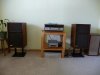
Well, that was worth it! Played "So Very Hard To Go" the trumpet solo in the middle was just soulful in this great break up song. Here they are in their little room:

P1040368.jpg

Between stopping to catch a tune, makes getting through the chores a bit erractic:D.

P.S. That's a Wharfedale Linton in the corner, sadly displaced.
 
Carol King and Tapestry now, very clear, but wife noted that between tracks noise was audible through both speakers.

I came in and we turned off the CD player, turned volume down to zero and through each speaker heard a soft steady low level hum coming through both speakers, louder in one speaker than the other (and no not the receiver, it is silent now that we did the Service Bulletin grounding fix for the Sansui 2000A).

What's interesting is the difference in loudness of the hum tracks the difference previously noted concerning the attenuators. In one speaker when the treble and mid range attenuators are turned down to the lowest setting on the minimum side of the attenuator the music stops playing in that speaker. On the other speaker when the treble and mid range attenuators are turned down to the the lowest setting on the minimum side of the attenuator the music continued to play. The louder noise is coming from the speaker where turning the treble and mid range attenuator to their lowest minimum setting did not turn off the music.

So tomorrow I will open and Deoxit both sets of attenuators, then test for any change in whether they operate the same in turning off the music and level of noise through the speakers. If this dosn't solve the noise issue then I will order up some capacitors and see if my local shop can trace back to the problem in the cross over. Much thanks to Toups for his cross over diagram.

OH WOW Tower of Power now that does take me back, I still dig it out from time to time just for "So Very Hard To Go", just added it to the play list!

Is the hum coming directly from a single woofer?

Yeah, I am a HUGE fan. I have their first 7 albums on CD, plus some later stuff. I'm a guitarist, and I play a lot of funk-type music, so...... TOP, the Meters, James Brown/the J.B.'s, Sly & The Family Stone, Isaac Hayes, Curtis Mayfield, Earth Wind & Fire, Al Green, etc... I really dig that funk/soul stuff from the '60's and '70's, and that's also a big reason why I love Wharfedales. They really nail those types of music.
 
Last edited:
Gang that's a good thought when the Beethoven CD gets done playing I will see if I can hear a difference in the noise from each of the three speakers.

One nice thing is that so far there is no mildew smell coming off the speaker cones. I think that while it doesn't hurt to play them for a day to get them moving there might be another thing at work-removal of moisture from the speaker cones and fabric surround. We are in the era of natural fibers in the construction of speaker cones and surrounds and they retain moisture. With that thought in mind I have removed the speaker grills to allow maximum air flow over the cones and surrounds. It can't hurt to dry them out as much as possible.

"Wanna Take You Higher" absolute pivotal performance in the movie Woodstock, the movie that made us all realize the concert we had missed:sigh:.
 
Gang that's a good thought when the Beethoven CD gets done playing I will see if I can hear a difference in the noise from each of the three speakers.

One nice thing is that so far there is no mildew smell coming off the speaker cones. I think that while it doesn't hurt to play them for a day to get them moving there might be another thing at work-removal of moisture from the speaker cones and fabric surround. We are in the era of natural fibers in the construction of speaker cones and surrounds and they retain moisture. With that thought in mind I have removed the speaker grills to allow maximum air flow over the cones and surrounds. It can't hurt to dry them out as much as possible.

"Wanna Take You Higher" absolute pivotal performance in the movie Woodstock, the movie that made us all realize the concert we had missed:sigh:.

If you love those guys, there is a quad LP version of Sly & The Family Stone's "Greatest Hits" that sounds awesome on two-channel turntables. Fuller, richer, and just plain better than the original mixes.

Yeah, I figure a speaker made from natural materials should sound more-natural than a speaker constructed from man-made materials. Bozak used wool in their woofers, as did Wharfedale. But you're right about moisture as well as overly-dry areas. Either can wreck a speaker if given enough time.
 
Last edited:
Whoops... One more thing.

You may find, when they're both up and running right, that you like them even more with the grills off. With kids, it's not so easy, but I used to run my W60E's with the grills off.
 
Back
Top Bottom