• The move to the new server is done. There are some software and database maintenance updates in process. This has us passing the hat around to help out. We appreciate any donations. Seriously, even a dollar helps. The payment page may be found here - https://www.audiokarma.org/support.html

Wharfedale W60D-Homecoming

Following up on Gang's question of where the noise is coming from one or more of individual speakers.

On the more noisy speaker, the woofer and mid-range are the source of the noise, the tweeter is quiet. On the less noisy speaker, all three of the speakers make about the same amount of noise which is considerably less than the noisy speaker.

The noisy speaker is the speaker that continues to play even when the attenuators are turned all the way down to the stop point on "minimum", which Toups notes should not happen. While the quieter speaker is the one that turns off the music when the attenuators are turned all the way down.

Final observation in both speakers when the attenuators are turned down to "minimum" the noise is less in the noise speaker and almost gone in the quiet speaker, and when the attenuators are turned all the up to "maximum" the noise is loudest in both the noise and quiter speakers.

It will be interesting to see if cleaning the attenuators tomorrow with Deoxit changes the noise in either speaker.
 
Last edited:
Toups wife and I just listened again to the speakers, it isn't like a hum or buzz. It is more like a shushing sound which increases in volume when the attenuator is turned from lowest "minimum" setting to the highest "maximum" setting.

The sound is identical in both speakers, but in one it is much louder than the other when both have the attenuator turned up to the highest "maximum" setting, also now as I move the attenuators from the "maximum" setting down to the "minimum" setting neither speaker stops playing music. So whatever caused the one time drop out of the one speaker when its attenuators were turned to the "minimum" setting is no longer occurring, perhaps multiple turns and a day of playing music has cleared that problem.

Given the very different levels of cadmium oxidation I found on the outside of the attenuators in the two different pictures I think it could well be that different levels of oxidation are at work in the attenuators.

Looking back at the pictures of the oxidation on the case of the attenuators I think this actually is the case. For example just compare the level of oxidation on the attenuators for speaker D07457 in post #35 with the level of oxidation on the attenuators for speaker D07477 in post #4, the heavily oxidized set of attenuators in speaker D07457 are in the noisy speaker, the lightly oxidized set of attenuators in speaker D07477 are in the quietly noisy speaker. Given this I will try to get deoxit inside the attenuators tomorrow to see if that will change the noise.
 
Last edited:
Have you tried hooking up a different speaker to see if the noise is still there?

I am suspicious of the amplifier rather than the speakers. Could be the speakers, but that would not be my first guess.
 
Per Toups suggestion I swapped out different receivers/amplifiers today. First up was our Hitachi SR-504 receiver and with the receiver set at idle the noise through the speakers was barely audible. The sound of the music was about the same as the Sansui 2000A, with a little increase on the volume knob to achieve similar decibels. Then came the Kenwood KA-7010 integrated amplifier and a whole new league of power, from mid 30 watt power to 100 watt power driven by separate transformers for each channel. By comparison per eHow the 2000A is : 20hz-40Khz THD 0.8% with signal to noise ratio of 60db, while per the specification sheet for the KA-7010: THD 20hz-20Khz is 0.06% with signal to noise ratio (IHF-A) (IHF-66) through the Tuner/Aux/Tape as 110db for 150 mV input. Through the KA-7010 there was no noise at all through the speakers at idle, black silence. Turning to the music, and upping the bass control two settings the Rollings Stones “Hot Licks” CD is jumping out of the speakers with the volume set just a smidge above the 9:00 setting (and yes this is about as far as the music needs and I want to go). Again no way to tell how many watts, but again I assume not much more than 5-10 watts.

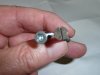
Here is a solution to a future problem. I sweated bullets when I saw slotted 40+ year old screws holding on the back of these speakers. Metal ages and slotted screws present great opportunity to round out the screw slots or break off half of the screw head. Fortunately making sure I had the exact fit slotted screw driver and keeping steady pressure down to seat the screw driver I was able to slowly ease the screw into motion and all screws came out without damage to their slotted heads, but…. So this solves that issue, new, steel, square drive screws. You still don’t want to be sloppy, but the future risk of having to drill out a screw is now gone.

P1040373.jpg
 
Ah, so it was the amplifier, at least for the noise issue.

Good choice to replace the screws.

Enjoy!

:tresbon:
 
I ordered a bottle of the DeoxIT with the needle dispenser as I have grown tired of having to mask everything whenever I try to get into tight spots like these two attenuators with the spray can and its long small hose, so cleaning the attenuators will wait.

In the meantime I picked up some walnut veneer and will work on patching two spots on back corners. one for each speaker, where the original veneer has been torn off the particle board.

Given past experience I am leaning towards the Dayton capacitors recommended by Ivan as there is not a lot of room on the cross over board for the small 8uF capacitor to fit into and doubt that a difference of 8uF versus 8.2uF in a 5% tolerance capacitor will make any audible difference or place strain upon the speakers.
 
Sorry guys pretty boring day here, other than the bike ride in the driving wind and rain. Though I did dig out Dobie Gray's CD and cued up "Loving Arms" as the chorus "Too long in the wind. Too long in the rain" kept running through my mind as I rode back home through the wind and rain. It sounded nice through the Kenwood and W60Ds. Now if I could just find that missing comma, Mrs. Ishmael had quite laugh too.
 
So here's my question, do I risk damaging the speakers if I go from an 8uf 50v capacitor to a 8.2uf 250v capacitor?

The latter that I am seriously considering is the:

Dayton Audio PMPC-8.2 8.2uF 250V Precision Audio Capacitor (this is a +/- 1% tolerance capacitor).

The 8uf capacitors I had found so far are all a +/- 10% tolerance, so while they are true 8uf capacitors, given a 10% tolerance their range of accuracy should be greater/worse than that of the 8.2uf capacitor with 1% tolerance, so it would seem to me that even though the 8.2uf capacitors are .2uf greater they would not exceed in operating tolerance that of the 8uf capacitors I have come across?

The Dayton 25uf 250v capacitor I am getting has +/- 5% tolerance, will this be a problem with the Dayton 8.2uf 250v that is 1% tolerance?

Let me know your thoughts as this is likely to be the last change to these speakers which are sounding really fine. The bass tonight listening to Dobie Gray sing "Drift Away" was very clear, we could follow the pluck of the electric bass notes and the bass drum whacks, and Dobie's voice was beautiful. Thanks again.
 
Last edited:
So here's my question, do I risk damaging the speakers if I go from an 8uf 50v capacitor to a 8.2uf 250v capacitor?

.... Thanks again.

The 8uf should be okay. Using the Erse online crossover calculator, and assuming that the old 8.2 is right on spec, your substitution might raise the crossover frequency by only 50khz, from 2425 to about 2475 (assuming 8 ohm speakers). I don't see any risk from raising the cross point (as opposed to lowering it).

If you wanted that extra .2, you could always solder that value cap in parallel. With that, I think you'd also reduce the over all tolerance margin because the percentage would be based on the small value of the "bypass" cap.

As for your square head screws, I did the same thing with my early W60s. My Wharfedale W90s came to me with Robertson screws (Canadian assembled?). Nice little history of Peter Lymburner Robertson at
http://www.robertsonscrew.com/history.html.
Seems all the screws in the de Havilland Mosquito were "square drive". :thmbsp:
 
Past, just to clarify the original capacitor that is currently in the crossover is a 8uf 50v which I assume is a +/-10% tolerance (I can't find a tolerance % on the body of the capacitor, but when I have searched online all the 8uf capacitors I have found are 10% tolerance and the current 8uf capacitors were likely made in the early/mid 60s due to age dates on the woofer cones and West German-cold war-marking on the capacitors).

I would like to replace the 8uf 50v capacitors with the Dayton 8.2uf 250v +/-1% tolerance capacitor.

It would seem to me to be safe to do this, as at 10% tolerance the original 8uf would have been safe to use so long as it operated between 7.2uf and 8.8uf assuming .8uf is the 10% tolerance value, while the 8.2uf with a 1% tolerance would operate safely between 8.282uf and 8.118uf assuming that .082uf is the 1% tolerance value. Since the operating range of the 8.2uf 1% capacitor falls within the 7.2uf-8.8uf safe operating range of the current original capacitor, wouldn't this change of capacitor values 8uf to 8.2uf not change the crossover frequency to such a degree that it would prove harmful to the speakers, or, the music reproduction?

Again, I live and learn, never knew about the Erse crossover calculator, now I will need to figure out the different types of crossovers to use it. Thanks again for your advice Past and sharing this website. Also thanks for the history on the square drive Robertson screw. Years ago when I was building beds, etc., for my kids I discovered square drive wood screws after having too many occasions where a Phillips head screw rounded out half way into red oak. After switching to square drive this was never again a problem. Thank you Mr. Robertson!
 
Last edited:
So here's my question, do I risk damaging the speakers if I go from an 8uf 50v capacitor to a 8.2uf 250v capacitor?

The latter that I am seriously considering is the:

Dayton Audio PMPC-8.2 8.2uF 250V Precision Audio Capacitor (this is a +/- 1% tolerance capacitor).

...

Absolutely no risk, the difference between 8 and 8.2 especially for a 1% 8.2 is definitely in the noise so to speak. The fact that they are rated for 250 V rather than 50 V gives an additional safety margin. (Although the DC rating isn't exactly the right number and other factors such as ESR come into play, but those are being sold for audio applications so you should be fine.) They look like a nice choice to me!
 
I did my W90's with Daytons and used 8.2 just fine. I also replaced the Lpads because the old ones were very erratic and causing more problems even after a good bath with deoxit. The speakers sound great now after the new caps broke in and the new Lpads are really smooth and let me tune in that high and mid section.
 
Thanks Toups, Ivan and Past, I have a pair of the 8.2uf 250v Dayton +/- 1% ordered to go with the Dayton 25uf 250v +/-5% capacitors previously ordered to recap the cross over. Tomorrow I will begin the process of patching two back corners where veneer has been torn away sometime in the past.

Teisco, where did you get your Lpads, do they offer Lpads for the W60D, or, is an Lpad a generic part of the cross over that you add all the other parts to? Currently the treble and mid-range attenuators just don't seem to be making a great deal of change in the sound when changed from minimum to maximum, but see below, although I am awaiting the delivery of a needle nose DeoxIT bottle to aid in cleaning them, so neither set of attenuators has yet been cleaned.

I think I will wait and see what a cleaning of the attenuators does to their function. Given the age of these speakers is replacement of the Lpads and all other components on them a recommended action, or, should I just replace the capacitors and wait? As I have mentioned before one speaker will go silent when the attenuators are both turned down to the minimum setting, but when I then turn the attenuators back and forth a couple times the speaker will again function when the attenuators are turned up to the maximum setting (the other speaker functions whether the attenuators are set at maximum, minimum or all points in between), and with both speakers attenuators turned to their maximum setting they have both always worked.

Thanks for your advice and suggestions.
 
Last edited:
Thanks Toups, Ivan and Past, I have a pair of the 8.2uF/250v Dayton +/- 1% ordered to go with the Dayton 25uf 250v +/-5% capacitors previously ordered to recap the cross over. Tomorrow I will begin the process of patching two back corners where veneer has been torn away sometime in the past.

Teisco, where did you get your Lpads, do they offer Lpads for the W60D, or, is an Lpad a generic part of the cross over that you add all the other parts to? Currently the treble and mid-range attenuators just don't seem to be making a great deal of change in the sound when changed from minimum to maximum, but see below, although I am awaiting the delivery of a needle nose DeoxIT bottle to aid in cleaning them, so neither set of attenuators has yet been cleaned.

I think I will wait and see what a cleaning of the attenuators does to their function. Given the age of these speakers is replacement of the Lpads and all other components on them a recommended action, or, should I just replace the capacitors and wait? As I have mentioned before one speaker will go silent when the attenuators are both turned down to the minimum setting, but when I then turn the attenuators back and forth a couple times the speaker will again function when the attenuators are turned up to the maximum setting (the other speaker functions whether the attenuators are set at maximum, minimum or all points in between), and with both speakers attenuators turned to their maximum setting they have both always worked.

Thanks for your advice and suggestions.

Oh, good... So all drivers are working in both speakers... Glad to hear it.

BTW... New speaker purchase coming soon. ;)
 
"Teisco, where did you get your Lpads, do they offer Lpads for the W60D, or, is an Lpad a generic part of the cross over that you add all the other parts to? Currently the treble and mid-range attenuators just don't seem to be making a great deal of change in the sound when changed from minimum to maximum, but see below, although I am awaiting the delivery of a needle nose DeoxIT bottle to aid in cleaning them, so neither set of attenuators has yet been cleaned."

If your Lpads are not making much of a change then you need to replace them. I tried cleaning mine with Dexoit 5 but they still were not working correctly and in fact one was broke and causing my amp to feedback on shutdown.

The Lpads are the two volume controls on each speaker. They look like potentiometers but are in fact Lpads. My W90's called for two Lpads at 50 ohms each but you cannot find 50 ohm Lpads as they were custom made for Wharfedale so I went with standard 8 ohm Lpads found at my local parts house.

They work just fine and are smooth and give me full control of the mid/high section. I used 15 watt Lpads and that was enough for my setup but I run a tube amp with only 20 some watts a channel, so if you are running a SS amp at 100 watts a channel you should get higher wattage Lpads.

Here is a link to a 100 watt 8 ohm Lpad at Parts Express; (these are ganged or double Lpads and I am not sure if yours are single or double, the W90's required double)
https://www.parts-express.com/parts...attenuator-100w-stereo-1-shaft-8-ohm--260-264

Warning; I am not an expert and this is what worked for me but may not work for you, try at your own risk.
 
Last edited:
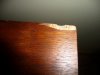
To borrow from Robert Frost's "Mending Wall" poem: "Something there is that does not love the left rear corners of my W60D speakers".

On both speakers at the left rear top corner a piece of veneer has been torn away:

P1040376.jpg
 
Last edited:
Back
Top Bottom