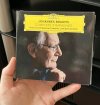
I have the Third (actually all four of them) with Karajan and Berliner Philarmoniker, Günter Wand and the NDR (the Hamburg radio orchestra), and John Eliot Gardiner and the Royal Concertgebouw (very fresh edition, released only two months ago).
Karajan is really nice, extremely competent, perfectly balanced. A solid, profously Germanic performance, and the perfect yardstick to compare the others against. His only flaw is that he doesn't repeat the exposition in the first movement. He never did. I don't think I've ever heard Karajan repeat an exposition.
Günter Wand is very similar. Same sound, same kind of approach, same serious, Germanic flavour. Which is no wonder, considering that both conductors and both orchestras are deeply rooted in the German school of the past century. The differences are very subtle. Wand seems a tiny bit more dynamic. I don't mean dynamic as in faster, but in the sense that differences between extremes are just a bit more pronounced in his performance than in Karajan's. Fast passages are a bit faster than Karajan's. Lyrical passages are a bit more lyrical than Karajan's. But not by much. Just a tiny bit, barely noticeable. Karajan is more balanced, while Wand feels a bit more "alive".
Overall, especially in the final movement, Wand's seems a bit crisper, while Karajan a bit more flexible. But that's not necessarily good or bad either way. Both versions sound great.
Also, Wand repeats the exposition in the first movement. This earns him extra points.
Gardiner is different, but in a very interesting, intriguing way. I have described this set on a different forum when I got it, so I'm going to paste the description that I posted there at the time:
"Overall, there's a general sensation of crispness, of sharpness. If I had to describe these recordings in a single word, that would be "crisp". Or "sharp". The orchestra feels like a well-oiled machine, having all its screws tightened exactly to the correct torque. There's no stray sound, nothing that might betray any trace of weakness in this high precision mechanism. All the instruments are so perfectly synchronized that they feel as if there were only one of each.
The tempo is a bit to the brisk side, but in a very interesting way. In several places, when it was a bit more alert than I was used to, and I knew that a slower section was about to come very soon, I was afraid that he might be too fast by the time he gets there and might ruin it. But no, he was able to slow down just in time, and even smoothly at that, causing me to breathe a sigh of relief.
It feels as if I were a passenger in a car driven by somebody else, approaching a traffic light at a speed that I deemed a bit too high. So I would become tense, I would brace either for impact or for a sharp brake at the last moment, but somehow the driver would manage to slow down perfectly smoothly, and to do it just in time to stop exactly at the right spot, thus relieving me of a tension that now proves to have been unnecessary. It's like he's telling me, "trust me, I know what I'm doing", but I'm not feeling entirely confident; I would like to trust him, but I still feel tense, but in the end it turns out he was right, and I feel relieved.
I'm not sure if my description makes sense, but that's the best analogy I can come up with. It's a very interesting sensation, one that I've never got with those well-behaved Germanic interpretations."
I love all three, each in its own way. All of them are great. If I had to choose just one, I think I would choose Gardiner. Karajan and Wand are both great (and very similar), but Gardiner's performance feels fresh and intriguing. It brings Brahms into the 21st century while still preserving his romantic charm. If I had to name a favourite, he would be it. But I'm happy I don't have to choose, because I like to listen to all three, and each time I do, I love that particular one.