You are using an out of date browser. It may not display this or other websites correctly.
You should upgrade or use an alternative browser.
You should upgrade or use an alternative browser.
What CD Are You Hearing Now?
- Thread starter Vlad Soare
- Start date

Thanks, I'll check them out.I've recently listened to two that I really like, one from the Sawallisch / Vienna Symphony set, and Herbert Blomstedt with the Leipzig Gewandhaus orchestra. The former does not include the exposition repeat in the first movement; Blomstedt does.
While I do like all three recordings that I happen to have (Karajan, Wand, Gardiner), each in its own way, somehow in the Second Symphony I can't shake off the feeling that something isn't quite right. I can't put my finger on it. It's just a vague feeling that something, somehow, could be a bit better.
I love Karajan's sound and style, it's so smooth and perfectly balanced, the tempo is perfect, everything is so well thought-out... But I'm beginning to think that this perfect balance might be a double-edged sword. It makes it a bit difficult to distinguish the various layers from each other. In Gardiner's version you can distinguish them more easily, but there's one little glitch I'm not yet sure what I feel about. In the second theme of the first movement, the 'lullaby' theme, his accents are a little bit too strong, which causes the melody to feel somewhat less smooth than I'm used to (though it does make the melody noticeably clearer, so it may not necessarily be a bad thing). Wand is somewhere in between - smoother than Gardiner, almost the exact same sound as Karajan, but a bit clearer than Karajan. But then, strangely, in Wand's version the 'lullaby' theme is a bit too weak - his only glitch, actually; everything else is fine.
Personally, I think the First and Second benefit from not having the exposition in the first movement repeated, because it's long, and quite a lot of development happens in it already, while the 'official' development is very short by comparison. I used to be a bigot when it came to exposition repeats. I used to think that skipping them should be punishable by prison, until I heard the Brahms First with it repeated and didn't like it. And then I understood that things aren't always as clear-cut as they might seem at first glance.

Yeah, now that you mention it, it certainly seems that way. I believe Neville Marriner was still active in his nineties, too.Incidentally, Blomstedt is now 97 and is still conducting, though he has canceled some recent engagements. I'm a huge fan. Also, Christoph von Dohnanyi, whose Third I recommended and whose Second I have previously enjoyed, is 94 and also still working. The old rule of thumb is, composers die young, conductors live long.
I think I chose the wrong career.



Crazy Legs is a studio album by Jeff Beck and the Big Town Playboys, released on 29 June 1993. The recording is an album of Gene Vincent songs. The album is considered to be a tribute to Gene Vincent and His Blue Caps, and in particular to Vincent's early guitarist Cliff Gallup, who Beck recognized as his biggest influence.
If someone is at fault, it may be the composer, not the performers. The Second is the last of the four that I came to appreciate, and although I love it dearly, I still think that the first movement doesn't exhibit the tight narrative trajectory of the others. If the repeat is observed the movement runs over 20 minutes, the longest in all the Brahms symphonies. While I prefer the repeat I don't object to its omission and many excellent performances exclude it.Thanks, I'll check them out.
While I do like all three recordings that I happen to have (Karajan, Wand, Gardiner), each in its own way, somehow in the Second Symphony I can't shake off the feeling that something isn't quite right. I can't put my finger on it. It's just a vague feeling that something, somehow, could be a bit better.
I love Karajan's sound and style, it's so smooth and perfectly balanced, the tempo is perfect, everything is so well thought-out... But I'm beginning to think that this perfect balance might be a double-edged sword. It makes it a bit difficult to distinguish the various layers from each other. In Gardiner's version you can distinguish them more easily, but there's one little glitch I'm not yet sure what I feel about. In the second theme of the first movement, the 'lullaby' theme, his accents are a little bit too strong, which causes the melody to feel somewhat less smooth than I'm used to (though it does make the melody noticeably clearer, so it may not necessarily be a bad thing). Wand is somewhere in between - smoother than Gardiner, almost the exact same sound as Karajan, but a bit clearer than Karajan. But then, strangely, in Wand's version the 'lullaby' theme is a bit too weak - his only glitch, actually; everything else is fine.
Personally, I think the First and Second benefit from not having the exposition in the first movement repeated, because it's long, and quite a lot of development happens in it already, while the 'official' development is very short by comparison. I used to be a bigot when it came to exposition repeats. I used to think that skipping them should be punishable by prison, until I heard the Brahms First with it repeated and didn't like it. And then I understood that things aren't always as clear-cut as they might seem at first glance.
Yeah, now that you mention it, it certainly seems that way. I believe Neville Marriner was still active in his nineties, too.
I think I chose the wrong career.
I'm not a big admirer of Karajan's performances. He seemed to think that his genius outshone that of the composer, and especially in his later years, he cultivated a kind of sensual beauty that doesn't always match the character of the music. With the Berlin Philharmonic, he shaped a blended sonority that tended to obscure individual voices, not helpful for music that evokes a conversation among instruments. His emphasis on a beautiful sound seemingly caused him to neglect precision of ensemble, some of his recordings being remarkably sloppy. Please take these general comments with a large grain of salt because I have not listened to any of his Brahms symphonies recently, largely because when I do, they tend to be well behind my favorites.
While I've not yet listened to Gardiner's Second, I did spin up his Third and thought it excellent, although as a live recording it does contain a few moments of not-quite-perfect execution. It's interesting to hear the Royal Concertgebouw Orchestra play in a period style, with a smaller ensemble, brighter sonority, and sharp accents.. And in a subject probably better explored in a different discussion, Gardiner follows the common 18th and 19th Century practice of placing the first and second violin sections at opposite sides of the stage, helpful when composers play the sections off against each other.
One set I've really enjoyed is Kurt Sanderling's with Staatskapelle Dresden from the early 1970s. In the Second, even in energetic sections the sound is amazingly transparent, revealing details that are difficult to hear in many other recordings. Listen to how beautifully the violin sections harmonize even in the rapid passagework of the finale. It projects a rare sense of warmth, humanity, and unanimity, as well as a rapport between orchestra and conductor that really illuminates the music. (Sanderling was another conductor who worked well into his 90s.)
A set with a quite different approach that I like features Paavo Berglund and the Chamber Orchestra of Europe. The smaller orchestra plays with leaner sonorities, and while some may miss the thick carpet of rich string tone in more traditional performances, these are bright, transparent, and unmannered. For live performances they are remarkably polished. The orchestra is seated in the common 19th Century arrangement, violin sections divided antiphonally and low strings on the left.
While each of those sets take a quite different approach, both really make this music come alive, and isn't that what we're really hoping to hear?
Yeah, exactly! That's what I was trying to say. That's my feeling, too. With Karajan you hear the forest, but not the trees, so to speak. He concentrates so hard on producing a beautiful, balanced forest sound, that he sacrifices the trees in the process. To be fair, the sonority he produces, albeit blended, is indeed beautiful, so I wouldn't necessarily hold this against him. This can work really well sometimes, even though the Brahms Second may not be such a case. Or maybe Brahms in general may not be such a case, because he has so many layers, so many individual voices that need to be heard. I wonder if this blended, 'forest' sound would be better suited to someone like, say, Bruckner, who pursues a kind of unified harmony rather than a multi-voice dialogue. I haven't yet heard Karajan conduct Bruckner (since I'm very new to Bruckner, having avoided him for many years), so I don't know if my assumption is correct. I'm just thinking out aloud.With the Berlin Philharmonic, he shaped a blended sonority that tended to obscure individual voices, not helpful for music that evokes a conversation among instruments.
I did notice this from time to time. Sometimes I have the feeling that he sacrifices some of the smaller details in order to force the music to fit a particular phrasing that he has in mind. I don't know if he used to do this on a regular basis, or just occasionally, because I'm not experienced enough to be able to tell every time. I only notice it when it's really obvious and I happen to know the piece well.His emphasis on a beautiful sound seemingly caused him to neglect precision of ensemble, some of his recordings being remarkably sloppy.
Sounds great. I can't wait to give those a try. Thanks!One set I've really enjoyed is Kurt Sanderling's with Staatskapelle Dresden from the early 1970s. In the Second, even in energetic sections the sound is amazingly transparent, revealing details that are difficult to hear in many other recordings. Listen to how beautifully the violin sections harmonize even in the rapid passagework of the finale. It projects a rare sense of warmth, humanity, and unanimity, as well as a rapport between orchestra and conductor that really illuminates the music. (Sanderling was another conductor who worked well into his 90s.)
A set with a quite different approach that I like features Paavo Berglund and the Chamber Orchestra of Europe. The smaller orchestra plays with leaner sonorities, and while some may miss the thick carpet of rich string tone in more traditional performances, these are bright, transparent, and unmannered. For live performances they are remarkably polished. The orchestra is seated in the common 19th Century arrangement, violin sections divided antiphonally and low strings on the left.



The BPO sound is more appropriate for Bruckner than for some other composers, but the only Karajan Bruckner I've heard in recent history are the Seventh and Eighth with the Vienna Philharmonic. The VPO sounds fabulous and its brassier sonority also works well for Bruckner but I was underwhelmed by the conductor. Wand, Giuseppe Sinopoli, Eugen Jochum, and Stanislav Skrowaczewski were idiomatic Bruckner conductors, just to name a few. Wand's EMI Bruckner was often captured in low-impact sound, but the BPO live recordings made late in his life are excellent.I wonder if this blended, 'forest' sound would be better suited to someone like, say, Bruckner, who pursues a kind of unified harmony rather than a multi-voice dialogue. I haven't yet heard Karajan conduct Bruckner (since I'm very new to Bruckner, having avoided him for many years), so I don't know if my assumption is correct. I'm just thinking out aloud.
I have to confess to an obsession with the Scherzo in the Bruckner Fourth, sometimes called the "hunting" Scherzo because of the wonderful horn parts. In a surprising number of recordings the horns are mushy but I've found a few that are satisfactory: Herbert Blomstedt / San Francisco, Karl Böhm / VPO, and Bruno Walter / Columbia Symphony, though the dated sound in that last one is a bit thin. I don't understand why getting it right is such a problem.
As you explore Bruckner you'll run across the version problem: his symphonies were often revised several times, sometimes with changes he didn't like, often by his students. The Fourth is usually played in a version from 1878 with the finale from 1880. In the original version the Scherzo is completely different (no hunting horns!), the outer movements treating the same material as 1878/80 but differently. I can understand why the 1878/80 version is "mainstream," but at the same time, the finale especially seems more organic, while I've always felt that the ending to the 1880 finale seems hokey and tacked on. The original version builds to a powerful climax over an extended period of time.
The Sixth is a relatively compact work that really seems well focused and is untroubled by competing versions. The Fifth is possibly the most complex, with a magnificent double fugue in the finale. If you hear a good performance live it will blow the roof off the concert hall, but it might not be the best choice if you're early in the Bruckner journey. The Fifth is also free of confusing versions, the main alternative, revised by Franz Schalk, having been discredited. It made cuts and added percussion, kind of a violation of Bruckner's aesthetic.
The Seventh is a terrific work throughout, with a wonderful Scherzo and a gorgeous slow movement that uses Wagner tubas. The Eighth is also a satisfying work, with a particularly beautiful slow movement. A "consensus" version is usually performed but again an original version exists that is a bit different.
I find the key to Bruckner is patience, just letting the music unfold at its leisurely pace.




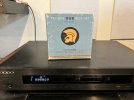

Nice! And extra points for the Oppo. I'm a big fan of the Trojan box sets. I think I'll dig out some reggae tonight.


twiiii
Lunatic Member
Well I woke at 4 AM with my tinnitus on vacation so I spent the day listening to Oscar Peterson and Basie LP and CD recordings with string bass and drums for 8 hours finishing up with listening to Brahms 4 Symphonies down loaded from iTunes. So a mix bag of everything.
Piano is my favorite instrument be it for jazz or classical music.
The Brahms was Bruno Walter conducting the Columbia Symphony.
Piano is my favorite instrument be it for jazz or classical music.
The Brahms was Bruno Walter conducting the Columbia Symphony.
Well I woke at 4 AM with my tinnitus on vacation so I spent the day listening to Oscar Peterson and Basie LP and CD recordings with string bass and drums for 8 hours finishing up with listening to Brahms 4 Symphonies down loaded from iTunes. So a mix bag of everything.
Piano is my favorite instrument be it for jazz or classical music.
The Brahms was Bruno Walter conducting the Columbia Symphony.
Maybe your tinnitus can invite mine to join it the next time it's off on holiday. Nice picks for music! I struggle with Brahms - though I'm very far from being a classical music specialist, so I'm sure I'm just missing the point.
Me tonight: