• The move to the new server is done. There are some software and database maintenance updates in process. This has us passing the hat around to help out. We appreciate any donations. Seriously, even a dollar helps. The payment page may be found here - https://www.audiokarma.org/support.html

What Year Did Solid-State Start Sounding Good?

I have an Acoustech 1A power amp 40W a channel, all silicon devices
from about 1963 which uses Solitron stud mounted outputs , It was given
a high rating in Stereophile magazine back in the day.

Brushed gold aluminum face , $395.00 in the 1963 Allied radio catalog.
I bought for $70.00 in 1968.

My friends commented it sounds like a tube amp. It sounds good today.
it could use a re-cap


acoustech-vi-preamp-control-center-ia_1_c963e4eeaaef6c231ada7262b960f2fa.jpg
 
One of the biggest misleading misunderstandings in the audioworld. While musical taste is a subjective matter sound quality is not.

This. Any properly working modern amplifier should have NO sound of its own - an amp whose sound quality can be described in any terms other than "clean and transparent" is either defective or being used to drive a load it's not suited for. Unless you're trying to push a low impedance load which runs the amp outside its SOA, or using a transformer-coupled output which is more sensitive to impedance variations, there's no excuse for an amplifier having a characteristic "sound".
 
You make me nostalgic, 604man. I found a Hadley preamp, 1968. Inside, all transistors had gold-plated pins inserted into tiny ceramic sockets; Volume was a stepped resistor array; all wiring point-to-point. Beautiful and sophisticated design. My son called it tube-like, "very warm". It was, but kind of foggy, little detail, flat dynamics. I put on ebay with a very high (I thought) reserve; I'd be happy if it didn't sell. But it did, far beyond the "high reserve".
 
This. Any properly working modern amplifier should have NO sound of its own - an amp whose sound quality can be described in any terms other than "clean and transparent" is either defective or being used to drive a load it's not suited for. Unless you're trying to push a low impedance load which runs the amp outside its SOA, or using a transformer-coupled output which is more sensitive to impedance variations, there's no excuse for an amplifier having a characteristic "sound".
I agree with ya on this point but I also feel that SQ is subjective,it's a matter of personal taste. While clean and transparent might be the sound someone describes another person might think it's too bright or harsh.Anyway it's the speakers that "sound" not the amp.
 
I agree with ya on this point but I also feel that SQ is subjective,it's a matter of personal taste. While clean and transparent might be the sound someone describes another person might think it's too bright or harsh.Anyway it's the speakers that "sound" not the amp.

Well I guess SQ could be called subjective. I believe a trained ear can hear what I miss. I have heard a few wonderful sounding systems. Some that seem to be greater than the components might have lead me to believe they could sound. Room? Maybe just a good day?
I am quite happy with my Kenwoods. 700C /700M and L-07CII/L-07M/ L-09Ms, at least for now.
 
The year my father bought a new Yamaha CR-620 with a set of NS-690's and a YP-701 turntable.
 
Great question. I'll ask the corollary question. When did tubes start sounding good? The OP's opening line is in question to begin with.
Tubes started sounding good with the introduction of the electrodynamic Rice-Kellog loudspeaker ca 1924/25 with the RCA Radiola 104. It's general adoption ca 1928-1930 was a step forward in the perfection of home AM radio and SQ generally, better audio transformers and diode detectors in the radios improved SQ potential further.
 
So tubes started sounding good in 1924 and solid state didn't until the mid 70's? Huh go figure. Personally have never met a tube amp that sounded as good as solid state. Technology marches on.
 
So tubes started sounding good in 1924 and solid state didn't until the mid 70's? Huh go figure. Personally have never met a tube amp that sounded as good as solid state. Technology marches on.
Tube tech was "ready for prime time" ca 1914 in telephone service, and the principles of linear triode operation well understood. Regular audio tech waited for a reasonably linear loudspeaker.
Solid state established first for hearing aids in the early 1950s with the best then available, later in the decade mainly with portable radios. Higher power capability came in the 1960s, with decent results as better silicon devices became available, good sound with germanium transistors was hit or miss prior. Some manufacturers like McIntosh held off solid state until silicon transistors, their and Fisher's first transistor products for instance sounded good.
 
Resisting the temptation to observe, snarkily, "I'm still waiting"... ;)

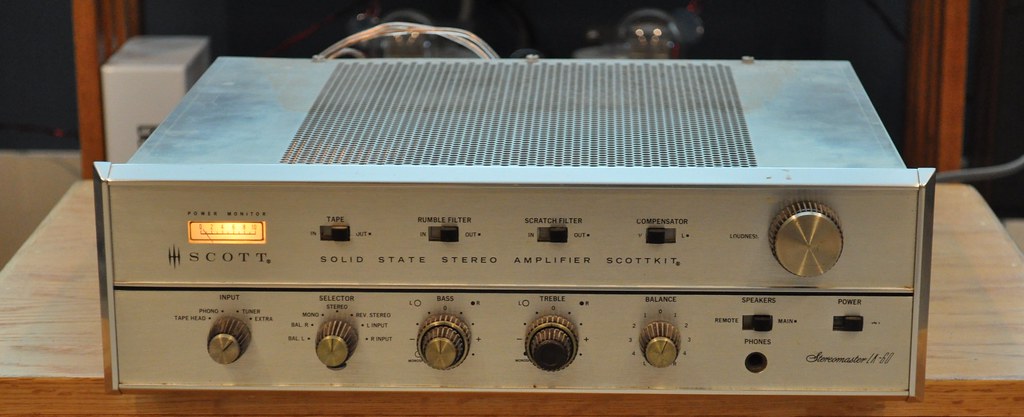
Some of the mid-late 1960s quasi-complementary soiled state amplifiers actually sound pretty good. E.g., I have an HH Scott LK-60 (kit version of the Scott 260 ss integrated amp) that is not bad sounding. It lacks the graininess and harshness common to early ss amplifiers. Big ol' DC blocking coupling caps to the speaker outputs probably round off the rough edges considerably :)

HH Scott LK60 DSC_0789 by Mark Hardy, on Flickr

Scan0008 by Mark Hardy, on Flickr
017.jpg

source: www.radioshackcatalogs.com (1966)


036.jpg

source: www.radioshackcatalogs.com (1967)
I think I have one I rescued from the scrap pile at the local SA, posted earlier.
 
Last edited:
Back
Top Bottom