What Is Reapping [speakers]? — answer
Trance88 wrote:
What is recapping???? Is the cap that center "button" thing in the middle of the speaker?
Some people might assume that you are trolling, but I read your post over and elected to answer you as best as I can:
Recapping refers to the removal and replacement of capacitors in an electric circuit, such as audio employs in virtually all of its commensurate components. And the term ‘recapping’ usually refers to changing-out of the electrolytic type capacitors. The other breed, which is commonly referred to as the ‘film capacitor’ type, may be subject as well. But it is the electrolytic type that receives most of the attention for very good reason
Electrolytic types are especially subject to degradation as a consequence three factors: time, temperature and engineering/production parameters. Due to physical constraints, the latter is nearly fixed. But the other two factors can be variable to a great degree. This allows for the fact that unit 'A' of the same model may see an operational life that is much longer than 'B'. Unit ‘B’ may have been operating in an environment that was simply more stressful on all the components, and electrolytic caps are often at the greatest risk in terms of longevity.
All electrolytic types have a more limited capacity for optimumal performance than do other constructions. But, they have very definite advantages, such as price and relative compactness of size.
In speakers, the much preferred type of electrolytic cap has been the non-polar type — alternately called a bi-polar capacitor. Cheaper speakers, or speakers of a certain vintage contain such capacitors. Such capacitors operate in an AC environment. This is a hazardous condition for electroytic capacitors. The electroytic paste which makes up the electrolyte in the cap is made effective by a polarized DC current. Without this environment, the optimal performance of capacitors in crossover circuits of speakers have a forshortened life expectancy. They may exhibit some effectiveness way past their useful, optimal life. And so old speakers may belt out the sound; nevertheless many users report huge benefits after substituting new caps for old. Replacing fairly decent film caps with new ones may not reveal anything like the same magnitude of change.
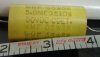
Many modern, quality speakers, as well as more and more pedestrian production are supplied with film type capacitors of one type or another. By definition, film type capacitors are non-polar. The health and integrity of this kind of capacitor does not require a polarized current. You can pass a sign wave through it for a very long period and it will be happy. Various advantages are available to crossover circuits that use this kind of cap. These are better explained by the more learned members who have mastered the trades. But I will say here that generaly speaking, film caps are the better substitutes for electrolytic capacitors should you find any in your work.
All that been said, it is fair to caution you that it is not unusual to find that there is not enough room on older crossover boards to mount film capacitors. They are invariabley larger than their electrolytic counterparts of the same value. Thus it is sometimes necessary to make modifications to the cross-over module in order to change cap types.
Should you attempt such a substitution, it is very important to learn and practise soldering techniques as well as the basics of consrtruction. Virtually anyone can learn how to do this if interest and effort is applied.
WARNING: Experience, effort and success in this area can lead to a serious addiction requiring professional counselling and extended rehabilitation!



:tresbon: :thmbsp: