• The move to the new server is done. There are some software and database maintenance updates in process. This has us passing the hat around to help out. We appreciate any donations. Seriously, even a dollar helps. The payment page may be found here - https://www.audiokarma.org/support.html

Why so much Wattage ?

Yes I'm aware of that. And whatever the SPL is at 13', I still do not average 1 watt per channel with most music. Sometimes I'll have to set the meter sensitivity at the -10dB setting (whereby full meter deflection is 5 watts) just to get a reading.

62caddy you listen at levels much lower than some of us. It's all good. I see 300 watts register a time or two per week at the moment on my amp and this is with 92 dB speakers. If my tri amp system was up and running, the power to my low freq cabinets exceeds 1200 watts at times. Different strokes, different folks!
 
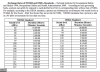
Indeed!. What SPL can the average listener tolerate for an indefinite duration? I submit it is no higher than 70- 80 dB but that is just a guess.
Mine is much closer to 85-95 like GChief posted above. It really depends on the music, I think. Some stuff just sounds lame at low levels, and some has bass that one needs to almost feel, while other types would give me a headache at higher levels but is fine lower.
 
upload_2019-10-22_14-49-47.png

This is continuous, so would be like the average imo for music, as it's not continous, unless it's terrible. So if you are going loud, don't go long!
 
I've been to many live classical concerts and depending on where you're sitting, the music is nowhere near as loud as the levels I typically enjoy when listening at home- even when sitting right up close to the orchestra.

In my experience (or at least the way I listen) the wider the dynamic range of the music (ie classical, jazz), the lower the "average" listening level. The more limited the dynamic range (ie amplified music), the average listening level is usually much higher.

So it naturally depends on the type of music - and of course the listener's tolerances and preferences.

.
 
Last edited:
Yep, forgot about that. It doesn't allow the clipping by reducing the power output so it can't. You lose the dynamic range of the music either way, sounds better without clipping though.

Most of us who have sold or owned PG equipped McIntosh amps for the last 40 + years have come to understand that seeing the red lights flash occasionally is OK, the more you see them flash, the more you ask the amp to exceed 1% distortion the more you guessed it, you need a bigger amp.
 
Mine are 85-95 at my listening position. Some songs get 100ish. All measured on a calibrated meter I use at work.
What is the sensitivity of the speakers you use with the 6wpc amp at 95-100db listening levels and how far are you from the speakers? Just curious.
 
Most of us who have sold or owned PG equipped McIntosh amps for the last 40 + years have come to understand that seeing the red lights flash occasionally is OK, the more you see them flash, the more you ask the amp to exceed 1% distortion the more you guessed it, you need a bigger amp.
How often do you suppose the power lights would flicker on the 2 to 6 watt amps discussed here if they had the power guard feature?
 
I had a Music Angel mini whatever on my bench today.......12 watts per channel with over 1% distortion so a PG circuit would be triggered a lot.
 
What is the sensitivity of the speakers you use with the 6wpc amp at 95-100db listening levels and how far are you from the speakers? Just curious.

93dB. I am right around 6.5’ away. I also ran this amp in a 18’ x 16’ room with the system on the long wall, the sweet spot was about 10’ away and with KG4’s the amp would do low 90’s (measured) comfortably.
 
93dB. I am right around 6.5’ away. I also ran this amp in a 18’ x 16’ room with the system on the long wall, the sweet spot was about 10’ away and with KG4’s the amp would do low 90’s (measured) comfortably.
Well, seeing the numbers you quote with the 18 x 16 room, the math says you have absolutely zero amplifier headroom available (actually negative headroom) with your amp and speakers at an spl of 92db at your 10-foot listening position. The picture is even worse if by "low 90s" measured listening levels you meant anything above 92db.
Could your amp's rating be very conservative and putting out more than spec? Is your source material very compressed or otherwise lacking dynamically? Could your ears be adapted to clipping distortion?
Just looking for some explanation for why what you are reporting doesn't jibe with the math - Distance 3m @ 92dbspl @ 93 1W/1M @ 0 amp headroom = 7wpc. Plug 3db of headroom into the calc and you need 14wpc. Make it 6db of headroom for more demanding music and you need 28wpc.
Ran the numbers on a couple of different calculators and came up with the same thing.
 
Last edited:
Run it with 2 meters (I think he said 6.5 feet), 93dB sensitivity, 91dB average/continuous SPL, and no headroom. I get 3 watts.

So, 6 watts with 3dB of headroom, and 12 watts with 6. Maybe get anther 2-3dB from room reinforcement. Dynamic material would still be clipping, but probably not to the point of serious degradation. If I remember correctly, the amp is rated at 6-8 watts (assumedly using the RMS method). A good amp could make near twice that at peak power...so I think the math works to illustrate what GChief's ears tell him...the amp can satisfy his needs.

My tendency is to have amps that provide a bit more headroom than that. When matching an amp to speakers, I shoot for something capable of an SPL in the low 90s at 8-10 feet, with enough in reserve to handle 9-12dB peaks. I am conservative in my approach, so I assume the amp's rated output is its max output, and that there is no effect from room reinforcement. Both of these assumptions provide a "buffer" for wider dynamics and non-critical listening (like turning it up a bit when you are cooking dinner in the kitchen). That's my approach for "quick and dirty" calculation of amp power requirements.

Good arguments can be made for other assumptions/approaches as well. This works for me.

And of course this is only a starting point...after that, the real test is whether or not I like how the amp I am using sounds with the speakers I am using. BTW, I have no qualms about using an amp that is a bit below my "calculated power requirement", or adjusting my calculation for a small space or near field listening.

That said, ideally the amp I choose to use will be rated higher than required...not because I believe it will sound better than one rated to just meet the requirement, but because it provides more flexibility with SPL and with different speakers. I only have so many amps, and don't want to buy a new one every time I set up a new system or change speakers!

Ok, I lied. I do want to buy yet another amp...but I'm trying to have better self control.
 
Mine is much closer to 85-95 like GChief posted above. It really depends on the music, I think. Some stuff just sounds lame at low levels, and some has bass that one needs to almost feel, while other types would give me a headache at higher levels but is fine lower.

85 dbs is the OSHA standard where hearing protection is required.
 
Is your source material very compressed or otherwise lacking dynamically? Could your ears be adapted to clipping distortion?

No, and since I continually swap between 3 amps, the other 2 being 140wpc and 35wpc the second half would be no. I have a pretty good grasp of the technical side and the physics of sound having operated and maintained sound transmitting, receiving, processing, recording and reproduction gear (as a career) for most of my adult life.

Since like all the rest running low power amps I apparently don’t know what I am doing or hearing ;). I will refer to my post #200 and just read along for the entertainment value. :rockon::rockon:

:beerchug:
 
Last edited:
So, 6 watts with 3dB of headroom, and 12 watts with 6. Maybe get anther 2-3dB from room reinforcement. Dynamic material would still be clipping, but probably not to the point of serious degradation. If I remember correctly, the amp is rated at 6-8 watts (assumedly using the RMS method). A good amp could make near twice that at peak power...so I think the math works to illustrate what GChief's ears tell him...the amp can satisfy his needs.
+3dB from placement if the speakers are 2-4 feet from a wall and +3dB reinforcement from two speakers. I get 100.8dB at 6.5’ with 6W.
 
Back
Top Bottom
