
I wonder if the OP got his answer...
I believe that he did...within the first 4-5 responses.


I wonder if the OP got his answer...
Read the decware page and got interested in the flea-watt theory and found a review by Steve Guttenberg of the little 2 watt Decware Zen tube amp compared to a 200 watt Bel Canto ss amp.

Read the decware page and got interested in the flea-watt theory and found a review by Steve Guttenberg of the little 2 watt Decware Zen tube amp compared to a 200 watt Bel Canto ss amp.
He reports something I was trying to convey when describing the difference I heard when I quadrupled my amp power. He said:
"The REF500S sounded more powerful than the Zen, even when listening at fairly moderate volume, and dynamics and bass had more energy. Treble detailing was superior and it was nice to have the freedom to crank the volume. The Zen squashed dynamics, even at quiet volume, compared with the REF500S."
He used very efficient Zu Essence speakers for the test.
When I put a 120wpc MC2120 in my system, I got the dynamics, bass and energy I was missing with the 30wpc amp at the same, very moderate, listening levels, so Guttenberg's experience was something I could identify with.
But according to some here, what Guttenberg (and I) reported isn't possible, as a watt is a watt is a watt and an amp can't sound more powerful, produce stronger bass, dynamics and energy unless that extra power is being tapped by the speakers.
Like him or not, he's got ears and has used them to do a lot of listening. He did praise the little amp for its warm sound and better soundstage than the big amp, though by warm he explained as tube coloring, which some find appealing over the detail and accuracy of ss.
Not referring to you. My reply and the quote I was replying to was at the head of my post - it was a reply to user Poultrygeist who recommended reading the Decware link.If you are referring to me, you are mis-characterizing my comments/questions. A watt is indeed a watt, but how they sound can vary significantly.
Let's assume 2 amps with precisely the same characteristics from the standpoint of distortion curves, damping, slew rate, etc etc ( a theoretical construct, to be sure), other than one can deliver 25 watts before clipping and the other can deliver 250. And let's assume that 25 watts is sufficient to deliver desired SPL without clipping. Why would the 250 watt amp sound better?
And that's what I have always said, even repeatedly in this thread.Read the decware page and got interested in the flea-watt theory and found a review by Steve Guttenberg of the little 2 watt Decware Zen tube amp compared to a 200 watt Bel Canto ss amp.
He reports something I was trying to convey when describing the difference I heard when I quadrupled my amp power. He said:
"The REF500S sounded more powerful than the Zen, even when listening at fairly moderate volume, and dynamics and bass had more energy. Treble detailing was superior and it was nice to have the freedom to crank the volume. The Zen squashed dynamics, even at quiet volume, compared with the REF500S."
He used very efficient Zu Essence speakers for the test.
When I put a 120wpc MC2120 in my system, I got the dynamics, bass and energy I was missing with the 30wpc amp at the same, very moderate, listening levels, so Guttenberg's experience was something I could identify with.
But according to some here, what Guttenberg (and I) reported isn't possible, as a watt is a watt is a watt and an amp can't sound more powerful, produce stronger bass, dynamics and energy unless that extra power is being tapped by the speakers.
Like him or not, he's got ears and has used them to do a lot of listening. He did praise the little amp for its warm sound and better soundstage than the big amp, though by warm he explained as tube coloring, which some find appealing over the detail and accuracy of ss.

Read the decware page and got interested in the flea-watt theory and found a review by Steve Guttenberg of the little 2 watt Decware Zen tube amp compared to a 200 watt Bel Canto ss amp.
He reports something I was trying to convey when describing the difference I heard when I quadrupled my amp power. He said:
"The REF500S sounded more powerful than the Zen, even when listening at fairly moderate volume, and dynamics and bass had more energy. Treble detailing was superior and it was nice to have the freedom to crank the volume. The Zen squashed dynamics, even at quiet volume, compared with the REF500S."
He used very efficient Zu Essence speakers for the test.
When I put a 120wpc MC2120 in my system, I got the dynamics, bass and energy I was missing with the 30wpc amp at the same, very moderate, listening levels, so Guttenberg's experience was something I could identify with.
But according to some here, what Guttenberg (and I) reported isn't possible, as a watt is a watt is a watt and an amp can't sound more powerful, produce stronger bass, dynamics and energy unless that extra power is being tapped by the speakers.
Like him or not, he's got ears and has used them to do a lot of listening. He did praise the little amp for its warm sound and better soundstage than the big amp, though by warm he explained as tube coloring, which some find appealing over the detail and accuracy of ss.


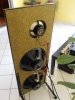

I once invested in a high power Classe CAP-150 driving inefficient Aerial Acoustic speakers. I'll admit the system sounded powerful with excellent dynamics but it failed in the one area that is most important to me with acoustic jazz. And that is the ability to resolve detail at low levels. The only way I've been able to achieve that is with a flea watt single ended triode amp driving highly efficient speakers. I do admit to using a more powerful ss amp for the separately amped bass woofers.
View attachment 1650831


I know. I could probably get by with less as the woofers are 98dbs.Cheater
I know. I could probably get by with less as the woofers are 98dbs.

I cannot speak for the OP, but I think the explanation is the underlying assumption is incorrect. I think many folks underestimate what is required and are hearing clipping effects.And let's assume that 25 watts is sufficient to deliver desired SPL without clipping. Why would the 250 watt amp sound "better"?

And let's assume that 25 watts is sufficient to deliver desired SPL without clipping. Why would the 250 watt amp sound "better"? What electrical/mechanical forces would account for this phenomenon?

Read the decware page and got interested in the flea-watt theory and found a review by Steve Guttenberg of the little 2 watt Decware Zen tube amp compared to a 200 watt Bel Canto ss amp.
He reports something I was trying to convey when describing the difference I heard when I quadrupled my amp power.
When I put a 120wpc MC2120 in my system, I got the dynamics, bass and energy I was missing with the 30wpc amp at the same, very moderate, listening levels, so Guttenberg's experience was something I could identify with.
Everybody keeps moving the goal post to a different set of conditions than those being set forth by the questioner.
The question was:
That means the amplifier is not being asked to deliver more power that it's capable of without clipping - not for 1 second, not 1/10th of second nor 1/100,000th of a second - at any time for a given piece of music.
The correct answer is extra power capacity will not contribute ONE IOTA to sound quality under these circumstances - all other things equal.

