• The move to the new server is done. There are some software and database maintenance updates in process. This has us passing the hat around to help out. We appreciate any donations. Seriously, even a dollar helps. The payment page may be found here - https://www.audiokarma.org/support.html

Wiring three pairs of speakers

Raphaz

AK Subscriber
Subscriber
I try to figure out if the following can be done, and what the best way is to do it:

Current setup:
- Large open loft space, high ceiling
- 150 W PC amp – selectable A, B, C and AB channels (I have the pre/main switched on)
- Chanel A: Pair of KEF Q500 @ 8 Ohms & KEF PSW2150 (bi-wired)

I'd like to add:
- Pair of smaller Polks @ 8 Ohms on Chanel B @ kitchen/living area
- Pair of Bose 301 III @ 8 Ohms on Chanel B as well @ upstairs mezzanine

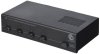
I have an old Bandridge Speaker Control Center ASB163 speaker switch (one amplifier in and 3 speaker channels).

There are speaker wires already installed for one channel (for one pair, meaning one left and one right speaker only). I had them tucked away inside the walls during renovations – they come out upstairs. I'd like to use these wires on channel B to power the Bose upstairs and continue from there to the kitchen to power the Polks, and maybe have the switch upstairs to be able to switch off/on one or the other pair on channel B (kitchen/upstairs).
If possible I'd like to use just the one source (installed wires) and have the four speakers on channel B (I guess that's called "in series"?) instead of running another bunch of wires from the amp's channel C all the way to the kitchen/living area.

In the end I want to be able to run the mains (on channel A), the upstairs or the kitchen (on channel B w/switch in between) each pair individually, or all three pairs together (with channel AB on).
I'm not intending to crank them all up loud at the same time – I'm aware that each pair has different wattage.

I also wonder how the switched on pre/main adds to the equation.

Is it doable?
What's the best way to wire this configuration as desired?

I hope I was able to explain it adequately and get some advice here!
Thanks in advance!!
 
Register to hide this ad
Add a receiver or integrated amp. Existing Tape/Rec(output) to 2nd integrated AUX (input). Connect speakers to the 2 amps. They will all play same music and have separate volume/tone controls.
 
If you use a wire to go from the first set of speakers + and - to the second set of speakers + and -, you will effectively be wiring them in parallel and that would be an impedance problem with the amp when playing A and B. Below 4Ω. Careful thought needs to be done to wire this correctly with switches at the locations you want to control the speakers.
 
Thanks, guys.

Second amp? Sure.
That’d mean a lot of wiring and added gear. I try to reduce wires and gear,..

Cautious thinking is exactly what I try here. I try to educate myself in order to do it right and “cautious”.
I’m not experienced, more detailed advice would be incredible helpful!

So far I left The A channel as is for the main.
Wired C channel speaker wires from receiver to switch (amp in), from there speaker line one wires go to speakers upstairs, channel two goes to kitchen. Safe as long as only one channel (from amp) and line (from switch) are on.

What exactly happens if I play all three pairs together (everything is matching 8 Ohms)?

Can I still have pre/main switch on amp on (necessary to bi-wire speakers and take advantage of sub amp)?

Thanks!
 
I can find no information on that switch box even on the banridge site. Do you know if it's impedance matching? That's the key to your query right there.
 
The Bandridge ones that I can find online are 8 Ohms (and some 4/8). I’ll check if the box has some info on it.
 
That’d mean a lot of wiring and added gear. I try to reduce wires and gear,..

Ha! I am always looking for reasons to add gear!

I have never found the whole concept of multiple rooms controlled by a single system very appealing. To me I guess it feels too much like a commercial setup, like a grocery store or something. I much prefer to have smaller systems in multiple locations. My idea, when we move into a bigger house some day, is to have multiple systems tied together with Chromecast Audio. You can tie them together and cast to one or many at the same time.

Sorry I didn't really answer the original question, except to offer the idea of multiple small systems. You could even power each set of speakers with a little T amp, thus not really adding any big gear taking up space.
 
Last edited:
Skipper:
There's no information on the thing itself, but most of the ones I can find online have 8 Ohms.
Let's assume it's 8 Ohms (that would be a match – if not I don't mind buying a new one), how do I go about it?

I like WillVT's idea but in my situation (it's a wide open loft space) I'd like to listen to the same thing simultaneously in different areas of the space without driving all neighbors crazy, and without tons of wires everywhere.
Right now I have the mains (plus sub) on channel A; and channel B goes into the switch, from where I run the upstairs on line 1 and the kitchen on line 2.
Also, would I have to give up the pre/main setting (which I have to take advantage of the sub's amp – but not sure yet if it really sounds much better / can be switched/bridged on or off) and the bi-wiring on channel A when I run A and B (with both pairs) channels all at the same time?

Thanks for advice!
 
When a speaker selector is described as "impedance matching" it means that when properly set up, you can have multiple speakers running simultaneously and still present a safe impedance (or load) to the amplifier. If they don't do that, multiple speakers can present an unsafe load to the amp.

Explain, please. What, exactly is this "150 W PC amp – selectable A, B, C and AB channels (I have the pre/main switched on)" amplifier you are describing?

Make and model please. It doesn't sound like anything I've ever heard of.
 
Last edited:
One question is what the 'AB channel' does. It sounds like this runs A and B outputs at once but you're saying you can also turn on A, B and C all at once so what would be the point of an 'AB channel' if that's what it does.

Some amps will not allow you to turn on all 3 outputs at once, since they are placed in parallel.

Even if you can, your problem is that 3 pairs of 8 ohm speakers running in parallel will present a nominal 8/3 ohms or 2.67 ohms load to the amp, and that's just nominal, the actual impedance curves of the speakers may dip below 8 ohms at some frequencies.

The impedance matching switch box would help you, but you can also hook up all 3 IF you don't play more than two at once. Assuming your amp can handle a 4 ohm load.

>>Also, would I have to give up the pre/main setting (which I have to take advantage of the sub's amp – but not sure yet if it really sounds much better / can be switched/bridged on or off) and the bi-wiring on channel A when I run A and B (with both pairs) channels all at the same time?

Not sure what the setup is here, I'm at a disadvantage not having set eyes on this amp before.
 
One question is what the 'AB channel' does. It sounds like this runs A and B outputs at once but you're saying you can also turn on A, B and C all at once so what would be the point of an 'AB channel' if that's what it does.
I checked the manual. It can run at most two pairs of speakers at the same time, and they must be eight ohms or greater. It can run A, B, A + B OR C alone.

I brought up the issue of an impedance matching speaker selector switch in posts 5 and 10 but both were summarily ignored. That would solve all his problems.
 
Last edited:
Of course it can't run A, B, and C all at the same time. My bad!

If I got that all right (just confirming, I'm not very experienced – sorry if I come across ignorant) I can only run two sets of speakers at a time. Is that correct?
Meaning there's no good way to run 1 set of speakers (plus sub) on A, and 2 sets of speakers on B (coming out of the speaker selector) at the same time (given everything is matching @ 8 Ohms)? Can you confirm?

Thanks for all the valuable education/comments!
 
Apparently the amplifier is designed to permit the powering of no more than 2 pair of speakers simultaneously - with the proviso that the speakers are a minimum of 8 ohms.

The proposed arrangement would result in impedance dropping to (a theoretical) 2.67 ohms - IF (that's a very big IF) ALL 3 pairs are operated simultaneously. So the answer is yes and no - provided no more than two pairs of speakers are switched on at a time yes. But some may argue operator error is very easy in this scenario.
 
Run the pair for highest fidelity I.E. sitting room, den etc off the A . Put the other 2 pairs in series and run to the B. There will be greater than 8 ohms and will not ruin your amp. Output will be less than max but you're not going to be blaring max volume in the kitchen are you ?

Series set up:

B(plus) -- ( +) spkr 1 spkr 1 (-) --( + )spkr 2 spkr 2 (-) --- B(minus)
|
If text comes out skewed, It is meant to show a series connection from B+ to B- for 4 speakers
 
Or, use one of the amp outputs to hook up an impedance matching switcher so the amp sees 8 ohms from that (even with two pairs hooked up to the switch). The third pair can go an another amp output.
 
Back
Top Bottom