• The move to the new server is done. There are some software and database maintenance updates in process. This has us passing the hat around to help out. We appreciate any donations. Seriously, even a dollar helps. The payment page may be found here - https://www.audiokarma.org/support.html

Wood Glue as Vinyl Cleaner

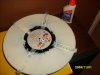
Here's my application method:
http://www.youtube.com/watch?v=Hq8jkEx7aiA

NOTES:
I run the TT for the application of the glue only, (33)
I cue off the TT and spin manually for teh spreading of the glue
I use a thin plastic membership card (thinner than credit card)
Bottle shown is my old Elmers Carpenters Glue bottle... great High Flow design
Glue used is Titebond II
I could have ended much sooner but i like to really work the glue in well.
Total Glue Time: Under 1:00
 
Last edited:
Here's my application method:
http://www.youtube.com/watch?v=Hq8jkEx7aiA

NOTES:
I run the TT for the application of the glue only, (33)
I cue off the TT and spin manually for teh spreading of the glue
I use a thin plastic membership card (thinner than credit card)
Bottle shown is my old Elmers Carpenters Glue bottle... great High Flow design
Glue used is Titebond II
I could have ended much sooner but i like to really work the glue in well.
Total Glue Time: Under 1:00

Very nice!
 
When the glue process lets you down

I processed 6 LPs that I was going through to clean them up. I used my usual PVA glue from the same pot that I had transported to the new house. Only this time I had my own space to let the LPs dry properly - or so I thought.

The basement workshop is rather humid - it's a new house - and cold at about 17-19 degrees Celcious on average, unless I turn up heating which I only do if I'm down there.

The LPs took 2 days do dry up for Side A and when I attempted to remove the film, I couldn't. The glue was brittle and broke into pieces instead of getting off in a single, stretchy piece of film. And what's more, the result was a total flop - not a hint of an improvement.

I am certain it's not the glue itself - the same glue has given me perfect results over and over in the past - in a warm appartment and during the summer.

To confirmt that, I repeated the process on one of the LPs, only this time in the sitting room above - where there's normal heating and a dryer environment. This time it set much quicker and the results were as expected - most of the clicks are gone.

I am pointing this out since I haven't seen any reference to environmental conditions before. It appears that the glue cleaning process won't be succesful in a humid, cold room.
 
SaSi, that's good info. It may well explain why I've had pretty good success with Elmer's Carpenter's Wood Glue, while others have had poor results with it. I guess we all have to find the particular glue that works best in our environment. I'm going to be getting some Titebond II later to give it a try again.
 
Alright, I am testing this method on a Chuck Mangione record. If it ruins the record, no biggie. I can go out to Half Price and buy a nother copy for a quarter.
 

Attachments

  • SD530424.jpg
    SD530424.jpg
    42.9 KB · Views: 112
I will not ruin the record. At worst, if the glue dries poorly (too brittle or not dry enough) you'll have difficulty removing it. The solution to that is to simply reapply the glue and when it sets properly all the old stuff will come off with it.
 
Alright, I am testing this method on a Chuck Mangione record. If it ruins the record, no biggie. I can go out to Half Price and buy a nother copy for a quarter.

Looking at your picture I'd make a couple of comments. First, you should try very hard not to leave little isolated islands of glue or areas where it is much thinner or thicker than the rest. These areas will be a pain in the azz to remove. Hint: Use a piece of scotch tape to pick up the little bits that might remain after you peel. The tape sticks amazingly well even to dry glue.
Second, I've never put the tape into the wet glue as you have, but I know others have done so. I don't find it necessary as I can always get a fingernail under the edge to start it peeling. You can always use tape even after it's dry. I'm curious how your method works out, please keep us informed!
 
When I used the Elmer's I let it dry and then used some masking or painter's tape. The Elmer's peeled up pretty well with that. But as an above poster said, temperature and humidity are big variables.
 
Looking at your picture I'd make a couple of comments. First, you should try very hard not to leave little isolated islands of glue or areas where it is much thinner or thicker than the rest. These areas will be a pain in the azz to remove. Hint: Use a piece of scotch tape to pick up the little bits that might remain after you peel. The tape sticks amazingly well even to dry glue.
Second, I've never put the tape into the wet glue as you have, but I know others have done so. I don't find it necessary as I can always get a fingernail under the edge to start it peeling. You can always use tape even after it's dry. I'm curious how your method works out, please keep us informed!

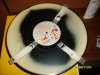
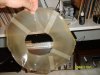
Four hours later and there's dry spots and wet spots around the outer edge. After watching the video on Youtube I decided to pull out another album and try applying the glue while spinning it on my crappy plastic Kenwood turntable. Here's some pics of what I have as of 3:18pm central time
 

Attachments

  • SD530425.jpg
    SD530425.jpg
    50.4 KB · Views: 85
  • SD530426.jpg
    SD530426.jpg
    25.1 KB · Views: 83
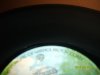
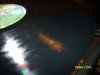
This just in! I went ahead and peeled off the glue from the record. Lucky me, the whole thing came off in one piece! I did notice a great amount of dust was gone...there were still specs here and there but were greatly reduced. The record sounds like I just cracked open the seal today. No more distorted highs! 30+ years of dust and debris out of the grooves!

P.S. I did try to play the glue copy. It's worse than trying to play a extremely warped record, but I can still hear elements of the original backwards.

P.P.S. Still wating for the first record to dry.
 

Attachments

  • SD530428.jpg
    SD530428.jpg
    31.4 KB · Views: 81
  • SD530429.jpg
    SD530429.jpg
    63.2 KB · Views: 103
i tried to play a 45 mask... surprisingly it was almost functional. (but i had set it down on a crooked surface for a while, before, so it wasnt as flat as it was when originally removed... i think ill try playing the next one immediately after removing!
 
I've been thinking about this, playing the mask. The groove, indention, should be the wall between two consecutive grooves, so you will get sound from one groove on one side and from the next revolution, the next groove, on the other side.

Tell us what it sounds like.
 
I finally got around to gluing up some lp's last night. This was my first attempt but I loved the idea right from the sight of the thread. I was the kid who used to put school glue on his hands and wait for it to dry just so I could peel it off. Anyway first attempt went without a hitch but unfortunately the records were just too badly scratched to tell if there was much of a difference. Makes me sad that my garage sale copies of Blonde on Blonde mono and Are You Experienced? aren't salvageable.

I just did 3 more sides that have very little scratch's but a decent amount of pops and clicks. I figure the intro to Stairway to Heaven should be a good test, hopefully the quite parts will be click and pop free.
 
I, like some other posters, have glued some LPs more than once. There are improvements to most LPs with up to three peels. Some have gone to four. I don't think there is a compulsive (I am one!) who has gone above 4 peels.
 
Last edited:
Well I guess I will have to do my Dark Side of the Moon again. I just finished peeling side 2. The music is much more dynamic but I am still getting crackling out of the guitar solo on "Any Colour You Like." I will have to redo Chuck Mangione because there's glue stuck on it still, but it does sound better. I am very impressed with the America's Greatest Hits LP I cleaned.
 
Sadly there is nothing that can help a scratched LP. And it seems some ticks are only reduced to 25% of the magnitude they were. But that makes music listenable to me with that reduction. The magic is the deep cleaning you get and many, many ticks are completely removed in my experience.

I converted a non-AK buddy 4 weeks ago. He bought a gallon after the first peel.
 
Last edited:
I've had two completely negative results from my experiments with a PVA wood glue.Yet,despite having that experience,I regard the method as entirely sound.I'm 100% certain that the glue I used was to blame(it's a disaster).

I can get Titebond II in Aussieland in smallish quantities(approx quart bottles).That's where I should begin to experiment.
 
Back
Top Bottom