

You are using an out of date browser. It may not display this or other websites correctly.
You should upgrade or use an alternative browser.
You should upgrade or use an alternative browser.
XP Series Speakers 1959-1973
- Thread starter TheRed1
- Start date


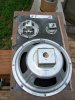
The speaker in my 51 Coronet is a JENSEN, as are the speakers in my 59 510, 560, and 61 CORONET II. The speakers in my '64 Custom Electra VII, '65 C.E. VIII, and '65 Futura all are FISHER manufactured. Stickers on them state "Manufactured by The FISHER Radio Corporation Speaker Division, Belleville, N.J.
Picture of the FUTURA SPEAKERS in 2010 during restoration.

Larry
Picture of the FUTURA SPEAKERS in 2010 during restoration.
Larry
Attachments

TheRed1
Console Conservationist
As long as they are not marked Made In X then you can conclude they were domestically produced. The Long Island City, NY address refers to Fisher's corporate headquarters and not their manufacturing facilities, however. Fisher speakers made after Sanyo took control have the Chatsworth, Ca. address which is also a reference to the location of their corporate headquarters.Well, my XP-56 (and identical in nearly all respects 102) are labeled "Fisher Radio, Long Island City, NY." I do not know if they were actually made overseas, but the drivers appear to be CTS or similar, not Japanese.
I just went back and read through your excellent thread on CTS and noted that one member confirmed he found their drivers in his Fisher XP-16 speakers. I wonder if anyone has a good photo of a CTS driver from an Emerson era Fisher speaker showing the speaker production code?
I'll be starting work on part 4 soon which covers the early Emerson era models. Hopefully when I pull all my sources together I'll be able to piece together some more of the history.
Last edited:
TheRed1
Console Conservationist
Part 4 of 5 (1970-1971)
1970
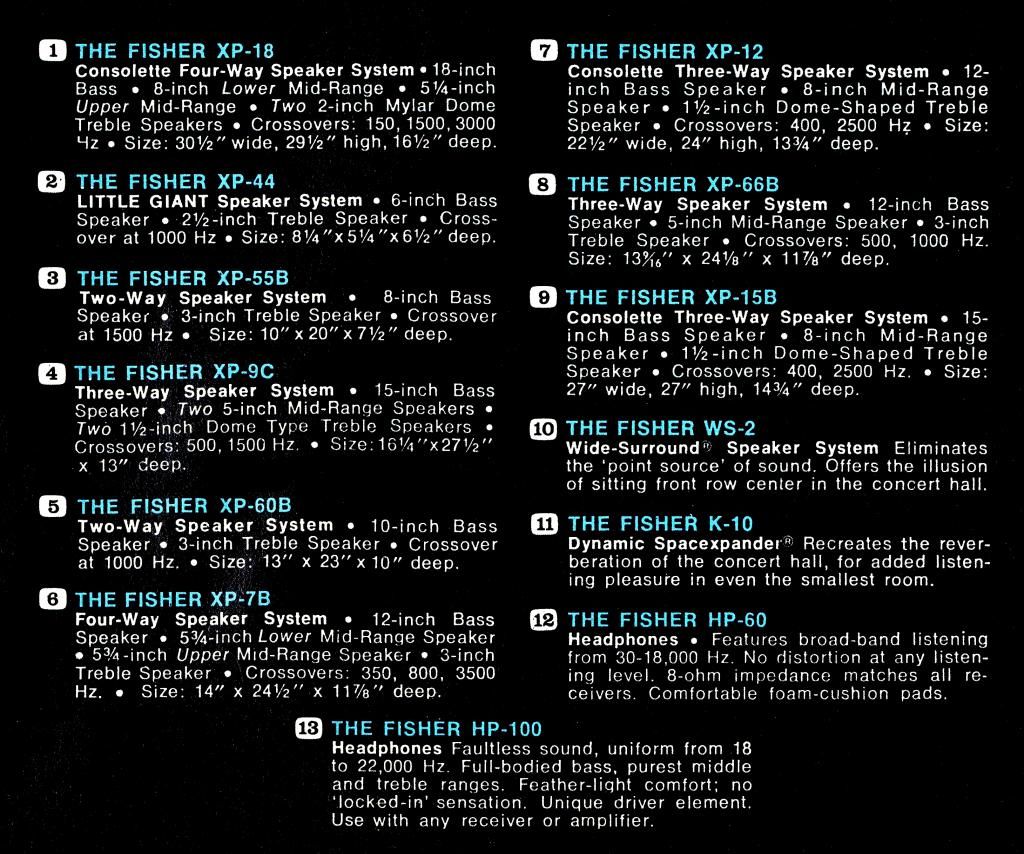
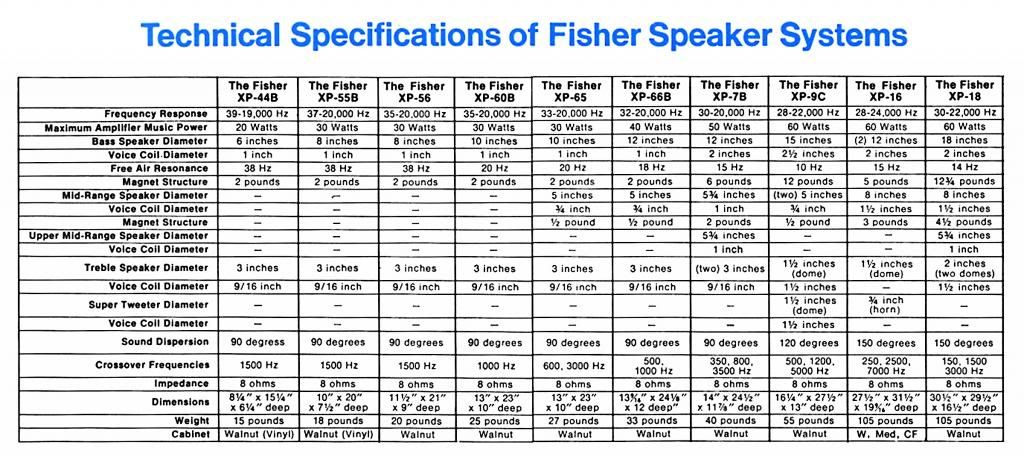
Despite having the same basic models as 1969, there were at least a few updates requiring a new letter suffix for 1971. The 4-way XP-9B became the 3-way XP-9C with a larger 15" woofer and the addition of a second 1½" soft-dome tweeter. The long-unchanged 3-way XP-7 finally received an update becoming the 4-way XP-7B. Also newly upgraded to "B" status were the XP-60B and XP-66B. I do not have any pricing information for either 1970 or 1971.
Note: Production of the Emerson era speakers appears to have taken place at Fisher's modern plant in Milroy, Pa. Due to shipping costs and the tariff structure of the early 70s, speaker imports had yet to make major inroads into US markets. Further discussion of this topic here. Some owners of Fisher speakers of this era report the use of CTS drivers. If you have an XP series speaker it would be interesting to be able to add the specific make of the drivers it contains.


1971
For 1971 Fisher retired the XP-15B and XP-12 consolettes; replacing them with the all-new XP-16. It came in three different (very different) cabinet styles: Contemporary, Country French and Mediterranean. The 1971 XP-9C seems like it should have merited a "D" designation since it was now a 4-way sporting a brand new super-tweeter which replaced one of the previous year's XP-9C's soft-dome "regular" tweeters. There were also two new, seemingly unnecessary, middle-of-the-already-crowded-pack, price point placeholders: the 2-way XP-56 and the 3-way XP-65. Finally, the entry-level XP-44 was updated, becoming the XP-44B.


The following excerpts from Fisher's "Technical Analysis . . ." brochure (copyright 1970) are courtesy the Smithsonian Museum of American History. This was part of a packet donated personally by Mr. Fisher in 1971 along with a 4-Channel Fisher 701 receiver and a set of 4 WS-80 speakers.


1970
Despite having the same basic models as 1969, there were at least a few updates requiring a new letter suffix for 1971. The 4-way XP-9B became the 3-way XP-9C with a larger 15" woofer and the addition of a second 1½" soft-dome tweeter. The long-unchanged 3-way XP-7 finally received an update becoming the 4-way XP-7B. Also newly upgraded to "B" status were the XP-60B and XP-66B. I do not have any pricing information for either 1970 or 1971.
Note: Production of the Emerson era speakers appears to have taken place at Fisher's modern plant in Milroy, Pa. Due to shipping costs and the tariff structure of the early 70s, speaker imports had yet to make major inroads into US markets. Further discussion of this topic here. Some owners of Fisher speakers of this era report the use of CTS drivers. If you have an XP series speaker it would be interesting to be able to add the specific make of the drivers it contains.
1971
For 1971 Fisher retired the XP-15B and XP-12 consolettes; replacing them with the all-new XP-16. It came in three different (very different) cabinet styles: Contemporary, Country French and Mediterranean. The 1971 XP-9C seems like it should have merited a "D" designation since it was now a 4-way sporting a brand new super-tweeter which replaced one of the previous year's XP-9C's soft-dome "regular" tweeters. There were also two new, seemingly unnecessary, middle-of-the-already-crowded-pack, price point placeholders: the 2-way XP-56 and the 3-way XP-65. Finally, the entry-level XP-44 was updated, becoming the XP-44B.
The following excerpts from Fisher's "Technical Analysis . . ." brochure (copyright 1970) are courtesy the Smithsonian Museum of American History. This was part of a packet donated personally by Mr. Fisher in 1971 along with a 4-Channel Fisher 701 receiver and a set of 4 WS-80 speakers.
Last edited:

Wigwam Jones
Caesar non supra grammati
If you have an XP series speaker it would be interesting to be able to add the specific make of the drivers it contains.
Thanks for posting all this great information!
To answer your question...
My XP-56 and "The Fisher 102" which appears to be a clone of the XP-56 both have 8 inch woofers, which are marked clearly with manufacturer code 137, which is CTS. Square magnets, doped cloth surrounds. They have slightly different other numbers on them, but they appear absolutely identical in every respect, and both are clearly manufacturer code 137. The tweeters are unmarked in both sets of speakers. I just went down to my basement and verified this just now, so I am not relying on memory.
I would have to pull the drivers in my XP-7 to tell you what the driver manufacturer codes are, and that's a bit of a pain, so it may be awhile before I can do it, but when I can I will update to this thread.
Also, contrary to the images you posted, both my XP-56 and 102 do NOT have finished baffleboards. They are black particle board, unfinished, with some chalk writing on them. They did not have the wood-grain veneer that is pictured. The model 102 speakers had the fancy plastic lattice work shown as optional in your brochures, though. Just plastic, glued directly to the grill cloth. Could hardly be more cheesy.
Last edited:
TheRed1
Console Conservationist
You're quite welcome. Thanks for your own information regarding the CTS drivers.Thanks for posting all this great information!
It's possible that the finished baffleboard was only used on the '71 models. The XP-56 continued through '73 so it's possible yours is a later model. The 102 debuted in '73 so that is certainly a later model. Is there any indication of a production date on the drivers?Also, contrary to the images you posted, both my XP-56 and 102 do NOT have finished baffleboards. They are black particle board, unfinished, with some chalk writing on them. They did not have the wood-grain veneer that is pictured. The model 102 speakers had the fancy plastic lattice work shown as optional in your brochures, though. Just plastic, glued directly to the grill cloth. Could hardly be more cheesy.
Do these illustrations look like CTS drivers to you?
From the Fisher's Technical Analysis . . . brochure - copyright 1970:
(Courtesy the Smithsonian Museum of American History)


Wigwam Jones
Caesar non supra grammati
It's possible that the finished baffleboard was only used on the '71 models. The XP-56 continued through '73 so it's possible yours is a later model. The 102 debuted in '73 so that is certainly a later model. Is there any indication of a production date on the drivers?
XP-56: code 137 7050
102: code 137 7203
I believe that means the 50th week of 1970, and the 3rd week of 1972, respectively.
Do these illustrations look like CTS drivers to you?
I would say not, with the possible exception of the midrange, which looks vaguely like the 8 inch woofers I have in terms of magnet shape. The woofer frames in your illustration shows the exact same design as I see in some old Fisher 12 inch console speakers I have, as well as in my 12 inch woofers in my XP-7's, as I recall (could be wrong).
What a great thread. I have had a pair of XP-9c's that I rescued from the landfill some years ago. The high end was very muffled and I never replaced the caps or attenuators. I think I should give them a relook. Thanks for all the great information. Much of this I could never find on line. Norm

TheRed1
Console Conservationist
Fisher's relationship with Bill Hecht's United Speaker Systems, Inc. did indeed start in the late '50s with their first product, the XP-1, being introduced in 1959. The transition from Jensen (and a few other suppliers such as Coral) to United in Fisher consoles was gradual, starting with the top-of-the-line President, Regent and Executive models and progressing down the model line-up. I haven't worked out a definitive chronology for the changeover.So did Fisher start the relationship with united in the late fifties? Was this for all speakers? I am sure my 61 Electra has Jensen woofers. Not sure what the mid and tweeter speakers are. Did the later speakers and consoles use united? Just seekin clarity on this.
Based on the similarity of terms used in the descriptions - console vs. component - it looks like the transition started in 1961 with "high compliance and high efficiency" woofers on the Executive model. The '62 President had "hemispherical high frequency units"; the '63 had "hemispherical high frequency dome-type tweeters" which were undoubtedly Hecht's. By 1966, Fisher was emphasizing that that year's President used the same driver array as the XP-10.
Fisher's descriptions of the speaker systems used in their low and mid-line models are generally lacking in detail. It might be possible to pin down the transition model year(s) by reviewing the Fisher Consoles "Compendium" sticky Fisherdude created at my request.
Last edited:

Kingfisher
Well-Known Member
Thank you Carter, this is a fantastic thread! I acquired a pair of XP-66k's last year from an estate sale. They need a lot of work and are in line with lots of other projects I have. I didn't know the 66k was a 66B with a fancy plastic grille on it. I also didn't know the 66 and 66B were different specs. As usual, your threads are very informative.
http://www.audiokarma.org/forums/showthread.php?t=391292
http://www.audiokarma.org/forums/showthread.php?t=391292
Normo; Take a picture, kind of close, which will give us a better idea.
Larry
Larry
TheRed1
Console Conservationist
Part 4 of 5 Addendum
1971 Radio Shack Prices
I found these on the radioshackcatalogs.com website. Interesting that the description of the XP-15C closely matches that of the XP-16. Perhaps the XP-16 was originally called the XP-15C. Note that the XP-7 was still available at a somewhat reduced cost. Not available at Radio Shack at this time were the XP-56 and XP-65, the two new mid-line models. They may have been mid-season introductions like the XP-16 appears to have been.
1971 Radio Shack Prices
I found these on the radioshackcatalogs.com website. Interesting that the description of the XP-15C closely matches that of the XP-16. Perhaps the XP-16 was originally called the XP-15C. Note that the XP-7 was still available at a somewhat reduced cost. Not available at Radio Shack at this time were the XP-56 and XP-65, the two new mid-line models. They may have been mid-season introductions like the XP-16 appears to have been.
- XP-15C 12" (2) / 8" / 1½" / ¾" super tweeter; 4-way; 28-24,000 Hz; 60 watts; 90 lbs; $199.95
- XP-9C 15" / 5" (2) / 1½" / 1½" super tweeter; 4-way; 28-22,000 Hz; 60 watts; 60 lbs; $199.95
- XP-7B 12" / 5¾" / 5¾" / 3" (2); 4-way; 30-20,000 Hz; 50 watts; 47 lbs; $149.95
- XP-7 12" / 5" (2) / soft-dome tweeter; 3-way; 30-20,000 Hz; 50 watts; 47 lbs; $109.95
- XP-66B 12" / 5" / 3"; 3-way; 35-20,000 Hz; 40 watts; 40 lbs; $99.95
- XP-60B 10" / 3"; 2-way; 35-20,000 Hz; 30 watts; 30 lbs; $79.95
- XP-55B 8" / 3"; 2-way; 37-20,000 Hz; 25 watts; 18 lbs; $49.95
- XP-44B 6" / 2½"; 2-way; 39-19,000 Hz; 25 watts; 15 lbs; $44.50
TheRed1
Console Conservationist
Part 5 of 5 (1972-1973)
1972
All I have to go on for 1972 is a price list. It is, however, a comprehensive list of all of Fisher's speaker models giving a brief description and listing all their various grill permutations. Unfortunately, Fisher's emphasis appears to have shifted more toward style and away from performance and innovation during these years. While your choices in speaker grills expanded, specs stagnated and in some cases began to slip slightly.
The higher-end models - XP-18, XP-16 and the XP-9C - carried on unchanged for 1972. Prices were up, though, with the XP-9C increasing $20. (Note the previous post with 1971 prices from the Radio Shack Catalogs website.) 1971's XP-7B became 1972's XP-7C, also increasing in price by $20 . The XP-66C got a new lighter-weight woofer, a heavier mid-range and a was $30 more expensive than the previous year's 'B' model.
1972's XP-65 appears to be a 'B' model which is supported by downward trends in its woofer specs (see the 1973 speaker specs versus 1971). The XP-60B had similar changes becoming the XP-60C with a $20 price increase. It is unclear exactly what was going on with the XP-56 since it was available in a plain version or a 'B' version - each $79.95 - AS WELL AS the extra cost 'K' fretwork grill and 'S' sculptured grill versions - each for $10 more. Fisher's confusing change in their use of a letter suffix to denote the grill style as well as the model generation makes it difficult to determine when new a version was being introduced.
Another case in point: the 1972 XP-55 was available in both 'B' and 'C' versions with the latter denoting an extra-cost fretwork grill option which was usually indicated by a 'K'. Typo? Judging by the '73 catalog entry below - apparently not. It was also available in an 'S' version. Mercifully, the XP-44B remained unchanged.

1973
Not much of interest here - just some illustrations of Fisher's vast assortment of grills. The technical specs mostly show only incremental changes when compared with 1971 (often in the wrong direction). There was a definite sense of stagnation at Fisher in the early 1970s. 1973 marks the end of Donald J. Harper’s tenure as the president of Emerson’s Fisher division. I’m not sure how much significance to read into his departure but it does coincide with the beginning of Emerson’s partnership with Sanyo.


1973 was perhaps notable for the introduction of Fisher’s ‘100’ series of speakers. I really don’t know what to make of these. The 101 through 105 models appear to be identical to existing XP models (see the equivalency bar I added at the top of the following chart). I have not been able to find any pricing data on the 100 series so I don’t know how they fitted into Fisher’s overall speaker hierarchy. Were they meant to replace the XP series? If so, I haven’t found any evidence of that. In fact, they seem to have disappeared after 1973 but that is not conclusive (I only have newspaper ads to go on after 1973). I did find one advertisement from 1974 for one of Fisher’s all-in-one stereo system deals which listed a pair of ‘100’ speakers as part of the package. Beyond that, it appears the 100 speaker series was abandoned in favor of the first ‘MS’ series Fisher speakers which appeared around 1975.

The only two 100 series speakers that didn't have XP equivalents were the 110S and 111K. They were the only unique 100 series speakers featured in the ‘73 catalog.

Beyond 1973
The XP series continued well after 1973 - at least in name. The period from 1974 through 1975 was dominated by sculptured grill XP ‘S’ models. Not much is known about the quality of Fisher speakers of this era. However, Fisher had gone mass market by this time and was competing on price. Their advertisements tended to focus on their past accomplishments and storied history. I can confirm the existence of the following models through 1975:
Starting in 1976 there were numerous new XP models such as the XP-48, XP-55X, XP-57, XP-62, XP-66KC, XP-68A etc. For the most part these were very cheap speakers with much smaller woofers than previous XPs. These are almost certainly not in the same class as previous speakers of the XP series.
The 1980s
By the early 1980s the number of Fisher speaker series had exploded. In addition to the ‘MS’ speakers there were now ‘DS’, ‘ST’, ‘STEC’, ‘MSM’, ‘SME’ and ‘STE’. And there was still an XP, too. Though it does appear that Fisher/Sanyo was making an effort to reclaim the XP’s former status as a high-end speaker. Witness the 1982 XP-95C:

I encourage corrections of any mistakes I may have made. I suspect there are several AK members out there with their own collections of Fisher sales literature who could possibly flesh out this thread with more details. Those with XP series speakers are also encouraged to post photos, ID their drivers and comment on the quality (or lack thereof) of their speakers.
1972
All I have to go on for 1972 is a price list. It is, however, a comprehensive list of all of Fisher's speaker models giving a brief description and listing all their various grill permutations. Unfortunately, Fisher's emphasis appears to have shifted more toward style and away from performance and innovation during these years. While your choices in speaker grills expanded, specs stagnated and in some cases began to slip slightly.
The higher-end models - XP-18, XP-16 and the XP-9C - carried on unchanged for 1972. Prices were up, though, with the XP-9C increasing $20. (Note the previous post with 1971 prices from the Radio Shack Catalogs website.) 1971's XP-7B became 1972's XP-7C, also increasing in price by $20 . The XP-66C got a new lighter-weight woofer, a heavier mid-range and a was $30 more expensive than the previous year's 'B' model.
1972's XP-65 appears to be a 'B' model which is supported by downward trends in its woofer specs (see the 1973 speaker specs versus 1971). The XP-60B had similar changes becoming the XP-60C with a $20 price increase. It is unclear exactly what was going on with the XP-56 since it was available in a plain version or a 'B' version - each $79.95 - AS WELL AS the extra cost 'K' fretwork grill and 'S' sculptured grill versions - each for $10 more. Fisher's confusing change in their use of a letter suffix to denote the grill style as well as the model generation makes it difficult to determine when new a version was being introduced.
Another case in point: the 1972 XP-55 was available in both 'B' and 'C' versions with the latter denoting an extra-cost fretwork grill option which was usually indicated by a 'K'. Typo? Judging by the '73 catalog entry below - apparently not. It was also available in an 'S' version. Mercifully, the XP-44B remained unchanged.
1973
Not much of interest here - just some illustrations of Fisher's vast assortment of grills. The technical specs mostly show only incremental changes when compared with 1971 (often in the wrong direction). There was a definite sense of stagnation at Fisher in the early 1970s. 1973 marks the end of Donald J. Harper’s tenure as the president of Emerson’s Fisher division. I’m not sure how much significance to read into his departure but it does coincide with the beginning of Emerson’s partnership with Sanyo.
1973 was perhaps notable for the introduction of Fisher’s ‘100’ series of speakers. I really don’t know what to make of these. The 101 through 105 models appear to be identical to existing XP models (see the equivalency bar I added at the top of the following chart). I have not been able to find any pricing data on the 100 series so I don’t know how they fitted into Fisher’s overall speaker hierarchy. Were they meant to replace the XP series? If so, I haven’t found any evidence of that. In fact, they seem to have disappeared after 1973 but that is not conclusive (I only have newspaper ads to go on after 1973). I did find one advertisement from 1974 for one of Fisher’s all-in-one stereo system deals which listed a pair of ‘100’ speakers as part of the package. Beyond that, it appears the 100 speaker series was abandoned in favor of the first ‘MS’ series Fisher speakers which appeared around 1975.
The only two 100 series speakers that didn't have XP equivalents were the 110S and 111K. They were the only unique 100 series speakers featured in the ‘73 catalog.
Beyond 1973
The XP series continued well after 1973 - at least in name. The period from 1974 through 1975 was dominated by sculptured grill XP ‘S’ models. Not much is known about the quality of Fisher speakers of this era. However, Fisher had gone mass market by this time and was competing on price. Their advertisements tended to focus on their past accomplishments and storied history. I can confirm the existence of the following models through 1975:
- XP-9S $219.95
- XP-7S $169.95
- XP-65S $109.95
- XP-56S $89.95
- XP-55S $69.95
Starting in 1976 there were numerous new XP models such as the XP-48, XP-55X, XP-57, XP-62, XP-66KC, XP-68A etc. For the most part these were very cheap speakers with much smaller woofers than previous XPs. These are almost certainly not in the same class as previous speakers of the XP series.
The 1980s
By the early 1980s the number of Fisher speaker series had exploded. In addition to the ‘MS’ speakers there were now ‘DS’, ‘ST’, ‘STEC’, ‘MSM’, ‘SME’ and ‘STE’. And there was still an XP, too. Though it does appear that Fisher/Sanyo was making an effort to reclaim the XP’s former status as a high-end speaker. Witness the 1982 XP-95C:
I encourage corrections of any mistakes I may have made. I suspect there are several AK members out there with their own collections of Fisher sales literature who could possibly flesh out this thread with more details. Those with XP series speakers are also encouraged to post photos, ID their drivers and comment on the quality (or lack thereof) of their speakers.
Last edited:

RogerKulp
Super Member
I came across a pair of the X10's they were in great shape, and I really wanted to buy them to go with my Fisher amp, but I have to say, I was not all the impressed with them as far as the sound. I think the hi frequency drivers were dead. When everything is working do they sound any good?
I love my X-101.I use it almost every day.I am currently using a pair of HeresyIIs I bought off CraigsList with them,but I also have a pair of Fisher X/XP speakers that I think are X-9s,I bought at Goodwill for a whole $6.99.They have no model number,and are a couple inches bigger all around than the X-9s shown here.They are definitely late 60s.I was not all that impressed with them either.There is a harsh quality to them,and something else I can't quite put my finger on.
RogerKulp
Super Member
XP-56: code 137 7050
102: code 137 7203
I believe that means the 50th week of 1970, and the 3rd week of 1972, respectively.
I would say not, with the possible exception of the midrange, which looks vaguely like the 8 inch woofers I have in terms of magnet shape. The woofer frames in your illustration shows the exact same design as I see in some old Fisher 12 inch console speakers I have, as well as in my 12 inch woofers in my XP-7's, as I recall (could be wrong).
Where are the date codes?