

You are using an out of date browser. It may not display this or other websites correctly.
You should upgrade or use an alternative browser.
You should upgrade or use an alternative browser.
Yamaha CA-1000/CA1000II Power Supply and Protection Circuit Diagnostics, & Lower SNR values with the QA403
- Thread starter Yamaha5000
- Start date

Yamaha5000
Never settle for 2nd best
I have been begging for explanations as you have just posted for three years now, I can learn from such explanations! All this other BS that others have provided goes into that DOG FOOD pile you explained last night!Point to the above, rather than just posting voltages, diy your own analysis and post what you think is happening, sure we get it wrong some times but that's how we learn rather than being spoon fed...

Yamaha5000
Never settle for 2nd best
I have been at this for 10 hours today, I need to take a break for a little while and clear my head and then come back and understand all of your information.So what does TR604,5 b/c/e voltages tell you.
Yamaha5000
Never settle for 2nd best
I can tell you at this moment that TR601 - TR612 are not shorted or open and the hfe #'s are as specified.
Plz, 1 step at a time so I can follow your thinking, may get to TR601,2 later.I can tell you at this moment that TR601 - TR612 are not shorted or open and the hfe #'s are as specified.
So what does TR604,5 b/e voltages tell you.
Yep, TR604 and 605 are "reverse biased" Ve > Vb so the transistor is off, need Vb > Ve for current floe/on condition.Plz, 1 step at a time so I can follow your thinking, may get to TR601,2 later.
Next step in the thought process should be "ok, which voltage is wrong/ at fault."
Since both transistors are off there is no e-c current flow so no current/volt drop through R619 so would expect Ve to be about -50 rail
so...
Yamaha5000
Never settle for 2nd best
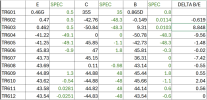
Here is an update to the voltage chart:
Yamaha5000
Never settle for 2nd best
R619Since both transistors are off there is no e-c current flow so no current/volt drop through R619 so would expect Ve to be about -50 rail
so...
-50.7vdc @one side
-41.19 @ the other side
Yamaha5000
Never settle for 2nd best
I am seeing Vbe on TR604 & TR605 to be greater than 0.6v, I think?
I am seeing a voltage drop across R619, I think?
I am seeing a voltage drop across R619, I think?
Yamaha5000
Never settle for 2nd best
MAybe it would help if I better understood the voltage/current path for B+/- & 50v +/-

TR604 and 605 are "reverse biased" Ve > Vb so the transistor is off, need Vb > Ve for current flow/on condition.I am seeing Vbe on TR604 & TR605 to be greater than 0.6v, I think?
So, under the circumstances, what does that tell you?I am seeing a voltage drop across R619, I think?
Happy to admit I may have the analysis wrong, certainly TR604,5 base voltages look like a key symptom however for the moment would like to understand R619 volt drop, approx 8Vdc / 68ohms approx 110mA, R619 is a 85mA fusible. You probably have a metal film, in any case I'd measure R619, has it drifted high?
edit the other possibility being either TR604,5 is breaking down e-c allowing a leakage current through R619
Last edited:
Yamaha5000
Never settle for 2nd best
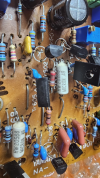
R619 is a cement resistor MICRON 20468:
Yamaha5000
Never settle for 2nd best
I just pulled R619 from the circuit and it now measures as open
Yamaha5000
Never settle for 2nd best
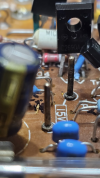
FYI:

Yamaha5000
Never settle for 2nd best
I replaced R619 with another MICRON 20468
50.5v @ one side
49.29v @ other side
NEW A=17.7ma
50.5v @ one side
49.29v @ other side
NEW A=17.7ma

That is not a cement resistor. It's a fusible resistor. These types have fuses in them and no longer are used . If you used too much heat to remove it you may have caused it to go open .
Yamaha5000
Never settle for 2nd best
That is very good information, Thank YouThat is not a cement resistor. It's a fusible resistor. These types have fuses in them and no longer are used . If you used too much heat to remove it you may have caused it to go open .
With the voltage measurements that I was getting, I would think it was blown prior to removal. I don't know when it blew since it was fine yesterday. Maybe Gremlins!

Yamaha5000
Never settle for 2nd best
FYI: I replaced the R619 and now everything is working as it should to conduct the AMP Board Calibration. Now I will button it back up and see if it continues to hold. Will keep you posted. 
Yamaha5000
Never settle for 2nd best
50vdc regulated power supply now blowing FR704
Yamaha5000
Never settle for 2nd best
FR704 became very hot and has a black burn mark around it's center but still measures 3.9ohms. PL and protection has stopped working. Tested some of the components in the PS and haven't found anything defective so far. Will pick it up again tomorrow.