still have all the specs on the cartridge so I will dig it out for you tomorrow and send a pic. The resonance of the arm I am sure I can find somewhere as well. Perhaps in the owners manual. I am thinking of getting a different cartridge and a platform for the TT from Iso Acoustics
The resonance of the arm is a function of it's "effective mass" (what mass the stylus sees/works against as it moves in the groove) and the compliance of the cartridge. This is a bit of a simplification but covers 99% of reality) The closer a mass is to the fulcrum of an arm or lever, the less it is expressed. Think of swinging a big softball bat two ways.
The greater the effectiveness mass, the lower the resonant frequency. (lower mass/higher freq)
The stiffer the cartridge's suspension (lower compliance) the higher the resonant freq (higher compliance=lower frequency)
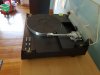
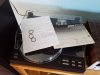
The PXs come with a pair of heavier counterweights to put where the little side mounted knurled screws are, as in your photo. They make the CW (Counter Weight) heavier so it can balance the arm nearer to it's fulcrum. Using them would move the CW closer to it's fulcrum and decrease the effective mass (ironic: adding mass reduces effective mass, but it does because of the physics of levers and masses) Unless the CW became too heavy and couldn't be moved close enough to balance because it hits the frame of the arm base).
Doing this may or may not improve the situation, depending on your cartridge's compliance.
Conventional wisdom is that we want an arm resonance of 8-12Hz(?)
Keeping it in the sweet spot reduces acoustic feedback and concerns like foot-falls exciting your woofers.
The simplest way to see what is happening is to use a test record like Analogue Productions "Ultimate Analog Test LP". Using the right track as it sweeps through some low frequencies, sometimes you can actually see the stylus skiz out. Or you'll hear the distortion as it mistracks. You can put an AC voltmeter on the output, whether at speaker terminals or REC Out, and watch the output; if you make a little graph, you'll see just where it resonates/higher voltage. And if you're real curious, an oscilloscope is informative.
And there's much more you can check with this disk.
There will be no spec for arm resonance, just information about it's effective mass which must include the weight of the cartridge, and, in the case of arms tensioned by a slider/weight, that as well. (springs, like my old Dual 1009 don't increase mass)
A somewhat reliable way to figure what your arms effective mass is, is to remove the CW and zero the TF (Tracking Force), and, with the arm parallel to the platter and the stylus on the deck of a little digital scale, see what weight is present.
This method is not real accurate but is close enough for most people. Its also real quick and easy!
There's all kinds of protocols for calculating resonant frequency with the effective mass and compliance known, but the test record doesn't lie and is quick and easy too.