• The move to the new server is done. There are some software and database maintenance updates in process. This has us passing the hat around to help out. We appreciate any donations. Seriously, even a dollar helps. The payment page may be found here - https://www.audiokarma.org/support.html

Zilch's AK Design Collaborative - Econowave Speaker

Biamp? Like this?
Yes, but the tweeter should connect to L-pad connection point (3), not (2). It's effectively not connected to common as you show.

I was about to suggest that when biamping, use the high-sensitivity circuit for the HF with a low-power HF amp when I noticed that you show R1 = 6 Ohms, and R2 = 16 Ohms with C3 0.47 uF. R1 should be 30 Ohms for the low-sensitivity E'Wave circuit.

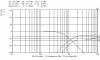
Those are not either standard E'Wave HF attenuation/compensation circuit values, nor do they appear on Wayne's chart, or my tweaking of his -6 dB and -8 dB selection.

Are these values you have arrived at empirically yourself according to your listening preference? What compression driver are you using?

They do not model well in Spice (top curve). You have very little HF compensation with those values, and the upper mids are sure to be very forward. Bottom curve shows the standard 30/16/0.47 uF low-sensitivity circuit transfer function with 8-Ohm resistive load:

attachment.php

Verify my sim please, Kegger.... :yes:
 

Attachments

  • Clmrt E'Wave Comp.jpg
    Clmrt E'Wave Comp.jpg
    45.2 KB · Views: 590
For whateveer reason Zilch I'm not seeing what your seeing?
His L-Pad looks correct to me as well?

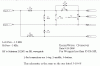
It looks like this to me?
Your referring to 2418?
 

Attachments

  • Wooger_L_y.GIF
    Wooger_L_y.GIF
    13.1 KB · Views: 63
I have my first set of crossovers built..

However, I have been thinking of building E-Waves into the sidewall of a shed (infinite baffle) adjoining an outdoor deck. The drivers would be facing out onto a dock and lake past the deck. Further, the drivers, although somewhat protected, would be exposed to the elements year round. I have some Poly cone woofers used in some Infinities that would lend themselves easy enough. However, my question(s): Are there design considerations that would not lend themselves well or need to be addressed?
 
PIO1980, I believe (But I'm not sure) your asking is Ewave a good fit for mono?

Just thinking off the top of my head I say no, this system is not "wide" dispersion, I
would think in mono you would want a wider coverage area then this system does ?
Anyone else care to way in?

On the prospect of the speakers being suitable for Ewave in stereo, I think they may
be very good candidates, I've downloaded the pdf, there are some usable parts there
to, the .6 coil, the L-Pad, it has a zobel on the woofer that looks like is setup correct,
the original xover is 4k and the woofer looks to play flat upto and beyond Ewave Xover.

I see nothing that says NO EWAVE HERE! Could be quite nice. :music:
 
Cosmos, Dan, congrats Xovers done! WHOO HOO!

On your other questions, I will pass the torch, as I just don't know. :tears:
 
Question to you all with better smarts and more experience is whether this mod reworking appears to be a reasonable worthwhile project for the stated objectives or just leave them as-is and consider finding a single with efficient woof potential for the reciever if I'm going to go this route, rather than, say, a high-efficiency near-full-range paper cone approach, and do just one E-wave cab for the mono reciever.
S.B.
Crossover's at 4.2 kHz, so the woofer's playing all the mids. Yes, E'Wave would be a substantial upgrade.

Cabs are 13" wide, and E'Wave is 12" x 6.5". If that's too tight, consider either the 8" or 6" square versions we're working with right now.

I have two observations: running two in mono is not going to give you an accurate "floating" sonic image unless you are listening from the precise acoustic center between them. Either side of center by as little as 1/4", and they'll interfere with each other.

Second, I don't know what you mean by a "contemporary" AR. E'Wave is not going to alter the existing CS-R300 bass performance....
 
For whateveer reason Zilch I'm not seeing what your seeing? His L-Pad looks correct to me as well?
Yes, 2418. There's no 30-Ohm R1 there, rather, 6 Ohms. Even if he intended 16 Ohms, that's wrong also, providing only half the requisite comp.

For biamp, we don't need an L-pad if the amp controls the HF attenuation, and I assume (perhaps erroneously) his intent is to remove it. He doesn't show one there, rather merely the board connections for one.
 
Gotcha, I "didn't" take that he was removing the L-Pad, if left it should be fine,
if not then I see and agree with what you had said. (May need it if no seperate amp volume control)

I would also agree that if the resistor was 6ohm the HF COMP would be way off,
I believe I see 30 ohm there though?
 
Are there design considerations that would not lend themselves well or need to be addressed?
I'd sure want some sort of removable cover over the horn, and perhaps the woofer also. There'll be condensation inside the compression driver every night, and moisture from the lake. Will that damage anything? I don't know, but I'd prefer not to have it exposed to the elements 24/7.
 
I believe I see 30 ohm there though?
I must be hallucinating or something. It says "R1 6 (omega)" here.... :dunno:

Just thinking off the top of my head I say no, this system is not "wide" dispersion, I would think in mono you would want a wider coverage area then this system does? Anyone else care to way in?
E'Wave horizontal dispersion is 90°. 10" woofer is narrower than that above ~1.8 kHz.

See Dickason Fig. 0.14 "Diaphragm dispersion chart."

It MAY widen out again when the CS-R300 "horn" kicks in at 4.2 kHz, but how much and for how high is indeterminate. E'Wave's dispersion stays at 90° throughout the VHF, as may be seen in the polar measurements performed by Geddes, posted earlier in this thread. Light blue is 60° beamwidth, and brown (@ -5 dB) is 90°:

attachment.php
 
It is a little blurry, but looks like 30 ohm to me, ?

I think we need the POSTER to tell us, ;)
O.K., if that's the case, then it's just one resistor and one cap to convert to the high sensitivity version for use with flea-power HF amps, which is what I was going to advise.

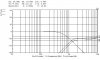
For the record, since I did the sim, here's what 16/16/0.47 uF does. I have a premonition the question's gonna come up at some point:

attachment.php
 

Attachments

  • Clmrt E'Wave Comp 16.jpg
    Clmrt E'Wave Comp 16.jpg
    44.9 KB · Views: 536
LOL, yu just had to do it aye!

Yah that aint gunna work, unless you have a driver that needs very little compensation. :)
 
It should have been the same as the "Low Sens"...lemme see here...

(Nothing empirical going on here, just some twisting of the pots...)
 
Yes, 2418. There's no 30-Ohm R1 there, rather, 6 Ohms. Even if he intended 16 Ohms, that's wrong also, providing only half the requisite comp.

For biamp, we don't need an L-pad if the amp controls the HF attenuation, and I assume (perhaps erroneously) his intent is to remove it. He doesn't show one there, rather merely the board connections for one.

I see R1 as 30, and R2 as 16?

russellc
 
I, not a fan of modern horn speakers, have been lurking this project out of curiosity and having a spot for an efficient decent sounding speaker system for a ca 8-10W P/P vt amp in a 1939 Sig Corps Hammarlund Super Pro 210X commo reciever.....

You should be a fan of Econowave.

Using all the audio bandwidth available in Econowave for sw/mw/lw reception is questionable, but you can insert an EQ to take out hash and high heterodynes. And when you want to listen to full bandwidth music in the radio shack, bypass it.

OT, but ... I have a military BC794 and an SP210 LX.
I think. Records appear to be sketchy.
When they were made, I assume Hammarlund was located down the block from me, on 34th St.
Very good PP audio section.
 
Maybe I missed something. Ur bi-amping? Using L-pads as well? Or as Zilch suggested, just showing board connections? Sorry, I'm just trying to follow.

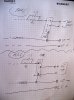
I ended up wiring the L-pads as in the pic, just to add to the confusion.:D

Like here:

http://audiokarma.org/forums/attachment.php?attachmentid=83308&d=1205870935

R1 = 30 ohms
R2 = 16 ohms

Biamp version I scribbled down (and regular version):

Pot 1 to T (-)
Pot 2 to T (+)
Pot 3 to ground

Not correct? (I wouldn't have a clue). I've seen diagrams where positive drive goes to pin 3. Pin two to driver pos, driver neg to pin 1 and amp neg.

eep
 

Attachments

  • lpad_insanity.jpg
    lpad_insanity.jpg
    81.2 KB · Views: 65
Like here:

http://audiokarma.org/forums/attachment.php?attachmentid=83308&d=1205870935

R1 = 30 ohms
R2 = 16 ohms

Biamp version I scribbled down (and regular version):

Pot 1 to T (-)
Pot 2 to T (+)
Pot 3 to ground

Not correct? (I wouldn't have a clue). I've seen diagrams where positive drive goes to pin 3. Pin two to driver pos, driver neg to pin 1 and amp neg.
All correct. :thmbsp:

I ended up wiring the L-pads as in the pic, just to add to the confusion.:D
Either way is fine, electrically, as long as the input is between terminals (1) and (3), and the output is between terminals (1) and (2); it's merely a matter of preference and/or convenience.

Jack's circuit, I do it Jack's way.... :yes:

I see R1 as 30, and R2 as 16?
I was having a Roseannadana moment, apparently.

No matter, it generated more data.... :tongue:
 
Crossover's at 4.2 kHz, so the woofer's playing all the mids. Yes, E'Wave would be a substantial upgrade.

Cabs are 13" wide, and E'Wave is 12" x 6.5". If that's too tight, consider either the 8" or 6" square versions we're working with right now.

I have two observations: running two in mono is not going to give you an accurate "floating" sonic image unless you are listening from the precise acoustic center between them. Either side of center by as little as 1/4", and they'll interfere with each other.

Second, I don't know what you mean by a "contemporary" AR. E'Wave is not going to alter the existing CS-R300 bass performance....

Thnx much for the detailed and useful responses so far for this at-present hypothetical project. I don't do woodwork, have not voiced speakers hands-on myself (tho' I have evaluated voicing adjustments for others) and would probably need a collaborator with actual experience and the tools and skills to help realize the project if it went forward.
Some responsive comments follow;

"Cabs are 13" wide, and E'Wave is 12" x 6.5". If that's too tight, consider either the 8" or 6" square versions we're working with right now."

I assume the largest WG fit-able would be preferable and the choice would ultimately determine the voicing details of the system. The largest WG & probably the 8" would definitely require moving the port on the tweet panel to either the woof panel or the rear. I think the removal of the tweet panel cut-out for the WG and the WG's shallowness would make the volume difference from original perhaps insignificant. Regardless, I'd prefer a tuning that wouldn't encourage a ported bass response hump if it changed.

"Second, I don't know what you mean by a "contemporary" AR. E'Wave is not going to alter the existing CS-R300 bass performance."
Except possibly in the above cited enclosure volume changes.
I'm thinking AR-4x & AR-6 in particular. Aside from good smooth bass extension for size, the over-all response of the ARs is more "High-End-accurate" sound oriented IMO than the subject speakers or most other speakers from that time which tend to sound like "PA-in-the-home" to me. As far as the '300's extension goes, I know it's set by cab size tuning and the woof itself. Therefore, I know it simply is what it is. Aside from avoiding a bass hump, I understand that it's a fairly efficient 40 watt mid-woofer that will give what it can in that box and no more.

"running two in mono is not going to give you an accurate "floating" sonic image unless you are listening from the precise acoustic center between them. Either side of center by as little as 1/4", and they'll interfere with each other."

There is some 'fudge' in 2-speaker mono listening that seems to depend on the speakers themselves as much as anything else. I prefer mono out of a pair rather than single-source mono listening if seated and just doing that. For other less critical listening, "mono-a-mono" works fine.
'Course you know this as well or better than I, I'm not expecting the impossible but pleasant suprizes are always welcome.
S.B.

 
Back
Top Bottom