• The move to the new server is done. There are some software and database maintenance updates in process. This has us passing the hat around to help out. We appreciate any donations. Seriously, even a dollar helps. The payment page may be found here - https://www.audiokarma.org/support.html

Zilch's AK Design Collaborative - Econowave Speaker

Also, if you decide you like round after considering that, anyway, and want a quality round waveguide, see the DDS Engebretson:

http://www.ddshorns.com/catalog.php?page=ENG190Pro

And for elliptical, 18-Sound XT1086:

http://www.eighteensound.com/index.aspx?mainMenu=view_product&pid=178

be careful with the eng190pro. while i don't have all the facts, various posts on other boards report that the company went bust and another group picked up the manufacturing. the result is *major* quality issues with the waveguides (think same kind of quality control as on geddes enclosures).

anyway, janowitz of aespeakers purchased a set for a kit he was working on and put pics on the web. he concluded that they were unusable. they really were *that* bad.

no such issues with the xt1086.
 
Thank you for the "Heads up," Publius.

I knew they had moved to Texas, I believe it is, but not the circumstance.... :(
 
The 2225H is a slamming woofer, and sounds great. I am in no, if any hurry to ever "convert" my other pair of 2225H to 2235H. The 2235H definately goes lower, and very powerfully as it does so. But you give up a little "immediacy" for lack of a better word. Drum rim shots sound about as close to real with the 2225H as any driver I have heard. The 2235H doesnt lose a whole lot of slam, just a little, but adds some very delicious bass.

Thanks for this useful comparison (and neat system too).

I'm wondering if there is a way to quantify this "slam factor". Is this something that would show up in the driver specs? It seems that a combination of high BL and low moving mass is the source for both the higher efficiency of the 2225 as well as the effect of more punch. While both have strong motors, the 2225 has about 1/3 less moving mass.

I was thinking about using the LE14H-3, but then i discovered that it is a relatively low efficiency driver (compared with many JBL pro style drivers). While many folks would say that one just needs to use a little more amp power to get the same results, my intuition is telling me there is more to the story. An analogy of my reasoning is that an elephant will never move as quickly as an insect no matter how strong it is.
 
Thanks for this useful comparison (and neat system too).

I'm wondering if there is a way to quantify this "slam factor". Is this something that would show up in the driver specs? It seems that a combination of high BL and low moving mass is the source for both the higher efficiency of the 2225 as well as the effect of more punch. While both have strong motors, the 2225 has about 1/3 less moving mass.

I was thinking about using the LE14H-3, but then i discovered that it is a relatively low efficiency driver (compared with many JBL pro style drivers). While many folks would say that one just needs to use a little more amp power to get the same results, my intuition is telling me there is more to the story. An analogy of my reasoning is that an elephant will never move as quickly as an insect no matter how strong it is.

It's an interesting analogy that seems to make sense but in the case of a loudspeaker, it doesn't really.
 
John did get a really bad DDS waveguide in his posession as have a few others, I've seen the pics. I've also read a few dozen very positive reviews of the round DDS horn.

I've used 18sound products and can give them a very positive recommendation.

XT1086 is nice, the XT1464 is a good one if you need a little more narrow dispersion horizontally.
 
Thanks for this useful comparison (and neat system too).

I'm wondering if there is a way to quantify this "slam factor". Is this something that would show up in the driver specs? It seems that a combination of high BL and low moving mass is the source for both the higher efficiency of the 2225 as well as the effect of more punch. While both have strong motors, the 2225 has about 1/3 less moving mass.

I was thinking about using the LE14H-3, but then i discovered that it is a relatively low efficiency driver (compared with many JBL pro style drivers). While many folks would say that one just needs to use a little more amp power to get the same results, my intuition is telling me there is more to the story. An analogy of my reasoning is that an elephant will never move as quickly as an insect no matter how strong it is.

Yes, the 2235H will have more mass for sure, it has the added "Mass Ring".

There is a driver that is the same cone as the 2235H but no added mass ring, 2234 maybe? I would like to try one, obviously it also shares the same motor as the 2225/2235 drivers do.

Russellc
 
I finally finished by EWave. I have been disappointed with my recent purchase of a set of JBL 46710K Cabaret Speakers. The 4671 is not intended for home use but I have read that some people are using it at home. On both my Fisher 500C and 300B SET tube amps, it sounds slow with no highs and muddy bass. On the Fisher, the bass is surprisingly absent.

I just happened to start reading this thread around the time Wayne started contributing and found that RussellC had been Ewaving a similar system with great success. I was still very sceptical because I can't see how the mid and bass could be improved.

Well, I finally had some time to do the crossovers the Ewave. I tried it right away after finishing wiring up 1 crossover. Wow, the change is phenomenal. Just as Russell said, the bass on the 2225H 15" woofer is fast with slam and clarity. It goes pretty darn low and this is with a single ended 300B amp. The clarity of the mid is much much clearer than the JBL original. The high is detailed and surprisingly smooth.

Just to make sure everyone is getting this...you changed the crossover and put EWG on the top end and now the bass isn't "slow"? I've been trying for years to convince people that woofer "speed" isn't so much about the woofer but the midrange. You get a well integrated mid/woofer combo and the woofer "speed" is there.

Ray
 
http://audioheritage.org/vbulletin/showthread.php?t=21501

http://audioheritage.org/vbulletin/showthread.php?t=11317

There are other JBL 14s that are more midbass drivers. You lose the LE14's extended bass to accomplish that, however. In designing a system, you choose the compromise of parameters which best achieves the objective and intended use.... :yes:

Agree. :yes: The aspect that I was trying to home in on was the observation that the more efficient driver actually sounds different in the midbass. The difference in frequency response is pretty easy to measure and to see. We have a pretty good idea of what the tradeoff is with respect to that.

The efficiency part is less clear though. :scratch2: Lots of folks would just say that the more efficient driver lets you get away with using less amp. However, what has been observed is that there is an aspect, "immediacy" or punch, that is also different between the two drivers. It's probably not a "night and day" type difference, but I don't even know what parameters or measurements to look at in order to have some idea of this difference. That's all I was asking about.

Interestingly, a large part of the Econowave principal is in some sense based on the fact that more efficient drivers sound "better" for some reason. The Econowave doesn't measure as flat as most dome tweeters, but the subjective reports are that it just sounds better; and, not just a little bit better, but *a lot* better. Also, it's not because everybody is actually playing their Econowaves at levels that can't be reached by dome tweeters. Some of it is surely the JBL horn, but reports about Wayne's 4Pi have been in the same vein; music just sounds more "alive" when played on compression drivers/horns.

Maybe Wayne, or someone who is really strong on the technicals, can lend a little insight here. My apologies if this is...:boring:
 
Hi, While I'm still able to do something about it,could you tell me what the best distance would be, between the woofer and the E-wave horn.I'm building the KPM's of Kegger's.Thanks, David
 
Hi, While I'm still able to do something about it,could you tell me what the best distance would be, between the woofer and the E-wave horn.I'm building the KPM's of Kegger's.Thanks, David
From what we learned in Wayne's discussion of the vertical nulls, as close as practical would appear to be optimum.

The squircle frame of the HPM-100 woofer allows the waveguide to get particularly close, and minimizes the distance between the acoustic centers. I believe I would take advantage of that, as we are also doing in recent LE14 builds. Nobody has precisely measured the location of the nulls with any particular E'Wave driver and alignment yet, though.

Note that we're talking a second- or third-order phenomenon here; it doesn't all turn to poop with greater separation. See Wayne's implementations.... ;)
 
From what we learned in Wayne's discussion of the vertical nulls, as close as practical would appear to be optimum.

The squircle frame of the HPM-100 woofer allows the waveguide to get particularly close, and minimizes the distance between the acoustic centers. I believe I would take advantage of that, as we are also doing in recent LE14 builds. Nobody has actually measured the nulls yet, though.

Note that we're talking a second- or third-order phenomenon here; it doesn't all turn to poop with greater separation. See Wayne's implementations.... ;)

When I mathed out the 1600 hz crossover solution I found that center to center distances of 10" or less place the nulls at or outside the waveguide's distribution pattern.

This has not been confirmed with objective measurements but appears to be borne out by nonscientific subjective impressions.

That said, given the choice I'd place the two sound sources as close as practical just out of superstition no mater what the math says.

<EDIT> But I'm recommending math as a guide, and not superstition. In all cases, if someone has already done the analysis by all means read their work and use it where appropriate.
 
Wayne Parham said:
The normal listening room is wider than it is tall, so the ideal coverage pattern is too. One problem that presents itself is a flare angle that is wider than it is tall terminates in a mouth that is also wider than it is tall. This means either the horizontal flare must be oversized to allow the vertical flare to develop enough to get pattern control, or the horn can be made smaller but it will sacrifice vertical control. However, if the adjacent drivers are stacked vertically, then interference nulls are formed at angles above and below, with the angle determined by the positions of the sound sources. If carefully placed, these nulls will act to reinforce pattern control, by providing it at low frequencies where the undersized horn is not able to provide vertical control solely by its dimensions.
....
 
Nulls

When I mathed out the 1600 hz crossover solution I found that center to center distances of 10" or less place the nulls at or outside the waveguide's distribution pattern.

This has not been confirmed with objective measurements but appears to be borne out by nonscientific subjective impressions.

That said, given the choice I'd place the two sound sources as close as practical just out of superstition no mater what the math says.

<EDIT> But I'm recommending math as a guide, and not superstition. In all cases, if someone has already done the analysis by all means read their work and use it where appropriate.

Parham has done this.

It's worth setting the center spacing correctly before you build.

With pink noise the vertical nulls are easily audible.
 
Parham has done this.

It's worth setting the center spacing correctly before you build.

With pink noise the vertical nulls are easily audible.

We discussed that quite a few hundred posts back, then went back over it again in the discussion of the ULA Ewaves.
Wayne's analysis is relevant, and is recommended reading for EWavers.
 
Kegger,
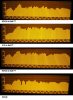
I hope this stuff will be useful to you; I haven't had time to do as much as I would like.

In listening tests so far (I don't listen at high volume, FYI,) I found the 6x6 sounds better with the 210. The 210 however can sound sibilant (5-8k region,) depending on the recording on that w'guide.

The HD120 tends to emphasize the "shhh" (4-5k,) and does not have the air the Selenium does.

My home tests of the 8x8 PTs are a bust because I find the 210s don't sound like the 220s do on them, which are flatter on that waveguide. My 220s are in the classroom, so I can't compare directly right now.

I hope to set up a pair with the XD120s on Econo crossover tonight and hear a movie with them. Check out the imaging, etc..

All I can do right now.
Will try the 18 Sound horn on BMS 4552ND eventually for reference.
attachment.php
 

Attachments

  • post12-27-08.jpg
    post12-27-08.jpg
    57.4 KB · Views: 578
Back
Top Bottom