on another note, any benefit to moving up to this big-@ss econowave?


You are using an out of date browser. It may not display this or other websites correctly.
You should upgrade or use an alternative browser.
You should upgrade or use an alternative browser.
Zilch's AK Design Collaborative - Econowave Speaker
- Thread starter Zilch
- Start date


http://audiokarma.org/forums/showthread.php?p=1726116#post1726116I came across these two reviews, though I'm not sure if either is the one to which you were referring:
New Speakers in Da' House- JBL S2600
JBL 4430 vs S3100 vs S2600 in home
All of this leads me to conclude that accurate imaging results when the audio signal from left and right channels arrives at the listening position according to (at least) three theretical aspects:
1. frequency response must be the same (including any reflections)
2. amplitude must be the same
3. arrival time must be the same
Amplitude can override arrival time, but ultimately, precedence prevails and limits the utility of the "trick" in small spaces. Geddes claims a sweet spot the width of his couch.
It's real, and so much so as to be disconcerting when first experienced, after which you succumb to the pleasure of listening as a social experience rather than a solitary one.
Only to the determinedly resourceful DIYer.Are S2600 horns available?
Very similar.How do the Everest I/S2600 style asymmetric horns compare with Econowave for the equidistant listener?
Not, basically. While the effect is generated via narrowing vertical dispersion inboard, it is normalized by the system vertical nulls.Do the asymmetrics create any other problems, such as with the reflected sound that makes them undesirable?
Check out the 108 dB sensitivity of this implementaton:on another note, any benefit to moving up to this big-@ss econowave?
http://www.jblpro.com/catalog/support/getfile.aspx?docid=810&doctype=3
I don't know the difference between 2374 and 2384; they are both vertically asymmetric....

Edit: 2384 is 1.5" throat, apparently.

Kegger
R.I.P. 1/12/1966 - 6/1/2017
RTA of Eminence APT driver on standard E'Wave crossover:
First on Crites Tweeter (APT 50 on Crites horn -- made for Klipsch Heritage series to replace K-77 or T35.)
Next on APT200, integral driver horn assembly:
http://www.parts-express.com/wizards/searchResults.cfm?searchFilter=eminence+apt&FTR=&search_type=main&WebPage_ID=3&x=0&y=0
Then APT 50, using APT 200 screw on adapter, with 6x6 PT.
Finally APT 50 ...with 8x8 PT.
The crites tweeter, so small, actually sounds good, as does the APT 200. The top end is cleaner in all instances when compared to the 18 Sound HD120.
The APT on 6x6 is very good.
My Heresies sacrificed for the experiment. So I'll listen to this on 6x6PT for a while, but it's not permanent. Crites tweeters go back into Klipsch, and the 6x6 will be installed along with 18Sound HD120; it's pretty good too; they get donated to the school radio station.
PS: My measurement mic has a few dB hump centered at 10kHz.
Nice info thanks,
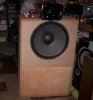
At the moment I'm playing with JBL 2225 in a cab I got from Andy that we retrofitted to
get the woofer all the way up to the top of the cab. (we all love pic's as well here right?)
Thanks Andy for the cab and the extra work involved. :thmbsp:
First Impressions on the XD-120's they didn't seem to be as inviting in it's lower registers
and the top end not as crisp an clean as I woulda hoped for, but with some xover tweaks
and some playing time on them they are a bit better sounding to me now.
Attachments
Kegger
R.I.P. 1/12/1966 - 6/1/2017
The first order of improvement is better drivers. The E'waveguide will play nicely down to ~1 kHz, and its constant directivity behavior is tough to beat. The Seleniums are the limiting factor, presently.... :yes:
You'll get no argument from me there Zilch, but I'd still be interested in a larger
horn with simular aspects that was "obtainable" I've got a few drivers around in
my stash that I'd like to play with on a different and larger horn.
I have and have had smallish to medium sized horns but never had the larger ones
in my own home, I'd be plenty temtped by a reasonably priced BIG HORN to try.


skywave-rider
Slumming in Akihabara
I DO love pics.

Sorry, had to do it.
That lovely 2225 looks like an 18" next to the 18Sound!
I admit, I'm jealous I don't really have room for the larger drivers.
If you feel like posting any of your x-over tweaks, I'm sure it will be of interest.
I will put my BMS on the 18Sound guide and if it looks interesting I'll post. Not Econo, though.
Regarding bigger guides and horns, I currently use the standard E'Wave-guide and Eminence H290 crossed at 1200 on Zilch's Z-19 crossover; and the E'Wave-guide on Wayne's 4Pi x-over (that's 1600.):tresbon:
Wait, you mean really big horns then, do you?
Sorry, had to do it.
That lovely 2225 looks like an 18" next to the 18Sound!
I admit, I'm jealous I don't really have room for the larger drivers.
If you feel like posting any of your x-over tweaks, I'm sure it will be of interest.
I will put my BMS on the 18Sound guide and if it looks interesting I'll post. Not Econo, though.
Regarding bigger guides and horns, I currently use the standard E'Wave-guide and Eminence H290 crossed at 1200 on Zilch's Z-19 crossover; and the E'Wave-guide on Wayne's 4Pi x-over (that's 1600.):tresbon:
Wait, you mean really big horns then, do you?
2352. It's 1.5" throat, but you'll be going there eventually anyway, and 1" throat adapters will work in the meantime.
[Give Coytee's Jubilees some serious competition.... :thmbsp: ]
http://audioheritage.org/vbulletin/showthread.php?t=13581
[Give Coytee's Jubilees some serious competition.... :thmbsp: ]
http://audioheritage.org/vbulletin/showthread.php?t=13581
Kegger
R.I.P. 1/12/1966 - 6/1/2017
"If you feel like posting any of your x-over tweaks, I'm sure it will be of interest.
I will put my BMS on the 18Sound guide and if it looks interesting I'll post."
Once I get a xover I feel is really working well, yes I will post the schematic for
those who may be interested in it. (trying some different things here)
Question: Have we/anyone done an impedance sweep of an Enonowave setup?
(Probably in the thread here somewhere)
By the way, I'm running out of room here FAST!
I will put my BMS on the 18Sound guide and if it looks interesting I'll post."
Once I get a xover I feel is really working well, yes I will post the schematic for
those who may be interested in it. (trying some different things here)
Question: Have we/anyone done an impedance sweep of an Enonowave setup?
(Probably in the thread here somewhere)
By the way, I'm running out of room here FAST!
skywave-rider
Slumming in Akihabara
2352. It's 1.5" throat, but you'll be going there eventually anyway, and 1" throat adapters will work in the meantime.
[Give Coytee's Jubilees some serious competition.... :thmbsp: ]
Zilch,
The 2352 shows really steady horizontal coverage at 90 degrees, but the vertical narrows down to 30 at 6.3kHz. A characteristic of bi-radial horns? I assume it's not a problem used with greater listening distances, like in a theater.
Looks cool, though.
Edit: It's "optimized aperture" not bi radial.
HUH?Question: Have we/anyone done an impedance sweep of an Enonowave setup?
Why, right there at post #2768, of course....

http://audiokarma.org/forums/showthread.php?p=2303272#post2303272

Duffinator
Spin The Black Circle
I'm curious what you're trying to gain with a larger horn over the econo or PT waveguide? More dynamics, volume, directionality?You'll get no argument from me there Zilch, but I'd still be interested in a larger
horn with simular aspects that was "obtainable" I've got a few drivers around in
my stash that I'd like to play with on a different and larger horn.
I have and have had smallish to medium sized horns but never had the large ones
in my own home, I'd be plenty temtped by a reasonably priced BIG HORN to try.
Interestingly, the smaller 2381 does the identical directivity thing. They both head immediately back to 50° at 10 kHz, tho, so they're not "beamy" in the conventional sense, like the Klipsch Tractrix.... :thumbsdn:Zilch,
The 2352 shows really steady horizontal coverage at 90 degrees, but the vertical narrows down to 30 at 6.3kHz. A characteristic of bi-radial horns? I assume it's not a problem used with greater listening distances, like in a theater.
Better pattern control down to 800 Hz and below, if the driver will support those frequencies.I'm curious what you're trying to gain with a larger horn over the econo or PT waveguide? More dynamics, volume, directionality?
[Also, imaginary gonadotrophia and "big horn" braggin' rights....
]
Duffinator
Spin The Black Circle
:lmao:Better pattern control down to 800 Hz and below, if the driver will support those frequencies.
[Also, imaginary gonadotrophia and "big horn" braggin' rights....
What about the larger (wider and not very tall) waveguides I first heard the 2452H-SL's on? The ones in the custom cabinets. They are larger! How low do they play?
skywave-rider
Slumming in Akihabara
So then to follow up on Duffinator's question, what's the attraction? Personally, I do think it's cool, industrial art; I guess the lower crossover point, it looks like a real 500Hz horn. But better power response can be had perhaps in our cheap waveguide. Sensitivity?
EDIT: Oh...stupid me..."gonadotrophia!"
EDIT: Oh...stupid me..."gonadotrophia!"
Kegger
R.I.P. 1/12/1966 - 6/1/2017
Yes "gonadotrophia" that is what I'm after. .. They do look rather cool!
I know shame on me for talking about the subjective sound, but larger horns that I've
heard just "sound" bigger and the music just kinda falls out of it with an ease that the
smaller horns just don't seem to do as well. Plus yes the lower xover point to mate to
the larger woofers a bit better. So I'd just like to experiment with some on my own to.
.. They do look rather cool!I know shame on me for talking about the subjective sound, but larger horns that I've
heard just "sound" bigger and the music just kinda falls out of it with an ease that the
smaller horns just don't seem to do as well. Plus yes the lower xover point to mate to
the larger woofers a bit better. So I'd just like to experiment with some on my own to.
Those are smaller than E'Wave, actually, JBL Consumer biradials, H4348. JBL plays them down to 800 Hz, as I recall. $800 a pair unobtanium.What about the larger (wider and not very tall) waveguides I first heard the 2452H-SL's on? The ones in the custom cabinets. They are larger! How low do they play?
There's an inherent transparency to the big horns that's hard to describe. The TOTL JBL Consumer horns have that, too, and the big TADs.So then to follow up on Duffinator's question, what's the attraction? Personally, I do think it's cool, industrial art; I guess the lower crossover point, it looks like a real 500Hz horn. But better power response can be had perhaps in our cheap waveguide. Sensitivity?
[We're talking megabucks here, tho.... :yes: ]