• The move to the new server is done. There are some software and database maintenance updates in process. This has us passing the hat around to help out. We appreciate any donations. Seriously, even a dollar helps. The payment page may be found here - https://www.audiokarma.org/support.html

Zilch's AK Design Collaborative - Econowave Speaker

Oh, wow. I am learning stuff with no effort at all on my part. It's like Speakers 101.

My first thought about time delay was that the diaphragm on a compression driver was just a brief cone in the middle of the voice coil, while the part that actually made sound on a woofer was the cone, which is greatly ahead of the voice coil. But it seemed like everybody who did "time aligned" speakers basically seemed to align the voice coils. I never considered the weight of the moving mechanism. But the point is well taken. It may serve well when time alignment becomes something that will get studied by yours truly.

Learning how use the RTA and electronic crossover has been a fabulous experience for me. And I haven't really even started. Scary, isn't it?
 
Learning how use the RTA and electronic crossover has been a fabulous experience for me. And I haven't really even started. Scary, isn't it?
Surprise is no longer an element in the on-going discovery of my own ignorance about these matters.... ;)
 
I finished my baffles and made cutouts for the components. My workmanship is craptastic.
:tears:

Unfortunately, I just read Wayne Parham's info Zilch provided a link for. My center to center distance is 10.25". But I do have 1/4" up/down play in waveguide position. Have not screwed that in yet. It might matter little at this point, but I'd like to optimize that spacing given the small amount of play I have.

So in attempting to do the AES paper math Parham shows, I realized I do not know what value to use for the Econowave crossover frequency. My assumption is that it is asymmetrical, and the acoustical crossover point will end up being about 1.6kHz. Sound right?

Mxlews and I struggled with time alignment in our C38s. Like you, we followed conventional wisdom and found that with the woofers mounted on the rear of the baffle, the physical alignment of the voice coils was nearly perfect. Measurements revealed that the LF lagged the HF, however, thus aiming the axis of time alignment downward toward our ankles.

HUH? We WANT the woofer voice coil ahead of that of the compression driver? The answer (I think) is that the mass of the moving assembly of the woofer has an inherent electro-mechanical delay, much like the response time of a conventional PM DC motor, and mounting it on the front of the baffle made for an improved time alignment.

You can check this out using the equipment you have. Invert the phase of the HF on the CX3400, and then watch the null at crossover on your RTA move up and down as you adjust the LF delay control. I believe you'll find that the maximum depth will occur with the woofer front-mounted, and the delay near zero. With the phase restored to normal, that's the alignment of maximum driver summation.

Another method of verification: with phase inverted and no delay, move the mic up and down to find the height at which the notch is deepest. The angle between there and horizontal to the midpoint between the drivers is the "tilt" of the plane of time alignment. Ideally, that's aimed at listening height with normal phase.... :thmbsp:

http://www.audioroundtable.com/PiSpeakers/messages/11054.html
 
Sound right?
Approximately, yes.

It's going to vary depending upon your lowpass filter.

Invert the phase on your HF driver and move the mic up and down for a deep notch to verify that's in the same range.

The further apart the drivers are, the less sensitive the tilt angle is to displacement of the acoustic centers.

I will illustrate with my divining rod.... :yes:
 
I will illustrate with my divining rod.... :yes:

Knowing you, I am expecting magic....


Common sense now kicking in. 1/4" at approx. 1.6kHz is meaningless. Perhaps would matter when spacing super-tweeter to HF in a 3 way.

When the other el-cheapo waveguides come in, I'll try to optimize that baffle before cutting out the holes.

PS: I got fiberglass...muahahahahahaha!
 
Knowing you, I am expecting magic....

PS: I got fiberglass...muahahahahahaha!
Fire 'em up.

PS: You have just kicked this thread into the top 10 reader interest (Views) AK Loudspeaker Forum threads of all time.

[It was already #4 in wordiness (Replies).... :p: ]
 
Zilch,

Now the Econowaveguide, Selenium and L-pad are on the way to me, Australia. Total price about $200 including postage to Aust. I should receive them next week.

Again thanks to Zilch and my friend Chad in Ohio who are sending the Selenium and L-pad from PE to me.
 
You are welcome, of course.

That's somewhat less than you had anticipated, as I recall.

We'll know how EconoWave sounds on the other side of the world (and down under) soon.... :thmbsp:
 
AustraEconoWaveGuidicus...a new species soon to be discovered?

a few questions about the practical implementation of the econowave:
1. what is the height of the econo wave guide? (measured at center, outside edge; i couldn't find it)

2. i was planning to use the 4550 (i know, econowave heresy) and actively cross it around 1000-1100 hz (to a 15" woofer). using the linkwitz calculation from the parham article, i calculate center to center spacing of 10.2-11.2" inches. is this about right or have i failed pythagoras?

3. the truly stupid question. for many of these two-ways, the horn seems to sit naturally 'low'. when this is the case, is it better to physically tilt the speaker back or to electronically tilt the coherent space up by delaying the signal to the tweeter?

4. what is the practical importance of setting the wave destruction at the edge of vertical directivity control? is +/-5 degree audible? +/-10 degrees?

5. for smooth transition in directivity from 90 degree wave guide to the woofer, i calculate the ideal crossover point to be right around 1000hz. (1130 fps / (13.5"/12")). is this correct? if so (and my guess that the waveguide is 6.4" tall is correct), then i calculate 53 degrees off axis for nulls, which is a little larger than the 50 degree directivity of the econo wave. so again, is this audible?
 
1. what is the height of the econo wave guide? (measured at center, outside edge; i couldn't find it)
6.5" overall. It's in the summary at #228.

2. i was planning to use the 4550 (i know, econowave heresy) and actively cross it around 1000-1100 hz (to a 15" woofer). using the linkwitz calculation from the parham article, i calculate center to center spacing of 10.2-11.2" inches. is this about right or have i failed pythagoras?
Seems right. There is some flexibility here.

3. the truly stupid question. for many of these two-ways, the horn seems to sit naturally 'low'. when this is the case, is it better to physically tilt the speaker back or to electronically tilt the coherent space up by delaying the signal to the tweeter?
Physically. You can't tilt the dispersion pattern electrically, as that is controlled by the horn and where it's aimed. All you're tilting is the plane of time alignment that way. Physically, you can tilt the baffle, tilt the waveguide alone, or raise its axis up toward listening height.

4. what is the practical importance of setting the wave destruction at the edge of vertical directivity control? is +/-5 degree audible? +/-10 degrees?
It augments the directivity control. Looking at the Geddes data, while the FR and SPL are tightly controlled within the design vertical beamwidth, they do not fall away precipitously outside of it, rather, they attenuate gradually. For ideal control, one might desire the SPL to shut off completely and immediatly outside that window. The nodes may be manipulated to "steer" where that occurs, for example, to minimize floor and/or ceiling reflections.

5. for smooth transition in directivity from 90 degree wave guide to the woofer, i calculate the ideal crossover point to be right around 1000hz. (1130 fps / (13.5"/12")). is this correct? if so (and my guess that the waveguide is 6.4" tall is correct), then i calculate 53 degrees off axis for nulls, which is a little larger than the 50 degree directivity of the econo wave. so again, is this audible?
In theory, yes. The best way to determine the result is to measure in the final alignment. Some systems sound better than others, and some just sound "right." These are all factors in making that happen.... :thmbsp:
 
Econowave grows and grows....Now there is another thread "Cheap Horns" which I have infected with econowave! I see it has now spread to Aussie land as well, so its impact is now "international" as well:thmbsp: Is this ready for stickification yet?

Russellc
 
Up and Running

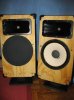
OK, got 'em up and running. Will try to measure today to see what's up in the low pass.
:D
attachment.php
 

Attachments

  • IMG_2131.jpg
    IMG_2131.jpg
    71.5 KB · Views: 654
Are these sealed, or ported out the back? How many cu ft is the box?

Thanks,
Russellc

Hi Russell,
They are about 2 cubic ft. but I did not calculate for woofer and waveguide. I also gained some volume from hacking out the old baffle and slapping a new one on top of the wreckage. Sealed, used closed cell foam strips on the baffle, woofer and waveguide.

I'm also sporting screw-on Seleniums now.

And what's that grille you've got there?

That's salvaged from the original speaker. It's secured with velcro.
 
Back
Top Bottom