

You are using an out of date browser. It may not display this or other websites correctly.
You should upgrade or use an alternative browser.
You should upgrade or use an alternative browser.
Zilch's AK Design Collaborative - Econowave Speaker
- Thread starter Zilch
- Start date


Bauhausler
Rational Subjectivist
OK, I'm confused. Are you saying I can bypass the DAC in my CD player for one that is in the active crossover???
The DEQ2496 is an EQ without crossover functions. I'll be using it in place of the external EQ required by the KEF speakers. It's possible that your XOVR has a similar digital input. If so it's worth trying.
FYI, the Dayton "Classic" 15" is on sale right now. 24% off with free shipping.
15" on sale for $49. Frequency range: 20-1,500 Hz
http://www.parts-express.com/pe/showdetl.cfm?Partnumber=295-325
12" is still the same old $36. Frequency response: 25-2,500 Hz
http://www.parts-express.com/pe/showdetl.cfm?Partnumber=295-320
15" on sale for $49. Frequency range: 20-1,500 Hz
http://www.parts-express.com/pe/showdetl.cfm?Partnumber=295-325
12" is still the same old $36. Frequency response: 25-2,500 Hz
http://www.parts-express.com/pe/showdetl.cfm?Partnumber=295-320

skywave-rider
Slumming in Akihabara
I got some extra 6x6s recently because I wanted to swap out the 8x8s in one of the systems I installed. I'm using the 6x6 at home right now and I like them.
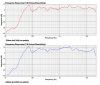
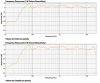
I measured the differences shown here at 1 meter on axis with the tweeter. I get best flattest response with the 6x6 and D220 driven + to +. With the 8x8, I had best response + to - (reverse) polarity.
However, when I compare to my D210s, best response with the 6x6 waveguides is with reverse polarity.
So, am I running the 6x6s with D220 drivers "backwards" when running pos to pos, even though the summation looks better?


I measured the differences shown here at 1 meter on axis with the tweeter. I get best flattest response with the 6x6 and D220 driven + to +. With the 8x8, I had best response + to - (reverse) polarity.
However, when I compare to my D210s, best response with the 6x6 waveguides is with reverse polarity.
So, am I running the 6x6s with D220 drivers "backwards" when running pos to pos, even though the summation looks better?
Attachments


HatchetJack
Chillin' The Most
Great job on your e-wave buildup vette1220. I will slide by sometime in
the next day or 3 for a listen.How do those Dayton Classics sound?
the next day or 3 for a listen.How do those Dayton Classics sound?
Bauhausler
Rational Subjectivist
FYI, the Dayton "Classic" 15" is on sale right now. 24% off with free shipping.
15" on sale for $49. Frequency range: 20-1,500 Hz
http://www.parts-express.com/pe/showdetl.cfm?Partnumber=295-325
12" is still the same old $36. Frequency response: 25-2,500 Hz
http://www.parts-express.com/pe/showdetl.cfm?Partnumber=295-320
I bought a pair of the 15s at regular price. It's not a 'bargain basement' driver. Very good build quality at the price. I have them in (5.5 cu ft ported) Valencia cabs, where they're less sensitive than the original Altec driver but have much better ouitput below 60 hz. I have tried them as 2-ways only with the original Val crossover and 811B. I have not tried them as a 2-way with the ewave, but the 1600 hz crossover point might present challenges for this great big paper cone.

The big difference in the waveguides is their depth, of course, and it's easily seen that, with both mounted on a flat baffle, the 8" pushes the driver and the acoustic center of the driver/waveguide combo further back relative to that of the woofer, though without measuring their relative time alignments, I hesitate to speculate which is more "in line."So, am I running the 6x6s with D220 drivers "backwards" when running pos to pos, even though the summation looks better?
The differences are apparent in the crossover region in your measurements, though it's clear they are not major, as no deep "notch" appears, rather, a more broadband, low "Q" rise/fall in the summation. Calculate the half-wavelength at those frequencies. The vertical nulls have likely shifted, as well. It's trade-offs we're talking here, and bottom line, once these are understood, which sounds best to you?
As to D210 vs. D220, the geometries are apparently sufficiently different to affect their alignments in different ways, further evidence that, in detail, each driver/waveguide combination stands separate in terms of what is "optimum." I did a very interesting study of the performance of the full range of available 1.5" PT waveguides using two very similar HF compensation filters, all with the same driver, over on LHF a couple of weeks ago, which illustrates this. It begins here, but the comparative action appears on the following page:
http://www.audioheritage.org/vbulletin/showthread.php?t=24291&page=5
Generally, your D210 vs. D220 study affirms my original findings as shown in Post #1 of this thread with respect to HF/VHF extension, and why they sound different in the way(s) they do, and it's easily seen why I prefer D220 with Jack's E'Wave HF comp components. Those could be adjusted to bring D210 into performing more nearly the same, but it would mean, effectively, more "boost" in that region, (your curves tell us how much,) which might not be accomplished without sonic consequences. You might try that, using my empirical analysis of Wayne's chart as a guide, and see (hear) what happens. Fun stuff, all of this.... :thmbsp:
Last edited:

jackgiff
Well-Known Member
I got some extra 6x6s recently because I wanted to swap out the 8x8s in one of the systems I installed. I'm using the 6x6 at home right now and I like them.
I measured the differences shown here at 1 meter on axis with the tweeter. I get best flattest response with the 6x6 and D220 driven + to +. With the 8x8, I had best response + to - (reverse) polarity.
However, when I compare to my D210s, best response with the 6x6 waveguides is with reverse polarity.
So, am I running the 6x6s with D220 drivers "backwards" when running pos to pos, even though the summation looks better?
When I first tried the D210Ti's versus the D220Ti, there didn't seem to be much difference in performance. Now the FR's of the latest D210Tis' seem to be a little more jagged across the range than the D220Ti's, but I haven't seen any drop off in the upper range like your waveforms show. Your FR's of both D210's on the 6 X 6 with reverse polarity look strangely like the D220 on the 6 X 6 with reverse polarity. How come the D220's FR straightens out due to reversing the drivers connections, while the D210's doesn't? Are all of the FR's measured with the drivers in the exact same positions each time?
I have extra waveguides and drivers here. Maybe I will take some measurements this next week, if time allows, and see what results I get. That would be very difficult to explain why one driver improves but the other doesn't. Maybe they will name the "effect" after you. :yes:
Bauhausler
Rational Subjectivist
FWIW, when I've swapped the 220 and 210 drivers on PH612 in the same setup the 220s I have sound slightly airier and more extended. Not night/day but enough to prefer the 220 as returning more information to my ear.
YMMV.
YMMV.
skywave-rider
Slumming in Akihabara
...Maybe they will name the "effect" after you. :yes:
Lord I hope not.

Well, I got the 210s some months ago, but yes, they are not from the era when you started Econowave, Jack. They must have changed along the way. I think they are NLA, at this point anyway.
There are a few interesting and odd things about the graphs, that's why I posted them. The positions are precise and exact, and I swapped the HF, used the same LF for those readings.

It's official...
Well, I'm finally into the building stage of an E-wave combo... in a BIG way.
Anime Weekend Atlanta is expanding its panel room space due to higher attendance expectations, and as such, needs a new pair of large panel-room speakers... for video, voice, music and such, in about a 10000 square foot room (about 120 feet wide and 80 feet long). So, I've got most of the parts (and am about to build the cabinets this weekend) for a DOUBLE 15 E-Wave setup. Got a pair of the Pyle PH612 horns, a pair of D220Ti's, and four good TOA 15" woofers (similar to, of all things, Radio Shack Mach 1 woofers, more than anything else, except with lighter-mass foam-edge cones)... it's going to be a 2.5 way setup, with the "helper" woofer crossed over at around 100 Hz or so. Probably will wind up around 96db sensitivity... I'm gathering parts to try both the normal E-wave and the above-95dB crossover versions, so I will be prepared, no matter which way it goes.
Cabinet is going to be around 8.2 cubic feet (4.1 per woofer), tuned into the mid-to-high-20-something Hz range, most likely. I've found that 2.5 way setups seem to like lower port tunings than the simulation programs recommend, so I'll start with a long port and trim to suit.
The dimensions will be around 49"H x 21"W x 18"D. Will put the drivers as far up on the baffle in height, as possible, so that they can "get over the crowd" better.
These speakers are slated to run off a Carvin F600 amp (300w/ch into 4 ohms, which is what it'll be with the double-woofers). Should be plenty of noise. I'm guessing right around 120dB before clipping...
Am still wondering what color to paint these... hmmm... wonder if that gallon can of red floor enamel is still any good? That's what I used to paint the "Big Reds" before (double 18, double 6.5, Eminence APT horn tweeter)... it's held up really well, and you can't mistake them for anything else! If I do this, I guess these will be the "Little Reds"... though, they're not exactly little!
Will post a few pics, if I get a chance, soon...
Well, I'm finally into the building stage of an E-wave combo... in a BIG way.
Anime Weekend Atlanta is expanding its panel room space due to higher attendance expectations, and as such, needs a new pair of large panel-room speakers... for video, voice, music and such, in about a 10000 square foot room (about 120 feet wide and 80 feet long). So, I've got most of the parts (and am about to build the cabinets this weekend) for a DOUBLE 15 E-Wave setup. Got a pair of the Pyle PH612 horns, a pair of D220Ti's, and four good TOA 15" woofers (similar to, of all things, Radio Shack Mach 1 woofers, more than anything else, except with lighter-mass foam-edge cones)... it's going to be a 2.5 way setup, with the "helper" woofer crossed over at around 100 Hz or so. Probably will wind up around 96db sensitivity... I'm gathering parts to try both the normal E-wave and the above-95dB crossover versions, so I will be prepared, no matter which way it goes.
Cabinet is going to be around 8.2 cubic feet (4.1 per woofer), tuned into the mid-to-high-20-something Hz range, most likely. I've found that 2.5 way setups seem to like lower port tunings than the simulation programs recommend, so I'll start with a long port and trim to suit.
The dimensions will be around 49"H x 21"W x 18"D. Will put the drivers as far up on the baffle in height, as possible, so that they can "get over the crowd" better.
These speakers are slated to run off a Carvin F600 amp (300w/ch into 4 ohms, which is what it'll be with the double-woofers). Should be plenty of noise.
I'm guessing right around 120dB before clipping...Am still wondering what color to paint these... hmmm... wonder if that gallon can of red floor enamel is still any good? That's what I used to paint the "Big Reds" before (double 18, double 6.5, Eminence APT horn tweeter)... it's held up really well, and you can't mistake them for anything else!
If I do this, I guess these will be the "Little Reds"... though, they're not exactly little!Will post a few pics, if I get a chance, soon...
Last edited:
skywave-rider
Slumming in Akihabara
... I did a very interesting study of the performance of the full range of available 1.5" PT waveguides using two very similar HF compensation filters, all with the same driver, over on LHF a couple of weeks ago, which illustrates this. It begins here, but the comparative action appears on the following page:
http://www.audioheritage.org/vbulletin/showthread.php?t=24291&page=5
Generally, your D210 vs. D220 study affirms my original findings as shown in Post #1 of this thread with respect to HF/VHF extension, and why they sound different in the way(s) they do, and it's easily seen why I prefer D220 with Jack's E'Wave HF comp components. ...
Thanks for your reply, Zilch.
I had been following that thread over on LHF for a little while, but am now caught up. I don't want to get lusty for 2452H-SLs. But your point is well taken about how all these aspects of design and individual components, including waveguides, must come together for best results, and best results does not necessarily mean the flattest most extended output from any driver.
Having said that, I think the 220s on the 6x6 sound remarkably good, flat and extended. Add to this the fact that those small waveguides are a few bucks, and the drivers cheap...:thmbsp:
I will try to listen to them in reverse polarity if I can get an extended session in. For now I have left them in pos polarity hookup and they are good.
I realized only after staring at the pics for a while that the best summation, to my eye, is subtractive. In my limited experience doing this stuff, I've always looked for the acoustical outputs of both drivers to add together and achieve a flat response. Here, I think I'm doing the opposite to achieve the same effect, and I don't know if that's common.
skywave-rider
Slumming in Akihabara
I can actually do overlays now. :stupid:
skywave-rider
Slumming in Akihabara
Well, I'm finally into the building stage of an E-wave combo... in a BIG way....
Will post a few pics, if I get a chance, soon...
Can't wait!
I'm all for flat black, but glossy enamel sounds appropriate for the venue.

vette1220
New Member
Ewave
Hi there i used the 12" dayton classic woofer.my crossover board is made from 3/4" dense plastic that worked out great.jbl horn and selenium driver.not for sure what the cabinet is but it is one inch shorter than the hpm100 cabinet.i lined the cabinets with a thin layer of fiberglass with a 3 1/2" fiberglass batt on the back panel. I put a 3"round x 3"deep port same as the hpm.powered by a pioneer spec system for the moment.an use a modified playstation one scph 1001.thanks for the speaker info because these things sound awesome.
Hi there i used the 12" dayton classic woofer.my crossover board is made from 3/4" dense plastic that worked out great.jbl horn and selenium driver.not for sure what the cabinet is but it is one inch shorter than the hpm100 cabinet.i lined the cabinets with a thin layer of fiberglass with a 3 1/2" fiberglass batt on the back panel. I put a 3"round x 3"deep port same as the hpm.powered by a pioneer spec system for the moment.an use a modified playstation one scph 1001.thanks for the speaker info because these things sound awesome.
jackgiff
Well-Known Member
Well, I'm finally into the building stage of an E-wave combo... in a BIG way. ...
Will post a few pics, if I get a chance, soon...
Atta Boy, Gordon. We are all anxious to see them "Little Reds."

HatchetJack
Chillin' The Most
I went by vette1220's this afternoon and had a quick listen.We played around with the placement and got them up off the floor and onto
some bar stools and I can confirm they sound awesome.I was pleasantly
surprised by the Dayton 12" classics and I think they sound just as good
as my hpm 100 e-waves and they dont have much break in time yet.Great job Vette.:thmbsp:
some bar stools and I can confirm they sound awesome.I was pleasantly
surprised by the Dayton 12" classics and I think they sound just as good
as my hpm 100 e-waves and they dont have much break in time yet.Great job Vette.:thmbsp:
Bauhausler
Rational Subjectivist
I took the plunge
Okay. I ordered the measurement mic to go with the Behringer DEX2496. I sincerely hope that having a new measurement toy doesn't send me permanently into Tweak Mode.
I'm going to be trying out the D220Ti/PH612 ewave combo as a sub for the 075 tweeter in a pair of JBL Barons I sold a friend. Initially I'll use the Ewave crossover and wire directly to the D130, bypassing the JBL crossover. The WG will sit on top for convenience. If I know him we'll shortly be cutting a new pair of baffles for the Baron cabinets. Scratch that. The PH612 will not fit in a Baron with a D130. Luckily the woofer position is OK for using the PH612 on top of the Baron cabinet.
Aaaannnd the EQ arrived today along with the KEF 103.3 speakers that I'll be using it with. I don't know when I'l lbe able to start using it. Probably after I do a LOT of reading in the manual. I have the speakers running with the KEF 103.3 KUBE I got with my other pair. They're fine except for moderate ugliness due to repainting, but they were cheap.
I'll have to open the speakers up for some repairs. The dustcap/foam ring on the woofers will need replacing and the parts are on order for that. I'll go through the crossover and replace the electrolytic caps in the tweeter and mid circuits with film foil caps and bypass some of the other electrolytics.
Okay. I ordered the measurement mic to go with the Behringer DEX2496. I sincerely hope that having a new measurement toy doesn't send me permanently into Tweak Mode.
I'm going to be trying out the D220Ti/PH612 ewave combo as a sub for the 075 tweeter in a pair of JBL Barons I sold a friend. Initially I'll use the Ewave crossover and wire directly to the D130, bypassing the JBL crossover. The WG will sit on top for convenience. If I know him we'll shortly be cutting a new pair of baffles for the Baron cabinets. Scratch that. The PH612 will not fit in a Baron with a D130. Luckily the woofer position is OK for using the PH612 on top of the Baron cabinet.
Aaaannnd the EQ arrived today along with the KEF 103.3 speakers that I'll be using it with. I don't know when I'l lbe able to start using it. Probably after I do a LOT of reading in the manual. I have the speakers running with the KEF 103.3 KUBE I got with my other pair. They're fine except for moderate ugliness due to repainting, but they were cheap.
I'll have to open the speakers up for some repairs. The dustcap/foam ring on the woofers will need replacing and the parts are on order for that. I'll go through the crossover and replace the electrolytic caps in the tweeter and mid circuits with film foil caps and bypass some of the other electrolytics.
Last edited: