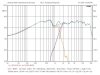
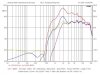
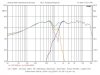
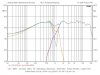
Zilch, looks like your way of doing it works pretty good too. The LE14A is a lot easier to use as a woofer than the 2214H. The cheap JBL woofer from the Decade 38 really surprised me. It was decent, mated well, and sounded very good. Looks aren't everything, are they?
Both JBL Pro and Consumer apparently know what they're doing in woofer design, and what are the rational compromises at different price points. Like their crossovers, the woofers are custom for the intended applications, but fortunately, there's often enough technical information available to provide guidance in using them for DIY. There are also "discoveries" to be made, like the fact that while JBL never made any closed-box products (other than some contemporary subs,) certain JBL woofers are well-suited to that use.
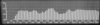
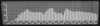
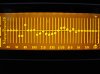
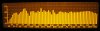
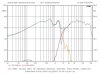
Does Clio get better readings than the Behringer RTA? It looks like you have a drop of about 8 db between roughly 6 KHz and 20 KHz. My RTA doesn't show that drop as being in the response of the D220Ti. What could cause this difference?
This series of measurements is all quasi-anechoic using time-windowed MLS to remove the influence of room reflections. RTA is "in-room" response, basically. If you EQ or comp flat in MLS, it will generate a downward-sloping response on RTA, generally accepted as desireable. Conversely, if you EQ or comp flat on RTA, it will be perceived as too "bright" by many listeners. That's why your DEQ2496 has a "Room correction" option in AutoEQ. Try that with any system to hear the ~1 dB/octave difference. :yes:
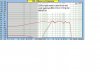
It looks like the response where the 2 KHz hump was corrected falls very fast as the crossover frequency is increased slightly, just as it did with the hi pass correction. The HF wave form goes from a sharp leading edged waveform to a large rounded off one over a very large frequency range as your crossover frequency is increased from 1132 to 1808 Hz.
Yes, it's a resonance, I believe, and "snaps" in and out depending upon whether there is enough energy at the requisite frequency to excite it, as you experienced dialing the frequency around. There's also a smaller one apparent at 4 kHz. Clearly, notching 2 kHz down has rendered this more manageable, and we're not locked into so narrow a range of frequencies to yield predictable results. Using the active crossover frequency to tame it is a crap shoot, in my view, whereas the objective here is to provide a wide range of adjustability for optimally matching E'Wave to woofers having different response capabilities.
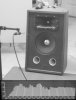
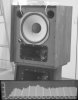
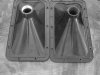
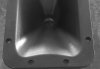
I moved the 2214H's to the front of the baffle, but inset then about a tenth of an inch, so that they will clear the grille cloth. I plan to also inset the Waveguides about 1/4 inch, so they are just even with the front of the baffle. This will make it easier to adapt the present grilles, and also make the time delay a bit closer. You were correct, with the woofer on the outside, the time delay is almost exactly at zero.
Excellent! I will soon have my own upsized (and upscaled) Baronets here so we can do apples and apples with them. :thmbsp:
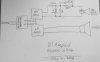
How about showing us a schematic of your correction methods, so we may try it ourselves?
I'm documenting that today, and I'll PM you what I have done, but it's not ready for prime time. My notch is brute force, so the impedance is probably quite nasty. Also, my Bridged-T compensation is not as optimum a contour as what you have already designed for this driver/waveguide combination. I'm just suggesting that you're not quite done yet.

:
I can hear you groaning at the thought, but my purpose here is primarily to demonstrate that, additional components notwithstanding, there is substantial merit and value in addressing the compensation and the 2 kHz peak separately, and since you understand it far better than me, I'm hoping you might try this with the Pi-speaker compensation for an even better result. Perhaps a parallel notch is a better answer, if you can get the "Q" high enough. E'Wavers using the active approach are not going to have an issue with an additional $15 in component costs that yields a more universally applicable and more easily integrated "ideal" HF module....