Well I know times are tough right now for a bunch of folks but I got screwed on the bass bins. Went to pick them up and the lady said her kids sold them an hour after we made the deal. She did give me my money back at least. Funny how her kids sold them when the ad only had her name attached. Really bummed.....I think these would have been the keepers in the den. Like an idiot I already bought the 2235 recone kits from simply speakers last night. AARRRGGGHHHHHHHHHHHHHH


You are using an out of date browser. It may not display this or other websites correctly.
You should upgrade or use an alternative browser.
You should upgrade or use an alternative browser.
Zilch's AK Design Collaborative - Econowave Speaker
- Thread starter Zilch
- Start date

Russellc
Addicted Member
I just ordered 4 from MCM, whom I see is listed below as a "friend" of AK, but I don't see a PE link anymore? Are they still "friendly"?
Unfortunately not.
Russellc
Russellc
Addicted Member
Zilch, a question maybe outside of the econo, but which one is more important to take into consideration for lower bass responsiveness Fb or F3 when building a speaker box?, in otherwords which one is the decided factor then.
They are two different things. F3 refers to the point that the bass response is down by 3 db. Is that what you're wondering?
Russellc
Russellc
Addicted Member
http://www.audiokarma.org/forums/attachment.php?attachmentid=151281&d=1242968714
and
http://home.comcast.net/~dnewma04/EconowaveBoM.htm
You want the first list, the 8 Ohm version.
I just got a set of the Ewave crossover boards in the mail today. They're specifically designed to fit the parts on that list and make the crossover build a snap.
Good luck.
Not that it would make much difference, but the schematic shows the 16 guage
1.5 coil, which has a resistance of .12, as is also shown in the schematic, where as the original plans ( as well as the list provided in the second link) show using the 18 gauge 1.5 coil with a resistance of .22.
Anyone think it might make for slightly different bass response? I guess what my question is, while the difference I know is small, would the lesser resistance
in a coil tend to give "more" bass or "tighter" bass? Just a general question about the effect of different resistances in coils on the LF end of the crossover.
Russellc
Russellc
Addicted Member
I put in an order for Ewave parts with PE on Thursday and they state that the PH612 is on backorder at this time. I had them ship the rest of the parts, as I have a set of PH612 here for present needs. I'll report when the ones ordered from PE arrive. It's next day shipping here from them.
Apparently JBL is back ordered as well.
russellc
Russellc
Addicted Member
Well I know times are tough right now for a bunch of folks but I got screwed on the bass bins. Went to pick them up and the lady said her kids sold them an hour after we made the deal. She did give me my money back at least. Funny how her kids sold them when the ad only had her name attached. Really bummed.....I think these would have been the keepers in the den. Like an idiot I already bought the 2235 recone kits from simply speakers last night. AARRRGGGHHHHHHHHHHHHHH
That's too bad, sorry for the loss! A member or two have built those boxes,
basically a 5 cu ft box with four three inch ports. The four ports a real nice design feature, 4 open is perfect for 2225H or 2226H, which works out to 40 hz, some prefer one port closed for a slightly different tuning, I thought is killed the ambience somewhat. Close one port and you've tuned to somewhere around 34 hz, perfect for 2235H. In fact, that's the same alignment as JBL 4430. Close two ports for a slightly lower tuning, I like the bass bloom on 2235H better with just one port closed. Finally, with 2235H you can replicate the 380 subwoofer by closing all but one port, and maybe adding a little boost around 25 hz or so. Not to mention, it makes a killer E'wave with either 2225H or 2235H. Each driver has its advantages, 2235H has killer low bass extension, 2225H has a little less extension, but incredible slam. You can hit it in the middle and use 2234H, essentially 2235H without the mass ring, for the little of both worlds.
Russellc
Russellc
Addicted Member
Thanks Bau & Zilch, exactly the information I was looking for.
Remember, lots of pictures along the way now, everyone here loves the pics1:yes:
Russellc
Russellc
Addicted Member
Parts Express now lists PH612 WG as In Stock. We'll see if I receive my back ordered ones in a day or two.
http://www.parts-express.com/pe/sho...2572&FTR=ph612&CFID=10175923&CFTOKEN=10079609
Please let us know! I'm about ready for another set, so far I've only used the JBL, but backordered again unfortunately.:tears:
russellc
Russellc
Addicted Member
I like that 6x6!:thmbsp:
I'll be putting together a 6x6 E'Wave for home, similar to the one I did earlier, but will use either Selenium D220 or B&C D210 and JBL Le8TH. Rest of the parts should get here soon.
I'm going to have to get a set of those, I still have the box (1/2 cu ft) and 6.5 inch bass driver ( now defunct "Precision" ) from my first DIY speaker project many years ago. I think it would definately jazz its performance up!
Russellc

Pio1980
AK Member
Prelim impressions on the AR-6 EW;
Setup- I have one with good tweet that sounded acceptable, one with dead tweet, both already set up on stands and this will make for a comparison with something I already found acceptable with one provisionally converted and it's midrange timbre-balanced to the 'good' AR-6.
I hear a "brighter" balance (not necessarily a negative) somehow from the EW side, with better and cleaner detailing. The center acoustical listening axis seems to fall roughly center-on for best mid-range "focus", definitely a good thing and better than the stock arrangement. It all sounds more dynamically responsive, "livelier" if you will.
While a costly way to replace an unobtanium $20 tweeter, it impresses as potentially a very cost-effective upgrade for a quite-good bookshelf sealed low-end section. It would only need a decent set of subs to be a suprizingly good full-range system if the initial impressions hold in time.
Setup- I have one with good tweet that sounded acceptable, one with dead tweet, both already set up on stands and this will make for a comparison with something I already found acceptable with one provisionally converted and it's midrange timbre-balanced to the 'good' AR-6.
I hear a "brighter" balance (not necessarily a negative) somehow from the EW side, with better and cleaner detailing. The center acoustical listening axis seems to fall roughly center-on for best mid-range "focus", definitely a good thing and better than the stock arrangement. It all sounds more dynamically responsive, "livelier" if you will.
While a costly way to replace an unobtanium $20 tweeter, it impresses as potentially a very cost-effective upgrade for a quite-good bookshelf sealed low-end section. It would only need a decent set of subs to be a suprizingly good full-range system if the initial impressions hold in time.
Last edited:

HatchetJack
Chillin' The Most
After some burn in time,the highs will smooth out and sound much better.
My L-pads started out at 11:00 and now are at 1:30 after a few months.
They will also sound better paired up when finished.
My L-pads started out at 11:00 and now are at 1:30 after a few months.
They will also sound better paired up when finished.

You've got to consider both. Changing Fb moves F3 around. Download WinISD and start looking at how they interact for particular boxes, alignments, and drivers.Zilch, a question maybe outside of the econo, but which one is more important to take into consideration for lower bass responsiveness Fb or F3 when building a speaker box?, in otherwords which one is the decided factor then.
It's damping factor, and at those values, the difference is insignificant. If you look at the 15 Ga. air core, it's 0.38; we're about half that....Anyone think it might make for slightly different bass response? I guess what my question is, while the difference I know is small, would the lesser resistance in a coil tend to give "more" bass or "tighter" bass? Just a general question about the effect of different resistances in coils on the LF end of the crossover.
Last edited:

dnewma04
The Healer
Not that it would make much difference, but the schematic shows the 16 guage
1.5 coil, which has a resistance of .12, as is also shown in the schematic, where as the original plans ( as well as the list provided in the second link) show using the 18 gauge 1.5 coil with a resistance of .22.
Anyone think it might make for slightly different bass response? I guess what my question is, while the difference I know is small, would the lesser resistance
in a coil tend to give "more" bass or "tighter" bass? Just a general question about the effect of different resistances in coils on the LF end of the crossover.
Russellc
Slightly, but probably not perceptibly. Lower series resistance leads to better damping.
HatchetJack
Chillin' The Most
I need help calculating port size. The inside dimensions are 10 x 13 x 24
and 89 db 10" dayton classic.I would like a single port in each speaker
enclosure.Can someone help me out? I know this is critical and dont want
to guess and have spent too much time online already with no luck.The
original cabs were rear ported 3" x 7" but I have plugged those and will
relocate to the front.Thanks
and 89 db 10" dayton classic.I would like a single port in each speaker
enclosure.Can someone help me out? I know this is critical and dont want
to guess and have spent too much time online already with no luck.The
original cabs were rear ported 3" x 7" but I have plugged those and will
relocate to the front.Thanks

Bauhausler
Rational Subjectivist
Thanks Dnewman and Zilch, more dampening would lead to tighter bass, with less warmth, right?
Russellc
The difference in DCRs between 2 different gauges of inductors is likely to be swamped by the differences between two 'identical' woofers. DCRs of VCs, for instance, can easily be different by .5 Ohm. Unless high power operation is a concern, just get two of the same inductor of either gauge and use them together.
On the caps, however, I'm a little fussy. I have hundreds of crossover caps and resistors on hand for repair work. I'll test and hand pick to match caps to 3% or better between boards when repairing a high quality speaker. The drivers may have significant variation but eliminating additional variables from the crossover helps keep errors from 'stacking up' and causing audible differences. Just me being fussy from my days when I worked in steel and aluminum instead of wire and solder. When a tiny misalignment means an hour at a Bridgeport to make a new part you measure twice...
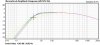
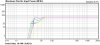
1.8 cuft gross, ~1.75 net internal volume (varies with duct length), BB6P recommends tuning to 27 Hz w/ 1 x 3" x 12" for maximally flat alignment, green, but 30 Hz doubles the power handling in the low frequencies, 1 x 3" x 9", blue. Use an elbow to achieve these duct lengths. Shorten to 7" (33 Hz) for more punch, if desired, violet.I need help calculating port size. The inside dimensions are 10 x 13 x 24 and 89 db 10" dayton classic.I would like a single port in each speaker enclosure.Can someone help me out? I know this is critical and dont want to guess and have spent too much time online already with no luck.The original cabs were rear ported 3" x 7" but I have plugged those and will relocate to the front.Thanks
Yellow is closed box:
Attachments
Last edited:
Russellc
Addicted Member
The difference in DCRs between 2 different gauges of inductors is likely to be swamped by the differences between two 'identical' woofers. DCRs of VCs, for instance, can easily be different by .5 Ohm. Unless high power operation is a concern, just get two of the same inductor of either gauge and use them together.
On the caps, however, I'm a little fussy. I have hundreds of crossover caps and resistors on hand for repair work. I'll test and hand pick to match caps to 3% or better between boards when repairing a high quality speaker. The drivers may have significant variation but eliminating additional variables from the crossover helps keep errors from 'stacking up' and causing audible differences. Just me being fussy from my days when I worked in steel and aluminum instead of wire and solder. When a tiny misalignment means an hour at a Bridgeport to make a new part you measure twice...
Understood as to that, I'm basically asking which way the resistance ( either less or more ) tilts the bass (looser or tighter), not necessarily this project's small difference, just differences in general.
Russellc