• The move to the new server is done. There are some software and database maintenance updates in process. This has us passing the hat around to help out. We appreciate any donations. Seriously, even a dollar helps. The payment page may be found here - https://www.audiokarma.org/support.html

Zilch's AK Design Collaborative - Econowave Speaker

Another, perhaps better, option is bottom - put 'em on stubby legs or spikes, or boards across the front and rear with the sides open. I don't know how the calcs work out with that, but I can't imagine much distance from the surface is required. That'd be a fun experiment, actually, watching the impdedance peak move as the height is varied.... :yes:

If going through the bottom, you could put them on these. 29 bucks from Harbor Freight. (without grinder of course)

http://www.audiokarma.org/forums/showthread.php?t=249862
 
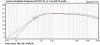
The PE trapezoid cabs #245-325 calc to 2.0 cuft internal volume. BB6P likes JBL 123 closed box (red) or DC300-8 (#295-320) vented (black, 29 Hz, 2 x 2" x 8") equally well:

attachment.php
 

Attachments

  • 2213H vs. DC-300.JPG
    2213H vs. DC-300.JPG
    36.8 KB · Views: 186
Hay ewavers
The PE knockdown trapezoidal boxes if the front baffle is installed as designed the internal volume is only 1.58 CF if the baffle is moved forward as suggested it only gains up to 1.74 CF. These measurements are done buy hand with in the boxes. The calculations for the JBL 128H I have really need 2 whole cubic feet to be ported and tuned. Any thoughts on expanding the space inside? I know Ziltch did some of this work early on but was not there a problem with dual box alignment issues? Could an extension on the back help or do you all think a fake stand would be better? Any help here would be great and I'm sure others would like to know this stuff as well

Borus
 
Thank you, Borus, we have a discrepancy; love it when that happens. ;)

Jack has a pair already, perhaps he will run the calc also.

Skywave and I will both have them next week, so we'll be able to measure the real deals.... :thmbsp:
 
Last edited:
Can't you raise up the wave guide, then raise up the woof to butt up to the guide, then go with two small ports on the bottom corners? I think that cab is a great deal.... thanks again Ross.

Can't you port it on the side or back?
 
Any thoughts on expanding the space inside? I know Ziltch did some of this work early on but was not there a problem with dual box alignment issues? Could an extension on the back help or do you all think a fake stand would be better?
128H sure likes 2.0 cuft, don't it? :guitar:

Bumping out the back or bottom should work. Double box played fine once I enlarged the opening between them. Those towers are among my best builds to date.... :thmbsp:
 
Zilch
I have the #245-325 box here what measurements would you like?
I could stand another set of eyes on the calculations. My #245-325 boxes seem smaller than I expected but maybe I'm doing this wrong (I hope) The internal area of the smaller back section is 22.562 X 11.5 or 259.4 sq in and if measured up to the back of ware the baffle is made to sit I get 9.5 in or 2465.25 CI's add this to the 2 X 22.5 X 9.5 for the angled sides and subtract the bracing or 1.64 CF moving the baffle forward is too hard to cypher well but it will not gain another 1/2 foot. Let me know.
Thanks Borus
 
What are the internal widths across the back and across the baffle, and the internal depth between them?

The internal height is 22.75", no, since the external is 24.25", subtract 0.75" each for the top and bottom? Or are they thicker than that?
 
Ok fellas remeasured I now get 1.876 CUFT with the baffle as designed. So finding the 0.123 CUFT just by moving the baffle forward should be easy. No need for fake stand.

Thanks Borus
 
I measure my pair at 1.6 cubic feet. The widest point inside is right at the back of the baffle, which is 14.875 inches. The back width is 11.125. The average of these two is 13 inches. The internal heigth is 22.75 inches. Depth from the back of the baffle to the inside of the rear panel is 9.375 inches.

13 X 9.375 X 22.75 equals 2,772.65 cubic inches. Divide by 1,728 gives 1.605 cubic feet. And that doesn't account for the space of the backing for the baffle.

Maybe PE's sales flyer is wrong? Or should I have flunked algebra?

Edit: I only flunked Measuring 101. I edited my measurements to show the true volume.
 
Last edited:
If the overall depth is 13" per PE (not shown in the pdf), and the internal depth is 8.75", can we account for this 4.25" difference?

Seems PE's no better at this than we are.... :tongue:
 
If the overall depth is 13" per PE (not shown in the pdf), and the internal depth is 8.75", can we account for this 4.25" difference?

Seems PE's no better at this than we are.... :tongue:

The overall depth is 12 inches, not 13, and the internal depth is actually 9.375 inches, as shown in my edited measurements. Adding 1.5 inches for two panel depths (Back and front), leaves a space of 1 1/8 inches between the front of the cabinet and the front of the baffle.

I edited my calculations on the previous page, since I measured from the back of the blocking, not the back of the baffle in the first calculations. That made it a bit smaller, 1.48 versus the actual 1.60. Still not quite as large as PE claims.

I always remember the old saying... "Measure once, cut twice."
 
Moving the baffle out another 3/4 inch would make the volume roughly 1.72 cubic feet. And space inside the cabinet is more critical than space in front of the baffle. Doing that would leave 3/8 inch for placement of a grille.

Moving the baffle forward 3/4 inch would leave a gap of approximately 1/8 inch between the edges of the baffle, and the sides of the cabinet, or about .0625 inches per side. That could be filled with glue, epoxy, putty, silicone, or monkey snot.

It is not 2 cubic feet, but can easily be made more useable. 1.72 cubic feet plots almost exactly as does 2 cubic feet according to WinISD. The loss is pretty much negligible. And by moving the baffle out to the front of the cabinet, another increase in size to about 1.8 cubic feet will occur.

This cabinet may still be the best choice for someone who isn't in to doing his own woodwork.
 
What would the inside volume be if you mounted the baffle on the front vs. inside? That might get it out to 2 cu ft. You would have to make larger baffle boards though.
 
I kind of lost track here but 1.97 is good right?

Also, if the board was attached to the front of the box, it would be much easier to veneer it as well.

Yes, 2 cubic feet was the magic number being bandied about. 1.97 is close enough, but then so is 1.72, as far as I am concerned.
 
Moving the baffle forward 3/4 inch would leave a gap of approximately 1/8 inch between the edges of the baffle, and the sides of the cabinet, or about .0625 inches per side. That could be filled with glue, epoxy, putty, silicone, or monkey snot.
Monkey snot = a vinyl bead as in Large Advent.

There's argument on another forum in favor of moving the baffle forward and rounding over the edge.

I'm getting respectable numbers at all of those volumes with the three drivers mentioned thus far -- 123A(-x)/2213(H) closed box, DC300-8, and 128H(-1) vented.

Another thought: consider a 10" woofer mounted on an adapter board from the rear of the baffle. The woofer frame sits recessed in the existing opening, which may then be rounded over like this:

http://www.jblpro.com/catalog/General/ProductFamily.aspx?FId=7&MId=5

What is the diameter of the factory cutout? Will a typical 10" driver nestle in there?

I think that's where I'm headed with a rear-mounted 12" woofer*; having a removable baffle affords the opportunity to better align the acoustic centers of the drivers doing this, and reduce the center-to-center distance between the woofer and compression driver as well. Measurements will tell.


*I ain't sayin' which 'til I try 'em; they've been sitting here for over a year awaiting this opportunity.... :D
 
Last edited:
The cutout diameter is 11.00 inch, if you can believe their drawing.

A new baffle made for a 10 inch that is screw mounted from the front gives more options to play with.
 
Back
Top Bottom