• The move to the new server is done. There are some software and database maintenance updates in process. This has us passing the hat around to help out. We appreciate any donations. Seriously, even a dollar helps. The payment page may be found here - https://www.audiokarma.org/support.html

Zilch's AK Design Collaborative - Econowave Speaker

How about two of the Dayton Classic 12s per cabinet? In parallel, this would increase the efficiency (but lower the resistance).

What changes would have to be made to the crossover to support this? Maybe a 2.5 setup?
 
If the two are playing up into the midrange, it's not a reasonable tradeoff as they would exhibit phase interference. Not an issue if you're building band speakers, but for home hi-fi, consider higher efficiency woofers, if that's the objective.

"2.5" is also applicable there; less so when lower efficiency woofers already have good extended bass response in singles....
 
So it sounds like a single ported Classic 12 and Econowave in an LCR theater setup should do the job when mixed with a pair of ported 15s handling the bass.

I suppose I should use the 'low efficiency' crossover design?
 
Djnagle
I think that's called the selective bio-dynamic hearing filter commonly called the "What did you say?" feature followed by "I heard you the first time..."
 
So it sounds like a single ported Classic 12 and Econowave in an LCR theater setup should do the job when mixed with a pair of ported 15s handling the bass.

I suppose I should use the 'low efficiency' crossover design?
Yes. DC300-8?

Several of us are building with them. Use a box modeling program to see how the low frequency performance varies in different size boxes with different tunings.... :thmbsp:
 
I read on another forum that there might be a fixed plan for an Econowave/DC300-8 combo .. possibly with a tweaked crossover.

Is there a timeframe for this?
 
That's also with DE250 compression driver on QSC waveguide, and still "in process."

I'm building similar with the Selenium D220Ti bolt-on type drivers. DC300s are here, but I've still got to glue up the trapezoidal cabinets to get seriously into it.

********
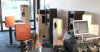
EconoWaves at Nor Cal DIY 2009:

attachment.php

Whispering to each other.... ;)

Æ photo.
 

Attachments

  • Nor Cal DIY 2009a.jpg
    Nor Cal DIY 2009a.jpg
    65.6 KB · Views: 259
Last edited:
First Pass at L/R4

This crossover was the least trouble of any I have ever built. It is not perfect, and certainly isn't ready for "production," but I was amazed at how close it is for the first pass. All values in the present circuit board are the calculated values, and there is no big hump at crossover frequency, no big holes, just pretty good performance. Some tweeking will be necessary, but no big parts changes. WOW!

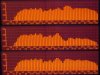
The first pic is the FR of a B&C woofer running without any crossover. It is nearfield (roughly one foot from the center of the speaker). Performance looks pretty flat, so maybe no Zobel will be necessary.

Second pic is an FR with calculated values in the Low Pass operating. Seems to be right close to 1.6 KHz. Some room effects are seen, due to a change in measuring position.

Third pic is of overall FR's with L-pad setting of Max on top, Min in the middle, and Listening level bottom. A little work will be needed to smooth the summing, and to fully compensate the HF.

The last Pic is of the crossover PC board.
 

Attachments

  • LWoofWFO.jpg
    LWoofWFO.jpg
    50.7 KB · Views: 34
  • RWoofCalcVals.jpg
    RWoofCalcVals.jpg
    44.7 KB · Views: 30
  • 1stPassPan.jpg
    1stPassPan.jpg
    90.3 KB · Views: 47
  • LR4Xover1.jpg
    LR4Xover1.jpg
    109.9 KB · Views: 73
EconoWaves at Nor Cal DIY 2009:

attachment.php

Whispering to each other.... ;)

Æ photo.

I had the pleasure of meeting Zilch at the Nor Cal DIY meet-up yesterday. My E-waves in their current bare plywood state are standing next to Z's own pair. They use P. Audio E12-200S woofers in ML-TL cabinets designed using Martin J. King's worksheets. They run 95 - 96 dB efficient, and are pretty flat to 40 Hz. The model says they should be good for 110 dB from 40 Hz on up, louder than I'll ever push them. The l-pad on the high-eff version of the E-wave crossover runs around dead center.

Here's a pic with a little less clutter (and Zilch's Indigina's, too).

Bill
 

Attachments

  • ewaves.jpg
    ewaves.jpg
    29.4 KB · Views: 123
For measurement fans, here's an in-room FR and impulse response of my E-wave. The big dip centered at about 160 is floor bounce. A measurement at floor level (which would be dominated b the port) is dead flat through the mid-bass, and that's closer to how it sounds.

The measurement was taken using HOLMimpulse, a very nice freeware program, a Dayton calibrated measurement mic, and an E-MU Tracker USB sound card which includes phantom power for the mic. The mic was on the tweeter axis, and (IIRC) about 1/2 meter from the face of the horn.

Bill
 

Attachments

  • ewave response.JPG
    ewave response.JPG
    47.8 KB · Views: 65
Hey Bad, are your waves filled with foam??? It looks like it in the pic. What does that do for the sound? Great looking speakrs by the way.
 
The L-pads have been duly tweaked, to about 65%. This is more like it, now the treble is up where I like it. And oh so sweet!

Here's a technical question about L-pads in general: why do they need to have a ground lead? Regular resistors just go in series with the circuit, without a ground wire. Aren't pots just resistors that can vary (variable resistors)?
 
Here's a technical question about L-pads in general: why do they need to have a ground lead? Regular resistors just go in series with the circuit, without a ground wire. Aren't pots just resistors that can vary (variable resistors)?
L-pads are two reciprocally wound rheostats of different values, one in series with the driver, and one in parallel with it. As you adjust the setting, both resistances change in such a manner as to maintain constant impedance as "seen" by the filter components, thereby maintaining a constant transfer function with respect to frequency response, while providing variable attenuation.... :yes:
 
Hey Bad, are your waves filled with foam??? It looks like it in the pic. What does that do for the sound? Great looking speakrs by the way.

Forgot about that! Yes, they are filled with 30 pore-per-inch rigid open cell polyurethane foam, a la Dr. Earl Geddes' designs. This has been discussed at length at DIYAudio.com. The idea is to attenuate wall-to-wall reflections within the waveguide ("high-order modes" in Dr. G's parlance). Since the reflections take a longer path through the WG, they are attenuated more than the direct sound that comes straight through the foam. I think this is a worthwhile tweak, it removes a little 'edge' from the highs but doesn't seem to affect the FR to any significant degree. There's probably a slight loss of output, but that's just a twitch of the l-pad.

I bought the foam as a 12" x 12" x 4" block intended for aquarium filtration, and carved the wedges to fit as well as I could. The foam stops just short of the driver's bug screen. They are retained with black thread criss-crossed between the mounting holes, so there's no glue to mar the WG's. I think this is a worthwhile tweak, it removes a little 'edge' from the highs but doesn't seem to affect the FR to any significant degree.

Dr. Geddes has been granted a preliminary patent for his application of foam in his own round WG design. His patent includes the convex shape of his foam plug, and there is prior art for foam in a horn, so I don't believe I am in violation with my flat-fronted foam.

I'm still curious whether anyone has tried removing the bug screen from the compression driver. It seems like it would be a real obstruction to the waveform as it enters the WG. It also seems like it's pretty well attached. Anyone pulled the screen from a DT220i?

Bill
 
I had the pleasure of meeting Zilch at the Nor Cal DIY meet-up yesterday. My E-waves in their current bare plywood state are standing next to Z's own pair. They use P. Audio E12-200S woofers in ML-TL cabinets designed using Martin J. King's worksheets. They run 95 - 96 dB efficient, and are pretty flat to 40 Hz. The model says they should be good for 110 dB from 40 Hz on up, louder than I'll ever push them. The l-pad on the high-eff version of the E-wave crossover runs around dead center.

Here's a pic with a little less clutter (and Zilch's Indigina's, too).

Bill
You did a nice job on your foam inserts and I'd love to do a blind test to see if I could hear a difference. Not to get too far off track but is there a thread on the DIY forum from the event yesterday? I see the photos posted but no thread newer than 2007. :scratch2: I really wanted to hear AE's speakers but had to leave early. If I had known there was going to be a raffle I would have stayed longer. :D
 
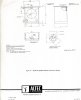
Hi Guys, Econowave really is very good, I think in the future replace the Altec 420Y (resonance in the bass 80Hz) for another 15 "woofer or 12",> 95 dB (Altec 414 or 416,(8 ohms) or JBL 2235H. My Altec enclousure is the Altec 861.
welcome woofer suggestions,thanks, Martin
 

Attachments

  • Dibujo.jpg
    Dibujo.jpg
    47.8 KB · Views: 64
Hi Guys, Econowave really is very good, I think in the future replace the Altec 420Y (resonance in the bass 80Hz) for another 15 "woofer or 12",> 95 dB (Altec 414 or 416,(8 ohms) or JBL 2235H. My Altec enclousure is the Altec 861.
welcome woofer suggestions,thanks, Martin

If you have 4-5 cu ft. I can STRONGLY recommend the JBL 2235H.

Russellc
 
Back
Top Bottom