R/R/C top-octave compensation
At least put a simple R||C compensation filter in series with them like Tom Brennan uses on his Altecs. Probably $10 for the pair, max.... :yes:
Be careful when using a series attenuator made from a single resistor in parallel with a bypass capacitor for top octave compensation. To get enough attenuation to match a horn tweeter with a direct radiating midwoofer, the series resistor has to be made large enough to seriously underdamp the crossover filter. What the builder generally does when going at this approach by ear is to attenuate the average passband level to psychoacoustically make up for that initial peak.
A person can install a traditional L-Pad, which has a series resistor followed by a shunt resistor, making a voltage divider with source impedance equal to what the crossover filter load is designed for. However, this is generally too thin sounding, because it doesn't conjugate the power response of the driver.
When you turn the L-Pad around, having shunt resistance first, you can set the amount of damping with it. A slightly underdamped filter works perfect, because it provides a
slight amount of peaking near the crossover frequency. The cap bypassed series resistor (and the inductive/resistive complex load of the driver) forms rising response which would make a diagonal line starting at the crossover frequency if it weren't for the slighty underdamped high-pass filter. The two features tend to form a curve that has an initial flat region followed by a region of rising response. This is a conjugate of the driver's power response, which is what you get from a CD horn, so the result is nice flat response at all angles in the horn's pattern.
There are some variations between drivers and horns, naturally. But what I've found is that differences in drivers tend to be mostly in the nature of breakup modes and voltage sensitivity. The differences in CD horns are mostly at the frequency extremes, where directivity is affected by throat and mouth features. Acoustic loading is an issue down low too.
Some drivers will have more energy up high due to breakup, and some will have less energy but smoother response. The crossover can't do much about those, nor should it in my opinion. I suppose you could try to tame HF breakup with notch filters but I think that's overcomplicated and counterproductive.
To avoid ripple at low frequency, simply crossover above the point where the ripples are. That avoids diaphragm resonance and the first 1/4 wave mode.
As for voltage sensitivity, that's really the easy part. The midwoofer and tweeter have to be level matched anyway. I don't consider 10dB attenuation to be a problem because you need that for proper top octave compensation. You still get all the benefits of horn loading, i.e. increased dynamic range, reduced distortion and directivity control. I don't know that I would want to use a woofer that required 20dB horn attenuation, but that's because I want a more sensitive loudspeaker than that. It's easy to find suitable midwoofers with sensitivity around 95dB/M/2.83v, give or take a few decibels.
So to me, the R/R/C approach works very well and turns out to be an almost generic solution. As long as crossover is done above the frequency where the horn becomes effective, the low end is right. Above that, all drivers share a similar power response curve so as long as the horn is CD, the compensation curve is the same for all of them. About the only thing you have to set is baseline attenuation, which can be obtained from a chart of R1/R2/C1 values.



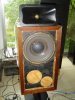
 but they are what they are, and are not what they arent! Same way with the mentioned speakers, popular vintage pieces, but when people wonder about power response and so forth of these antiquities when compared to Econowave made from LE14 and ECWG on top, well its true. One can enjoy them for what they are, but a WHOLE lot of what they arent is revealed in an actual listening comparison. As stated it will be absolutely no contest, period. those two golden oldies will be whipped proper




 :
:


