• The move to the new server is done. There are some software and database maintenance updates in process. This has us passing the hat around to help out. We appreciate any donations. Seriously, even a dollar helps. The payment page may be found here - https://www.audiokarma.org/support.html

Zilch's AK Design Collaborative - Econowave Speaker

...
I should be getting to EconoWave HP (high power) here soon, using 2262H, 2432H and PT-F95HF in PE KDTrap cabs. We'll do the crossover with PCD.

....

Zilch, are the 2262H's "Dynamic Braking" coil windings selectively shortable by the user? I read the lit and it's not clear.

If it is, there must be 6 terminals on that woofer: 2 pair for VCs and one pair to short (if desired) the braking coil.

Cool.
 
I used it in an car audio install where I used a DVC in a IB setup and used the pot to dial in the in car frequency response I wanted.

Dan Wiggins was the first I recall using this method and he referred to it as Resistively Damped Operation.

One thing it can do is make a woofer work in a much wider variety of enclosure sizes by changing the Qts.
 
Cool. I (think) I see how it could change the driver's resonance. But I'm not sure if it is similar to changing the mechanical or electrical resonance. And it's a separate sub circuit. I know I sound all newjack...sorry. It's pretty interesting.

just saw your pdf...reading now.
 
The JBL system is a little different. It's a shorted coil(or two) that dramatically damps motion outside Xmax, where the braking used by shorting a 'normal' VC is used to control Q of the speaker. Their braking coils are much lower impedance than a normal VC, so they apply a much stiffer brake.
 
Zilch, are the 2262H's "Dynamic Braking" coil windings selectively shortable by the user? I read the lit and it's not clear.
If they are present, they are not accessible, and neither are the separate differential drive windings.

Let's not confuse differential drive with conventional dual voice coil designs; the two windings MUST be driven by the same signal.

2262H is the neodynium differential-drive upgrade of 2206H, with which I worked a bit earlier in this thread. In this case, the substantially reduced weight is a significant advantage. It's used in the new 7212 series AE designs, with the 2432H, a new titanium-diaphragm version of JBL's mid-size 1.5" compression driver:

http://www.jblproservice.com/pdf/AE Series/AM7212,95-WH.pdf

I'm mating these with the compact PT-F95HF waveguide, a combo not presently offered by JBL. The earlier 243x series neodyniums had a phase plug issue in the top octave with this waveguide, but in preliminary testing at ZilchLab, 2432H does not. It is also a comparatively inexpensive $260 apiece.

[Calling this build "Econo" will be a stretch, but I AM putting it in cheap cabs.... ;) ]
 
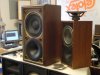
Zilch, is that a B&C DE10 with a Selenium adapter on the lower right? If so what waveguides have you tested it in?
 

Attachments

  • DSC01427.JPG
    DSC01427.JPG
    58.4 KB · Views: 69
Hmmm. After reading that "Stacking Bi-Radial Horns" paper that Zilch linked to, I'm really curious about whether this might work. It sounds like their findings were along what I thought might happen... a comb filter effect, with lots of "little bumps"... the number of "bumps" in the on-axis vertical response axis goes up, but the magnitude of each bump goes down... they, essentially, "average" at a given position (or change in position) after you get so many of them working together...

Of course, cost is always a factor... so, I may experiment with a less-expensive horn driver (the Eminence 1001, which, in quantity, can be gotten for less than half the price of the Selenium D220), and see if I can "shape" the response to something useful. Nice thing is, with 10 or 11 of them per speaker, I can use quite a bit of compensation, and still have plenty of output...

Regards,
Gordon.
 
Zilch, is that a B&C DE10 with a Selenium adapter on the lower right? If so what waveguides have you tested it in?
Yes, I've tried it a couple of times, but not in an organized fashion, rather, "I wonder if this will work," the answer thus far being, "Not as good as another option."

Hmmm. After reading that "Stacking Bi-Radial Horns" paper that Zilch linked to, I'm really curious about whether this might work.
There are several other tech notes on the JBL Pro site relating to this; it's what they do, and it's not easy to make happen.

p.s.: I was not able to get into the sales data sheets earlier today, but it's back up, now, clicking CBT on the Pro home page.... :yes:
 
Last edited:
Has anyone tried any of the Pyle titanium compression drivers? I noticed they are quite cheap. I usually steer clear of Pyle since they have a habit of offering zero useful data about their speakers. But I'm wondering if one of the ~$20 CDs might be used for an ElCheapoWave design.
 
Has anyone tried any of the Pyle titanium compression drivers? I noticed they are quite cheap. I usually steer clear of Pyle since they have a habit of offering zero useful data about their speakers. But I'm wondering if one of the ~$20 CDs might be used for an ElCheapoWave design.
Yes, tried by another in this thread, and updated to Selenium shortly thereafter.... :dunno:
 
Personally, I'd love to hear how that woofer stacks up against an AE in equivalent box with similarly designed HF.


If they are present, they are not accessible, and neither are the separate differential drive windings.

Let's not confuse differential drive with conventional dual voice coil designs; the two windings MUST be driven by the same signal.

2262H is the neodynium differential-drive upgrade of 2206H, with which I worked a bit earlier in this thread. In this case, the substantially reduced weight is a significant advantage. It's used in the new 7212 series AE designs, with the 2432H, a new titanium-diaphragm version of JBL's mid-size 1.5" compression driver:

http://www.jblproservice.com/pdf/AE Series/AM7212,95-WH.pdf

I'm mating these with the compact PT-F95HF waveguide, a combo not presently offered by JBL. The earlier 243x series neodyniums had a phase plug issue in the top octave with this waveguide, but in preliminary testing at ZilchLab, 2432H does not. It is also a comparatively inexpensive $260 apiece.

[Calling this build "Econo" will be a stretch, but I AM putting it in cheap cabs.... ;) ]
 
I'm just seeing some Dayton woofers?

Russellc

They are higher efficiency than the DC series, and are listed as 'new' at PE...I figures they would be an economical choice for an E-Wave build, esp. since Dayton seems to offer the JBL waveguide now as well...

JSS
 
They are higher efficiency than the DC series, and are listed as 'new' at PE...I figures they would be an economical choice for an E-Wave build, esp. since Dayton seems to offer the JBL waveguide now as well...

JSS

Oh! I misunderstood. I thought it was a completed E'wave speaker that was being discussed. Now I understand.:stupid:

Russellc
 
Update - no joy yet

Got my Pyle 612 waveguides and put one of them on top of one of my Advents for comparison testing. The e-wave highs do seem better than the original Advent. But now I am hearing a definite hollowness or lack of presence in vocals, especially female. I would describe it as the fundamental is almost missing and only the harmonics remain. Could this be a result of the 17" center-to-center spacing from waveguide to woofer that this temporary setup has? The listening is close to on-axis about 8 feet away. I don't want to commit to cutting the Advent cabs if I don't prefer the new sound, and currently the original setup is superior.

For the e-wave I am using the generic <95dB 8 ohm crossover with the Peerless 830411 8" 8 ohm woofers that I put in the Advents a few years ago. The crossover is hooked to the woofer and the Selenium D220Ti/Pyle 612 e-wave is on top of the cab. It is wired OUT OF PHASE as that crossover diagram specifies. I tried normal polarity and the sound had more flaws. The non-e-wave Advent still has the original crossover and tweeter with the Peerless woofer.

Would the excessive spacing likely cause the vocal issue, or might the crossover need some tweaking?

I tried the cab on its side to get the the waveguide closer to the woofer, and it sounds better overall, but the hollowness--lack of vocal presence --is still there. I tried reversing tweeter polarity to normal and it doesn't affect the problem.

I ran some freq sweeps. I used my Stryke test cd, 34 tracks of sine waves from 36Hz to 20480Hz. With each spkr, one at a time, 30" from a radio shack dB meter at 29" high (midway between woofer&tweeter). The e-wave spkr was tested with both tweeter polarities and several different L-pad settings. I couldn't see any consistent difference between the stock Advent and the e-wave that I could correlate to the vocals issue. With reversed polarity, as the crossover diagram specifies, there was a 12dB dropout at 2500Hz, which was completely filled in with normal polarity. I am keeping it at normal polarity for now. Was reversed tweeter polarity a mistake in the crossover diagram?

My gut feeling was that the problem lies in the woofer part of the e-wave crossover, compared to the Advent crossover. The Advent uses only a single small (unmarked) coil on the woofer. At the low end, both spkrs measured identical except between 112Hz and 806Hz, where the stock Advent was about 2dB lower. This is the opposite of what I expected based on sound.

The waveguide does sound a little better than the Advent tweeter, but not enough to offset the loss of vocals presence. Any ideas please? Thanks in advance!
 
Back
Top Bottom