• The move to the new server is done. There are some software and database maintenance updates in process. This has us passing the hat around to help out. We appreciate any donations. Seriously, even a dollar helps. The payment page may be found here - https://www.audiokarma.org/support.html

Adjusting if cans

Carbsandcaps

Super Member
When adjusting IF cans with 2 slugs how do you know which to adjust first? Is it just a case of getting the strongest signal by moving both?
 
Register to hide this ad
Do you have an example of a specific tuner? That does not have alignment instructions?
Assumption is you are speaking of a L/C double tuned I/F filter? If so then sweeping the I/F might be the best method to center and tune the responses to have minimal ripple and steep slopes. Just an idea :-)
 
When adjusting IF cans with 2 slugs how do you know which to adjust first? Is it just a case of getting the strongest signal by moving both?

Really doesn't matter top or bottom which is done first. You just have go back and forth to get the best result. Whether that be just tweaking for a peak on the signal meter. Lowest distortion or best looking curve on a sweep. Theoretically best practice would be adjust the primary then the secondary. There's not a hard and fast rule on what is primary and secondary. Different circuits, type of transformers, etc.
 
When adjusting IF cans with 2 slugs how do you know which to adjust first? Is it just a case of getting the strongest signal by moving both?
Some schematics will have an arrow pointing up or down in the IF transformer symbol by the primary or secondary. Also Sam’s has a photo in the service literature on vintage gear that identifies adjustments with a callout. New stuff I don’t know.
 
Some schematics will have an arrow pointing up or down in the IF transformer symbol by the primary or secondary. Also Sam’s has a photo in the service literature on vintage gear that identifies adjustments with a callout. New stuff I don’t know.

So there’s no universal answer as to which is the primary? Could be the upper or lower?
 
So there’s no universal answer as to which is the primary? Could be the upper or lower?
If the arrow points up on the schematic primary, the upper slug adjusts the primary. In my limited experience there is no consistency in schematics or upper always being the primary. But the Sam’s or manufacturers service literature will tell you.
 
It's more common for components around the IF cans or the caps inside the cans to fail than the coils themselves loosing tune.

You need to use a Sweep generator with a Scope to be able to see and adjust IF response.

I've lost count of all the radios ruined by someone trying to "Tweak" IF coils.

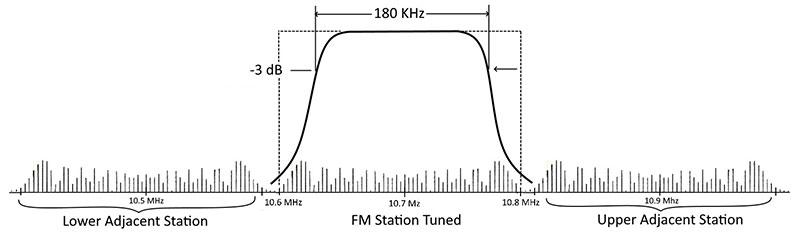
Source: Did RF, IF and Chroma alignment on tube type color TV's for a living. All went away once we went Solid State with Modules. For FM you need to massage the filters and coils to get a flat top and steep sides and most times it's pretty sketchy...

AK FM alignment discussion

NV_0520_Whipple_FigureB.jpg
 
Last edited:
It's more common for components around the IF cans or the caps inside the cans to fail than the coils themselves loosing tune.

You need to use a Sweep generator with a Scope to be able to see and adjust IF response.

I've lost count of all the radios ruined by someone trying to "Tweak" IF coils.

Source: Did RF, IF and Chroma alignment on tube type color TV's for a living. All went away once we went Solid State with Modules. For FM you need to massage the filters and coils to get a flat top and steep sides and most times it's pretty sketchy...

AK FM alignment discussion

NV_0520_Whipple_FigureB.jpg
For best results on AM, yes.
For proper results on FM, essential.
 
It's more common for components around the IF cans or the caps inside the cans to fail than the coils themselves loosing tune.

You need to use a Sweep generator with a Scope to be able to see and adjust IF response.

I've lost count of all the radios ruined by someone trying to "Tweak" IF coils.

Source: Did RF, IF and Chroma alignment on tube type color TV's for a living. All went away once we went Solid State with Modules. For FM you need to massage the filters and coils to get a flat top and steep sides and most times it's pretty sketchy...

AK FM alignment discussion

NV_0520_Whipple_FigureB.jpg
Caps I have seen in IF cans of AM radios were ceramic, and those have good reliability in that setting.
 
A buddy of mine decided to check out his table radio to see if in needed anything. After cleaning it up, he noticed that two square cross section cans about 4" tall each had 2 screws in them, and he checked to see if they needed tightening and found that, yes, they were loose. So he did a good job of tightening those babies down nice and tight, as well as two more screws on the tuning capacitor, and when h put the radio back into its cabinet and tried it out, it did not work at all. He asked me to look at the radio and mentioned all he did to it, including tightening every screw he saw as being loose. "Oh", I said, and discovered that the screws on the IF cans were tightened down nice and tight. I explained to him what he had done, and got the signal generator out and peaked the IF's at 455kHz and also adjusted the oscillator trimmer cap on the tuning "condenser". The little radio jabbered once again!
 
Called by their original name "Silver Mica" capacitors.

Have replaced many dozens of them that died from "Silver Migration".

These are now hitting 50 to 80 years old, Still fairly reliable but not bullet proof.
 
The screw compression mica trimmers are very reliable, the silvered mica shunts with slug adjusted coils are anything but.
The Hammarlund open ceramic air trimmers are likewise utterly reliable.
 
Still have nightmares from replacing the band switch (Right hand side) on this Hallicrafters beast and it's full of silver mica caps from 1942.

Switch shorted out from "Silver Migration".

e-614-hallicrafters-sx42.jpg


sSX423.jpg
 
t's more common for components around the IF cans or the caps inside the cans to fail than the coils themselves loosing tune.


I've lost count of all the radios ruined by someone trying to "Tweak" IF coils.

very true, short of component failure it shouldn't be very far off, just needing a little tweak to compensate for component drift. If its far off, something failed or someone got out the golden screwdriver and fiddled with it.

I've fixed a few things that got that treatment myself. The amount of time it takes when every single thing has been screwed with is not insignificant. Usually I've done it the crude way with a fixed frequency generator and done a simple peak alignment just to get things at least somewhere in the ballpark, then align it from there. Sometimes that requires multiple rounds, or injecting signal mid-way through the chain to get it done. Depends how badly someone has screwed with it.

Caps I have seen in IF cans of AM radios were ceramic, and those have good reliability in that setting.

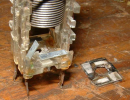
later tube stuff often had un-sealed mica caps in the bottom of the transformers. The Miller K-Trans was one such type. It was basically two metal fingers with a sliver of mica between it, just sitting in the bottom. Eventually the silver would migrate across the mica and arc, making it sound like a thunder storm inside the radio or sometimes just seriously de-tuning it. Happened on AM and FM. The fix is basically to open up the transformer, bend those tabs out of the way and yank out the mica sheet to eliminate the cap and hang a cap across the terminals externally before re-aligning it.

1725884737437.png
 
Yikes, Now I'm having flash backs~! Great picture~!

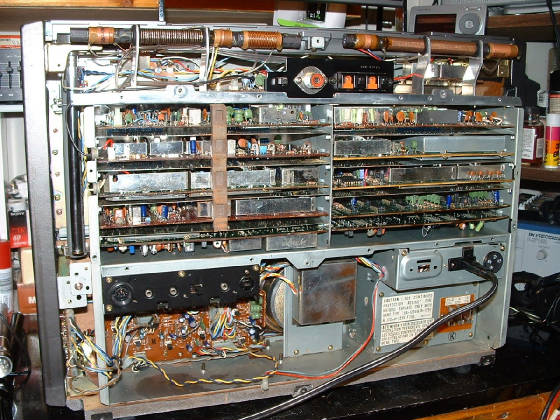
Bought 5 or 6 Panasonic SW receivers super cheap that were "Tweaked" which really sucked because they were "Double Conversion" and some bands were "Triple Conversion" so many coils...

If that wasn't bad enough some LF bands had "Up Conversion" Booo...

panasonic484900.jpg


fetch.php
panasonic9000inside.jpg.w560h420.jpg
 
Back
Top Bottom