• The move to the new server is done. There are some software and database maintenance updates in process. This has us passing the hat around to help out. We appreciate any donations. Seriously, even a dollar helps. The payment page may be found here - https://www.audiokarma.org/support.html

Alexey Korf post at Lencoheaven about tonearms

Maybe I’ve missed your point, why do you think it was written?

Believe there’s many here with a wide range of tonearms, on one end of the spectrum I’ve got a Denon DA401, and a Grace 707, at the other end a several 10-12” arms, and Karmadon Gray 108 clone…

VR
Andy

Why does it matter?
 
If it doesn’t matter, why make a big deal out of the speculations of others:dunno: Just trying to understand the perceived problem(s).

No, my question is, how are B&K's motivations pertinent? If you feel they'd manufacture data or misrepresent findings, then I suppose it would be meaningful to this conversation.

If you feel that is unlikely, why bring it up at all?
 
Does Korf actually, or directly challenge Hooks Law?
If his calculator doesn't calculate the same eigenfrequency as the traditonal calculators, then yes.
Do the traditional calculators completely or accurately represent Hooks Law?
If they use the following formula: f=1/(2π√M⋅C), then yes. This is literally Hooke's Law.
All 'traditional' calculators calculate the exact same figure with the same input parameters, so I figure they all use this formula (Hooke's Law)

Furthermore, if he’s “wrong” then why does his calculator work whatever % of application (appears to work more often than not).
What makes you say his calculator works?
Wong number is wrong number.

There ‘s obviously issues with calculators, are these issues (In Vitro vs In Vivo), a misapplication Hooks Law.
Afaik there are no issues with the traditional calculators.

Why do some cartridge/tonearm combo’s work well that are presented as extremely mismatched by calculators?
"Work well" is not an objective statement. The calculators only calculate the eigenfrequency of the resonance (spring mass system)
Whenever someone attaches the label "work well" to it, then it becomes an interpretation, not a hard number. And this is about calculation hard data (it's a calculator), not subjective interpretations. A subjective interpretation is whether or not this all is important in the greater scene of life :D;)

Korf’s research and applications also fails to answer the question but it comes closer in some respects, doesn’t it?
No. his calculator gives an incorrect representation. Both in eigenfrequency (at least some examples that I tried, I haven't tried all combinations obviously) as in predicted amplitude of the resonance (I think it's way higher based upon both wave analysis as just watching the resonance).
Your question should be the other way round. Korf asks the right questions, but imho what he comes up with doesn't come closer in many respects.
Like I stated before, imho the only thing his caculator represents correctly is that acceleration of the headshell increases when the resonance frequency becomes higher, given when the amplitude stays the same.
This is only logical, higher frequency means the headshell changes direction more times per second. That automatically means higher acceleration. You don't need a calculator for that.

But why are you such a firm believer in Korf's calculator?
Have you actually measured resonance frequencies in a calculated effective mass arms and known compliances (or measured the same cartridge in different calculated effective mass arms) and put those numbers in both the korf calculator and a traditional calculator and have found the Korf calculator giving the correct number and a traditional calculator an incorrect number?
Or have you measured amplitude of a resulting resonance, cross referenced it with the amplitude when the cartridge is not in resonance and compared that with the 10% or 20% rise in resonance that the korf calculator predicts and found that correct?
If you have documented such measurements I would love to see it, because my findings are different.
If you just look at my video, I see at 11 and 12Hz an amplitude of the resonance that is way more than 10% or 20% of the amplitude at say 7 or 8Hz, where as you can see in the screenshot of the korf calculator that I posted, the excursion of the headshell at the peak of the resonance is well below 12,5mm (that would be half way inbetween the 10mm line and 15mm line) whereas at lower frequencies below the eigenfrequency, the excursion is stated at 10mm.
That difference is just way to low.

Regarding the acceleration of the headshell excursion, what Korf's calculator basically tells you, is to stay below 10,25Hz. Every combination that I tried that falls just in the 'green zone' is calculated at ~10,25Hz. But do you need a separate calculator for that? One sentence that tells you that should be enough I believe?
His examples of what acceleration is good or bad are so extreme (a 5CU denon DL-103 in a 14gr arm for example, or a 40CU cart in a 40(!) gram arm....) that he just plays captain obvious here.

 
Last edited:
No, my question is, how are B&K's motivations pertinent? If you feel they'd manufacture data or misrepresent findings, then I suppose it would be meaningful to this conversation.

If you feel that is unlikely, why bring it up at all?

Really, I didn’t bring it up, the conversation has been going on for several posts, maybe even pages;)


VR
Andy
 
No, my question is, how are B&K's motivations pertinent? If you feel they'd manufacture data or misrepresent findings, then I suppose it would be meaningful to this conversation.
I think it's already blown out of proportion. There's nothing in that paper that's news these days - and it's highlight is the new (1977 contemporary) measurement gear that happens to be made by B&K.

Ladegaard refers to the same old harmonic oscillator formula (see p2) which is centuries old. It is basically a differential equation that is a derivative of Hooke's law and Newton's 2nd law of motion (Korf is very aware of it too).

All this paper does, is emphasizes the cause and influence of 'interface problems' between the elements in a turntable, as measured using B&K gear, with a conclusion revolving around how important it is to pay attention to the frequency response of a turntable that's bellow 20Hz. That may had been news back in 1977, buy anyone these days who had tried to check the compatibility of their cart to their tonearm based on any online calculator using the same old formula, knows this already.

The B&K paper recommendation is to keep the RF between 15 - 18Hz and apply a damping Q of 0.5. That's their opinion, based on their measurements, with their own gear. It's a toothpaste commercial with Paul Ladegaard being the presenting dentist on behalf of B&K. Since 1977 these figured had fallen out of fashion and had dropped to 8 - 12Hz as displayed, for example, by the vinyl engine cart/tonearm matching calculator. It's really no news and nothing to get worked over for. Let's move on.
 
I also doubt to a certain extend his predictions about the elastomer used as a spring.
I mean, he basically states that an elastomer has a different stress strain curve as a spring, and under tension the change in spring constant is greater than with a spring.
To a certain extend he might be right about that, but what I'm missing is proof.
Not that that would happen at all, but mainly that it happens within the boundries that cartridges operate. That is the only situation that is important.
And that test is really really simple. Just measure the resonance frequency with a low stylus pressure, and with high stylus pressure. That's it. anyone can do this, but Korf apparently didn't.

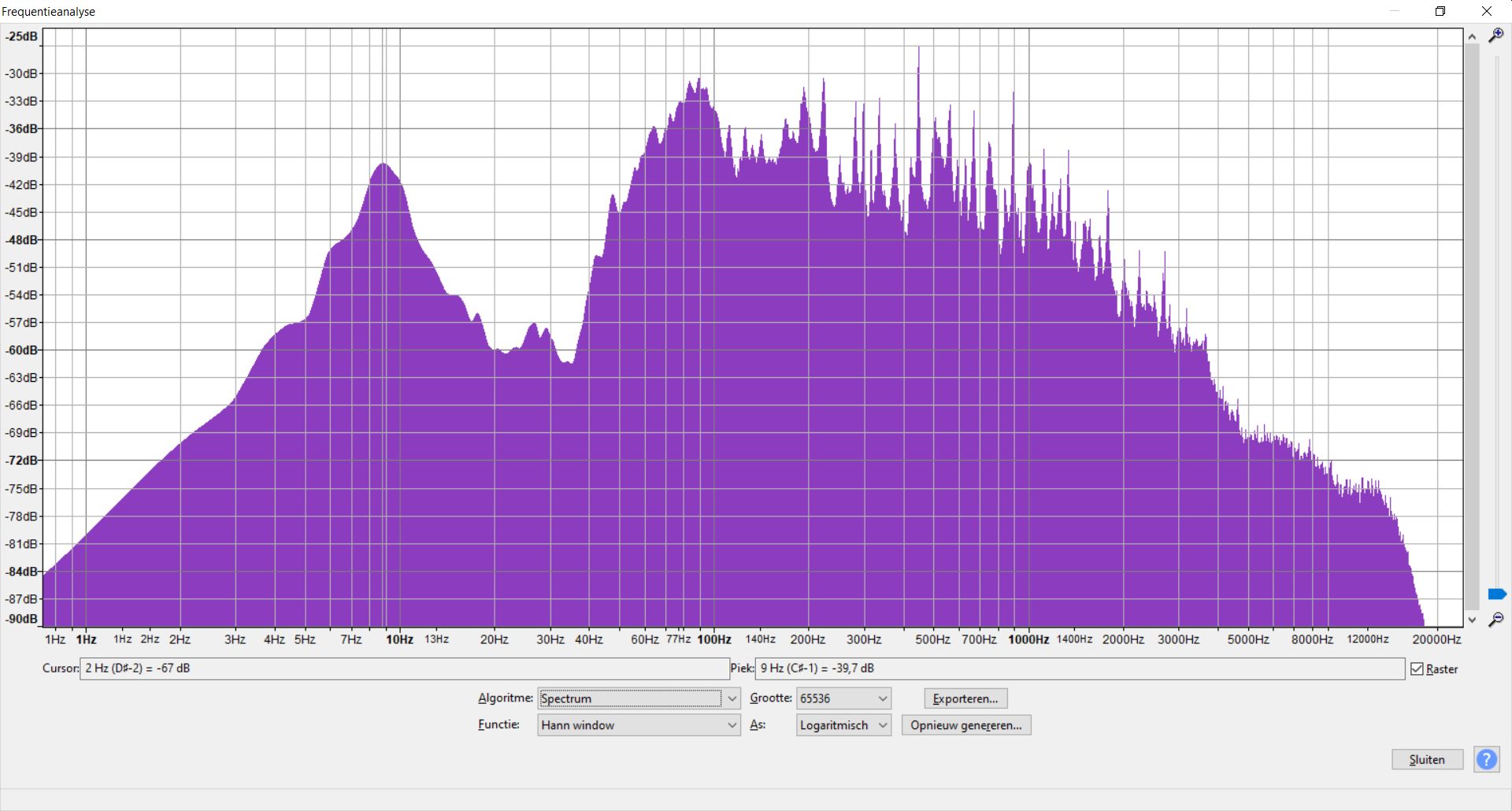
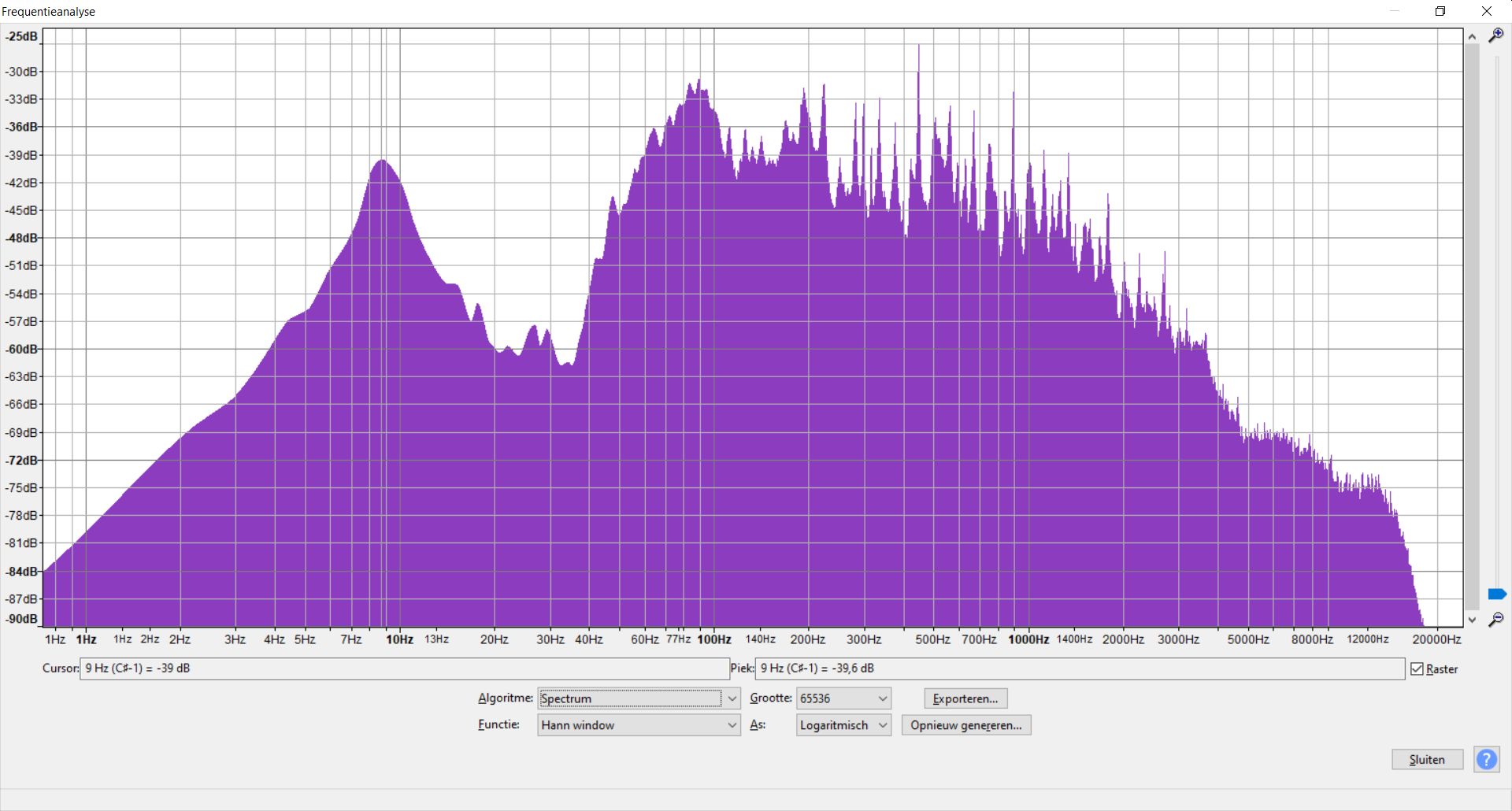
So I did some measurements at 2gr. and at 3gr (used an at3600L), so that's 1 gram difference, which is of course a really really big margin when it comes to stylus pressure.
Results (I did this with normal music and audacity, and recorded the same piece of music):
2 grams VTF:
3600l-beastie-2gr.jpg


3 grams VTF:
3600l-beastie-3gr.jpg


You can see the resonance is basically the same. The 3gr VTF resonance is slightly wider, but the eigenfrequency didn't change. Therefore the compliance didn't change.

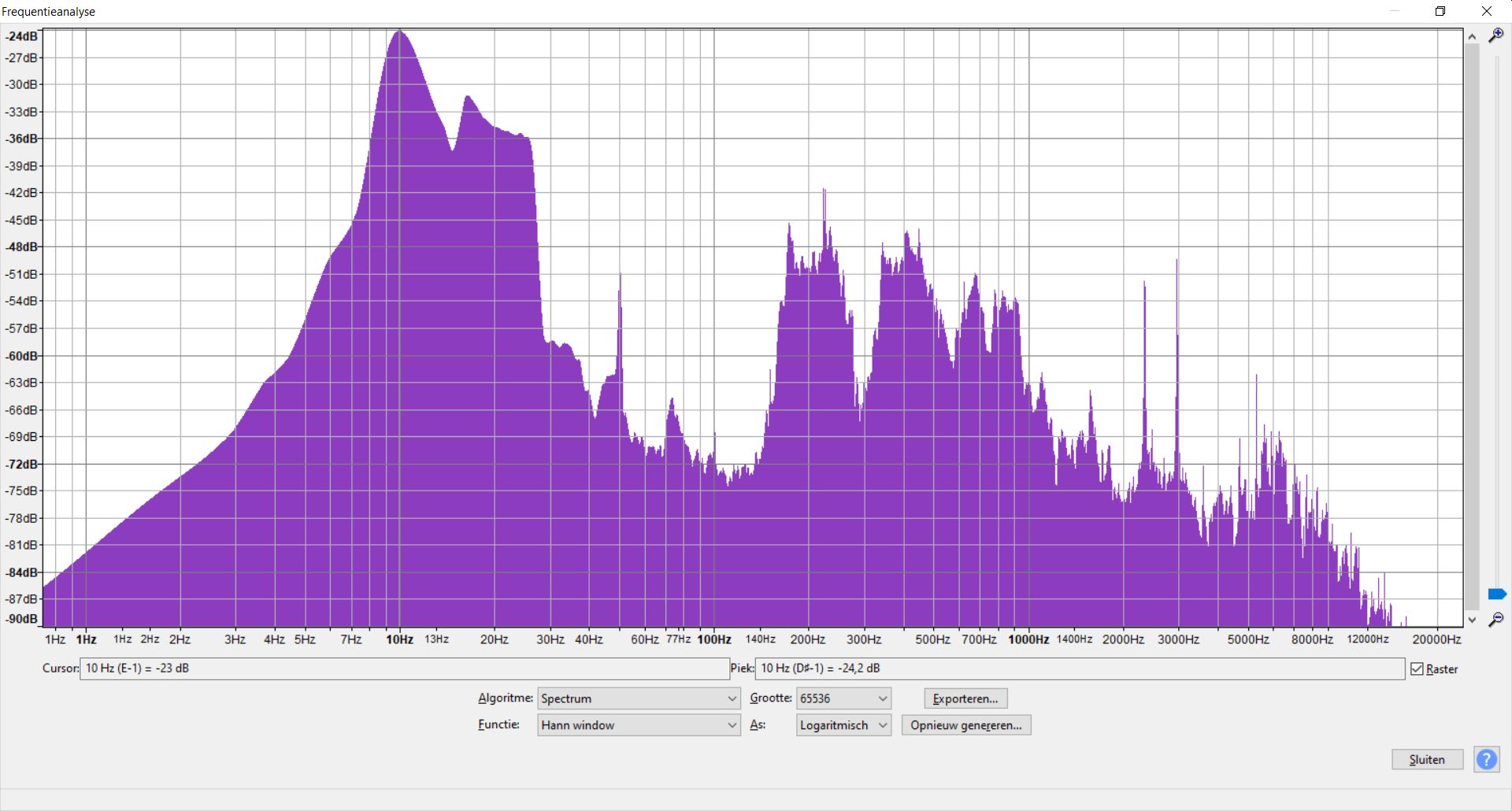
And I also repeated the test with a vertical resonance track (so not lateral, like most test records have), just to show if there's a the difference in the direction the stress on the elastomer takes place:
2 grams VTF:
3600l-ortovert-2gr.jpg


3 grams VTF:
3600l-ortovert-3gr.jpg


So to me these spectrograms look remarkably similar. So this tells me that although elastomers may change their spring constant when stressed, the scope/spread of force within VTF is usually sets has a too narrow bandwith that the spring constant changes.

Note that the peak in the resonance track is about 26dB higher, so the cartridge wobbles about 20 times as much when playing a resonance track than when playing normal music.
These tests were made on a dual 721.
 
Last edited:
^ Thanks. The spectrograms look similar to me too. Just pondering... the last time I took apart a cheap AT cart (I didn't actually, it fell apart on its own) I was surprised to find the suspension was a doughnut ring that appeared as (white) hard plastic. I was expecting an elastomer but it really looked like a piece of hard plastic. Just curious... can you do this test with a different cart?
 
I think it's already blown out of proportion. There's nothing in that paper that's news these days - and it's highlight is the new (1977 contemporary) measurement gear that happens to be made by B&K.

Ladegaard refers to the same old harmonic oscillator formula (see p2) which is centuries old. It is basically a differential equation that is a derivative of Hooke's law and Newton's 2nd law of motion (Korf is very aware of it too).

All this paper does, is emphasizes the cause and influence of 'interface problems' between the elements in a turntable, as measured using B&K gear, with a conclusion revolving around how important it is to pay attention to the frequency response of a turntable that's bellow 20Hz. That may had been news back in 1977, buy anyone these days who had tried to check the compatibility of their cart to their tonearm based on any online calculator using the same old formula, knows this already.

The B&K paper recommendation is to keep the RF between 15 - 18Hz and apply a damping Q of 0.5. That's their opinion, based on their measurements, with their own gear. It's a toothpaste commercial with Paul Ladegaard being the presenting dentist on behalf of B&K. Since 1977 these figured had fallen out of fashion and had dropped to 8 - 12Hz as displayed, for example, by the vinyl engine cart/tonearm matching calculator. It's really no news and nothing to get worked over for. Let's move on.

Just going to make hopefully one final comment, which is that the results in the paper pretty closely matched my own experiences building my DIY arm.

Early efforts resulted in a featherweight and resonances in the 13-15Hz range. From reading threads on many forums I convinced myself that a lower resonant frequency should improve bass response. I should have known better at this point as I was already comparing vinyl with digital versions and the bass was "right there." But it was early days and I was up for giving it a shot and maybe leaning something.

So before I know it I'm ordering cocobolo (dense) lumber with which to remake the wand, a variety of M2.5 hardware from China to increase mass out at the cartridge, and making brass weights on my CNC router. In hindsight using a bunch of blue-tac may have been the answer, but at this point I'm satisfied this direction will yield results, may as well make things look pretty.

But what I learned was that as I pushed the resonant frequency down, tracking suffered. I have a large collection of test vinyl, some intended as such and some that was poorly pressed and/or defective. For example, a Grappelli album that was cracked right through when I received it (it was NOS). When I received this album I hadn't realized it was cracked and tossed it on my table w/ the featherweight arm and heard a small tick on each revolution. "Darn, it is scratched" I thought to myself. Got up and inspected the album and found the crack. I was surprised it played with just that tick.

So this became one of my test records, not too unlike the offset album the B&K engineers made. And I found that as my effective mass increased and resonant frequency decreased, my arm struggled more and more with tracking that album. At lower resonant frequencies, it wasn't uncommon to experience skips, while the featherweight continued to track the album w/o difficulty, just a "tick." Other test vinyl provided a variety of confirmation, albeit in a more subtle manner.

Early days I had only skimmed that B&K document and honestly didn't understand much of what they were getting at, many of the concepts were only vaguely familiar to me. It was only as I gained more experience and went back to reading some of the papers that I realized that much of what I had experienced lined-up fairly well with the B&K paper.

So I was surprised when Korf mentioned that paper a time or two and yet seemed to arrive at the exact opposite conclusions. If B&K and Korf can't both be right, it would seem the only explanation is that in the real world at least, where we aren't playing weird test albums and where a Crossly Cruiser can play 99.9% of records manufactured, is that it just doesn't matter so much. I have vinyl I'd classify as supremely hot and vinyl with cracks and warps and speed bumps I use for testing but obviously were I a more typical record collector and not a DIY tonearm builder, none of that vinyl would appeal to me, few others will have anything similar in their collections.

In the real world, if an album won't play satisfactorily people will move onto the next album and not give it too much thought, only a DIY tonearm builder wonders "what if?"

I'm not claiming to be an expert or a know-it-all or anything of the sort. Just a guy that built some tonearms in his basement and accidentally discovered that the B&K paper seems to hold some truth.

I know return you to your regularly scheduled programming.
 
^ Thanks. The spectrograms look similar to me too. Just pondering... the last time I took apart a cheap AT cart (I didn't actually, it fell apart on its own) I was surprised to find the suspension was a doughnut ring that appeared as (white) hard plastic. I was expecting an elastomer but it really looked like a piece of hard plastic. Just curious... can you do this test with a different cart?

So these are the results with a different cartridge. (the white grommet on the AT3600L is I think the stiffest grommet AT has, but it's still elastic, otherwise the cantilever can't move)

In all fairness, that was a good question. Because AT cartridges not only have an elastomer damper, but also a piano wire that takes up part of the compliance. Just like pretty much all MC cartridges have.
So to completely eliminate any 'piano wire compliance' I took a cartridge that has only a rubber/elastomer grommet around the cantilever and the cantilever itself sits only lightly pressed in the grommet.
This is with a Pioneer PC-50 cartridge (I don't have that many cartridges in this style and certainly not well known ones that work (no saggy suspension or such). This cartridge has an aftermarket (pfanstiel) stylus.
So the suggested VTF for this cartridge is 1,5-2.1gr, but I made recordings at 1,3gr and 2,3 grams. So this is again an exxageration of the suggested range, so if any of the under and overstressing happens, this certainly covers it.
So these are the results from the recordings I just made, again on a Dual 721 (in many ways this is my go to player when I want to experiment)

So, music with 1,3gr VTF:
pc50-13gr-shrtppl.jpg


Music with 2,3gr VTF:
pc50-23gr-shrtppl.jpg


The resonance is at the same frequency, and the height of the peak is also the same imho.


Vertical resonance track with 1,3gr VTF:
pc50-13gr-orthovert.jpg


Vertical resonance track with 2.3gr VTF:
pc50-23gr-orthovert.jpg


So like my previous post with at-3600L results, this is all the same again imho.
So what to me is strange, is that Korf didn't do these simple tests himself.
Of maybe he did and didn't like the results...;). If nothing changes, there's nothing to publish :rolleyes:
 
So what to me is strange, is that Korf didn't do these simple tests himself.

In the earlier days I found his blog posts intriguing but as time progressed it seemed clear there was little rigor or hygiene in the testing, and when the topics reached conclusions they were tantamount to hand waving. Still, there are a few tests I’d like to repeat just to see how he got to where he got.
 
I don't want to get further into the weeds on the B&K stuff, but I'll just say this: I am a practical person. Fact is, to achieve the resonances posited by B&K you are going to be using a combo that just isn't common with common gear.

The highest resonance I have been able to achieve on arms of common mass and cartridges of common compliance is ~11Hz, that's measured, not using any calculator. I have personally run combos from 7-11Hz and have not experienced any major practical problems. Any limitation on tracking/tracing (technically 2 different things) using a halfway decent arm were always down to the cartridge IME, FWIW. Some carts don't perform all that well on challenging records.

Fact is, the vast majority of arms sold today are not standalone arms but arms that come with "integrated" turntables. By and large they are medium mass. Look at all that Hanpin and Ya Horng stuff - mostly medium mass, no low mass options available really.

Pro-Ject makes the lightest arm I have seen on a mass-produced commonly available turntable at 6g. Typically they package that with a cartridge around 20 CU compliance. Resonance will be around ~9.5Hz on a rig like that.

Two of the most popular arms for "vinyl enthusiasts" are the Rega RB series and the Technics 1200 arm. The common versions of these arms will be 11-12g effective mass. Getting them lighter is very difficult without doing DIY mods to them or sending them out to a specialist. IIRC the magnesium 1200G arm is supposedly around 9g effective mass. Not light enough to get the resonance way, way up there with common MM carts.

Now let's look at common cartridges. Most are somewhere around ~15-20 CU, give or take, by Western compliance standards. There are some old-fashioned outliers but these are not the common MM carts most people are using.

I could be wrong, but I would guess someone at one of these turntable or cartridge companies thought about or experimented with the idea of higher RF on the cart/tonearm and thought it wasn't practical or worthwhile. Too bad we will probably never hear from the engineers that work at these companies on these points. It would be interesting to get their perspectives.

Now, if you are in the world of wild DIY experimentation and vintage, exotic featherweight arms much of the above doesn't apply to your situation.

My 2 cents.
 
Last edited:
In the earlier days I found his blog posts intriguing but as time progressed it seemed clear there was little rigor or hygiene in the testing, and when the topics reached conclusions they were tantamount to hand waving. Still, there are a few tests I’d like to repeat just to see how he got to where he got.

Would love to see a University mechanical engineering dept. or a credible third party try to replicate and control better with some of his tests. Would also like to see some real world, practical tests, and whether any of his theories result in audible improvements in a proper double blind test.
 
Would love to see a University mechanical engineering dept. or a credible third party try to replicate and control better with some of his tests. Would also like to see some real world, practical tests, and whether any of his theories result in audible improvements in a proper double blind test.

I’m recalling some of Frank Dennie’s comments on what he had to do for isolation at Garrard to get to meaningful LF measurements. A University lab may be the best bet to get access to the necessary environmental isolation. Don’t see it happening outside of finding someone for whom it’d be a passion project.
 
You probably mean Q factor?
These systems are imho per definition underdamped, so the Q factor is per definition higher than 0,5, and I suspect it to be really high (so very little damping/damping factor)
Q factor to damping ratio
d5c3916703cae7938143d38865f78f27faadd4ae
(zeta) relation: Q=1/(2
d5c3916703cae7938143d38865f78f27faadd4ae
)

I expect there to be also very little tonearm damping at 10hz, unless there is a silicone fluid damper, or an electromagnetic damper, or eddy current damper.

I looked at an AT cantilever. I could be wrong but it looks rather well dampened to me.

https://www.dropbox.com/s/n9nagjbkhhsoi53/Fönster000.png?dl=0
 
Last edited:
If his calculator doesn't calculate the same eigenfrequency as the traditonal calculators, then yes.

If they use the following formula: f=1/(2π√M⋅C), then yes. This is literally Hooke's Law.
All 'traditional' calculators calculate the exact same figure with the same input parameters, so I figure they all use this formula (Hooke's Law)


What makes you say his calculator works?l
Wong number is wrong number.o


Afaik there are no issues with the traditional calculators.


"Work well" is not an objective statement. The calculators only calculate the eigenfrequency of the resonance (spring mass system)
Whenever someone attaches the label "work well" to it, then it becomes an interpretation, not a hard number.


No. his calculator gives an incorrect representation. Both in eigenfrequency (at least some examples that I tried, I haven't tried all combinations obviously) as in predicted amplitude of the resonance (I think it's way higher based upon both wave analysis as just watching the resonance).
Your question should be the other way round. Korf asks the right questions, but imho what he comes up with doesn't come closer in many respects.
Like I stated before, imho the only thing his caculator represents correctly is that acceleration of the headshell increases when the resonance frequency becomes higher, given when the amplitude stays the same.
This is only logical, higher frequency means the headshell changes direction more times per second. That automatically means higher acceleration. You don't need a calculator for that.

But why are you such a firm believer in Korf's calculator?
Have you actually measured resonance frequencies in a calculated effective mass arms and known compliances (or measured the same cartridge in different calculated effective mass arms) and put those numbers in both the korf calculator and a traditional calculator and have found the Korf calculator giving the correct number and a traditional calculator an incorrect number?
Or have you measured amplitude of a resulting resonance, cross referenced it with the amplitude when the cartridge is not in resonance and compared that with the 10% or 20% rise in resonance that the korf calculator predicts and found that correct?
If you have documented such measurements I would love
to see it, because my findings are different.

The onus to prove Korf’s Calculator good or bad I’ll leave up to you, based on the post at Lencoheaven and Korf’s own blog I’m fairly confident he would openly discuss the matter with you.

Believe Korf is just trying to address, account for the variables that aren’t taken into consideration by traditional resonance calculators, but hey I’m not Korf.

There’s a multitude of sites and papers discussing similar topics like:

https://nirvanasound.com/wp-content...he Resonant Frequency of the Tonearm Mark.pdf

However you got me with define “works well” um, dud can’t possibly respond to that…..note the dumb founded aposiopesis of the previous statement:rflmao:

Works well together isn’t an enigmatic term especially as it relates to our hobby, and each time we set up a cartridge/tonearm we observe and make a judgement.

The whole premise of this site is to share experiences, discussing/sharing observations of what works well together and what doesn’t.

Experienced based conclusions are based on observation(s) of actual application(s) and derived from a comparative analysis based on evidence produced from these combinations it’s systemic to the process.

Our whole hobby is observational and experienced based, what works well together isn’t just a subjective opinion, multiple indicators, variables and evidence come into play.

If the resonance of a particular tonearm arm/cartridge combination causes an issue, like a rise in output, then it’s immediately audible and recognizable. These increases in output inevitably happen within the frequency range of the listening experience and produce distortion in our recorded music (evidence)—doesn’t work well together :rolleyes:

Picking an appropriate recording to do our analysis is certainly important and requires an understanding of the frequency where issues are likely to exhibit themselves, sometimes it can sound like a bad loudness circuit, some would argue any loudness circuit;) If the woofers react badly or the cartridge bounces, then it’s certainly not working well.


The experience/knowledge of the user within the technical aspects of the subject matter is extremely important, If @Tnsliver recommends a tonearm, my confidence in his recommendation is based on the observational history of my experiences with his posts and replies, convulsions based on interactive observations :blah:

VR
Andy
 
That paper discusses and applies a conventional Hooke's law calculator. It doesn't address damping as a separate entity to calculate
There are multiple errors in that paper btw, it's very sloppy written imho.
First of all, 10^-6cm is not abbreviated to CU. CU= compliance unit, so the complete 10^-6cm/dyne or mm/N or µm/mN or in whatever systems of units you want to express it (CGS, MTS, MKS, pick your flavour), secondly they talk about the conversion factor between 10Hz measurements and 100Hz measurements. There's no such thing. It's pretty easy to find cartridges that have the same compliance at 100Hz but a totally different compliance at 10Hz.
And its way too long for the information it's holding, it's written as if you endlessly try to explain something to a child. Really annoying. It's key information could be written on half a page instead of 6. I try to avoid such information.

Works well together isn’t an enigmatic term especially as it relates to our hobby, and each time we set up a cartridge/tonearm we observe and make a judgement.

The whole premise of this site is to share experiences, discussing/sharing observations of what works well together and what doesn’t.
Ok, but a calculator calculates a number. Works well is a conclusion that is subject to interpretation. A number isn't. If the number is 6, you can't interpret it as 7 or 10 or 12 etc.
So when comparing calculators and measurements, it's about factual numbers.
I'm not really interested in what someone's thinks sounds nice. I've heard plenty things other people think sound nice and I don't and vice versa. And I've also seen that with other people in blind listening tests that I held. With clips with obvious 'faults' where some people chose the 'faulty clip'(for instance a worn stylus) as the better one, where others immediately pinpointed the problem.
So I mainly try to express performance (and claims to performance) in factual, objective standards that can only be interpreted in one way.
Like how much does a cartridge track at a certain VTF, what's the resonance frequency, how high is that resonance output compared to a reference tone (this gives an indication of damping) etc.
Because if you can calculate or measure something, you can see if someone's statement is true or not (if he makes a factual statement).
Just as what Korf claims about elastomers and their stress/strain curves. There's obviously a truth to it, but my measurements show that at what point the things occur which he claims occur, fall way outside the parameters we use to play our cartridges, so it doesn't happen under our tonearms. At least I don't see it, and he doesn't provide any proof.
So that claim (and therefore the use of his calculator?) is......scaremongering? (I have no better word for it, but the gist of his story is that we should use his calculator and not that 'old formula' because it's flawed in so many ways....)
 
Last edited:
That paper discusses and applies a conventional Hooke's law calculator. It doesn't address damping as a separate entity to calculate
There are multiple errors in that paper btw, it's very sloppy written imho.
First of all, 10^-6cm is not abbreviated to CU. CU= compliance unit, so the complete 10^-6cm/dyne or mm/N or µm/mN or in whatever systems of units you want to express it (CGS, MTS, MKS, pick your flavour), secondly they talk about the conversion factor between 10Hz measurements and 100Hz measurements. There's no such thing. It's pretty easy to find cartridges that have the same compliance at 100Hz but a totally different compliance at 10Hz.
And its way too long for the information it's holding, it's written as if you endlessly try to explain something to a child. Really annoying. It's key information could be written on half a page instead of 6. I try to avoid such information.


Ok, but a calculator calculates a number. Works well is a conclusion that is subject to interpretation. A number isn't. If the number is 6, you can't interpret it as 7 or 10 or 12 etc.
So when comparing calculators and measurements, it's about factual numbers.
I'm not really interested in what someone's thinks sounds nice. I've heard plenty things other people think sound nice and I don't and vice versa. And I've also seen that with other people in blind listening tests that I held. With clips with obvious 'faults' where some people chose the 'faulty clip'(for instance a worn stylus) as the better one, where others immediately pinpointed the problem.
So I mainly try to express performance (and claims to performance) in factual, objective standards that can only be interpreted in one way.
Like how much does a cartridge track at a certain VTF, what's the resonance frequency, how high is that resonance output compared to a reference tone (this gives an indication of damping) etc.
Because if you can calculate or measure something, you can see if someone's statement is true or not (if he makes a factual statement).
Just as what Korf claims about elastomers and their stress/strain curves. There's obviously a truth to it, but my measurements show that at what point the things occur which he claims occur, fall way outside the parameters we use to play our cartridges, so it doesn't happen under our tonearms. At least I don't see it, and he doesn't provide any proof.
So that claim (and therefore the use of his calculator?) is......scaremongering? (I have no better word for it, but the gist of his story is that we should use his calculator and not that 'old formula' because it's flawed in so many ways....)


Yes, all your points are valid to a degree, but we don’t have a calculator that produces objective numbers based on all the variables.

We don’t want to throw out the “Baby” with the bath water;)

Like most people who run into a combination that works when it’s a bad match on the calculator(s). I’m at somewhat of a loss to explain why my Karmadon Gray 108 clone and Shure V15 III works, my understanding is that this combo works with an actual Gray 108, that’s where my pairing idea originated. No one knows the Gray’s effective mass but it’s obviously over 30g and probably much more, and that combo doesn’t exhibit any anomalies on any of my systems (have the habit of moving arms around). That combo produces “bad” numbers on any calculator….

Is it the viscosity dampening of the arms movement, or a combination of fluid dampening and cartridge dampening, or does the arm design cancel out the frequency anomalies?

I’m being a bit facetious overall, but the discussion is interesting nonetheless,

Andy
 
No one knows the Gray’s effective mass but it’s obviously over 30g and probably much more, and that combo doesn’t exhibit any anomalies on any of my systems (have the habit of moving arms around). That combo produces “bad” numbers on any calculator….
Actually... no one knows the Shure V15 III dynamic compliance because Shure, as most USA mfgr's, stated only the static compliance. Effective mass is tricky business too. Half the times people refer to it as if it was weight, when it's really inertia. The look of a tonearm can be very deceiving
too. Also, the term 'works' is really the essence of the difference in opinions, as it's highly subjective. Maybe it really does 'work', maybe it only 'works' for you.

I think the real problem, once again, stems from expectations alignment. People think those traditional calculators tell them what 'works' and what doesn't. This is far from the truth. The only thing those calculators tell us is the resonance frequency to expect based on the compliance of the cart and the effective mass of the tonearm. Providing there's no mistake in the java script code of those online calculators, what they say is the absolute, honest to god best mathematically and physically known to men, objective truth - and there's no way on earth they are wrong. Whether or not the desired RF as expressed in the interpretations of those calculators results is ideal (i.e. 'works'), is once again an opinion, a fashion, or a recommendation. You don't have to accept the best RF range is 8 - 11Hz (as implied by some calculators), but assuming the data you've punched in is correct, you better believe the result, because it's absolutely and indisputably correct.


Yeah I’m not going to rehash the “works” thing again, let’s just say the combo example doesn’t exhibit any anomalies in the audible listening frequencies ;)

Your also right about the Shure compliance numbers, but what arms (effective mass) is commonly suggested/used for the Shure V15 III?

Also my decision to try this combo was based on others using the original Gray 108 & Shure V15 III, the Gray 108 most certainly has a higher effective mass than a Karmadon 108 and even though neither one has a published effective mass, don’t believe anyone would define them as light or medium?

Your points are well taken an can’t be dismissed, but there’s a reason that most writing on the subject of Tonearm & cartridge compliance matching begin by some statement to the effect—*“As a general rule, high compliance cartridges work best with low mass tonearms” *Quote from Sumiko

Have several arms that there’s no published effective mass, and as yo correctly stated, looks can be deceiving, the Pickering 190D will make most declare high mass tonearm, however the only vertical movements on that arm is the tiny lever that the cartridge mounts to.

VR
Andy
 
Back
Top Bottom