• The move to the new server is done. There are some software and database maintenance updates in process. This has us passing the hat around to help out. We appreciate any donations. Seriously, even a dollar helps. The payment page may be found here - https://www.audiokarma.org/support.html

Altec 846B Valencia restoration next steps

So if the brain is working right, just using a cap gets you a 6db filter but also a 90° phase shift. Using the inductor as well gets you a 12db filter and 180° shift; just a polarity inversion. You're not high passing the existing horn, so a long gentle slope isn't ideal imho, you want it to come in where the existing high end is dropping off and not muck up below. Those size inductors are pretty cheap so no huge outlay.
Great information and food for thought – thank you! Definitely want to go with a steeper than 6dB/oct slope.

The phase shifts are giving me a headache, though. Since I am using the N1201-8A network the LF section is 2nd order (180 deg.) and the HF section is 3rd order (270 deg.) so now I wonder if
1) 180 deg is the best solution for the super tweeter, and
2) whether I should have wired my 806s/811 horns in reverse

… as for 2) I guess reverse or not, the phase difference to the LF is 90 degrees plus or minus so doesn't matter?

Last consideration and then I'll stop and start building the darn thing: Is the difference between a 8 Ohm and 16 Ohm L-pad negligible at this point? Everything else in my system has a 8 Ohm impedance so the 16 Ohm JBL 2405 is a bit of a rebel.

Cheers!
 
Great information and food for thought – thank you! Definitely want to go with a steeper than 6dB/oct slope.

The phase shifts are giving me a headache, though. Since I am using the N1201-8A network the LF section is 2nd order (180 deg.) and the HF section is 3rd order (270 deg.) so now I wonder if
1) 180 deg is the best solution for the super tweeter, and
2) whether I should have wired my 806s/811 horns in reverse

… as for 2) I guess reverse or not, the phase difference to the LF is 90 degrees plus or minus so doesn't matter?

Last consideration and then I'll stop and start building the darn thing: Is the difference between a 8 Ohm and 16 Ohm L-pad negligible at this point? Everything else in my system has a 8 Ohm impedance so the 16 Ohm JBL 2405 is a bit of a rebel.

Cheers!

Best thing to do about the phase is ignore it. Figure it out after with positioning and investing polarity. Doesn't matter what's right, matters what sounds best. I think you're best getting the correct lpad, it'll work but with what drawbacks is out of my experience.
 
I think you're best getting the correct lpad, it'll work but with what drawbacks is out of my experience.

Alright, I really tend to get sucked into these things too deep. I have two 8 Ohm L-pads lying around; I haven’t been able to find 16 Ohm L-pads so far, and if I do I have a feeling they will be too expensive.

So here’s my thoughts about the L-pad being 8 Ohm for a 16 Ohm rated speaker:

The maths part: Assuming I have understood how a 8 Ohm L-pad works with a 8 Ohm speaker, the following should be true:
1) at zero attenuation, the series R in the L-pad is close to 0 and the parallel R close to infinite; reflected impedance is 8 Ohm (for those frequencies the speaker impedance is actually 8 Ohm)
2) at full attenuation, the series R is 8 Ohm, parallel R is close to 0; reflected impedance is the 8 Ohms to ground
3) at half attenuation, the series R is 4 Ohm, parallel R is 8 Ohm; reflected impedance is 4 Ohm + the 4 Ohm from the 8 Ohm in parallel with 8 Ohm = 8 Ohm

Now if I apply the same values to a 16 Ohm speaker:
1) at zero attenuation: 0 + 16 Ohm = 16 Ohm
2) at full attenuation: 8 Ohms to ground
3) in the middle: 4 Ohm + (8 Ohm + 16 Ohm) / 2 = 16 Ohm

Considering the blanks between these 3 points fill in smoothly in a curve, does that mean that if I put a 8 Ohm L-pad in front of a 16 Ohm speaker, the reflected impedance stays at 16 Ohm from no attenuation to half attenuation and then falls off to 8 Ohm?

If yes, this wouldn't be all that bad – ”half” attenuation sounds plenty.


Or the other option: I get a few fixed resistors and try 3-5 different combinations until I find the one I like best.

Cheers!
 
I’ve also completed a restoration on a close cousin to your speaker, the Altec Flamenco. My cabinets were too rotted out. RBH Sound’s cabinet shop cnc a new pair from very heavy, inert material. My horns were ok. I recapped the crossovers and cleaned the pot. I used a 1.75” firm speaker foam panels to treat the walls. Purchased from Simply Speaker. I kept to the original design with three surfaces covered. Both woofers reconed by Matt at Utah speaker Reconing.

They sound amazing. What I want to do next, is bypass the crossover, and use a MiniDSP 2x4 HD to control the horn and woofer. Tune it up with REW.

You have done a nice job.
 

Attachments

  • IMG_2315.jpeg
    IMG_2315.jpeg
    336.4 KB · Views: 20
I love that grill screen, what did you use?
Over here it’s just called “mesh fabric” – it’s really cheap stuff made from polyester or nylon; same that’s sometimes used for the mesh in bags, backpacks, etc.

It doesn’t hide the driver and it’s average good protection for larger (light) projectiles thrown by toddlers.
 
Last edited:
They sound amazing. What I want to do next, is bypass the crossover, and use a MiniDSP 2x4 HD to control the horn and woofer. Tune it up with REW.
If you want to squeeze more performance out of your Altec drivers, great thought. I have been using a MiniDSP (SHD) with great satisfaction over the past few years for my M19’s.

Prior I updated the cross-over and made other improvements to the M19’s but the implementation of an active (DSP driven) cross-over made a huge difference.

Although the software provided by MiniDSP in combination with REW works very straight forward, it will take a bit of a learning curve and a lot of time to conduct measurements and interpret the data for optimizing your set-up. ;-) - what gives, it is a hobby!
 
I just realized I never really posted a photo of how my Altec Valencias ended up looking with finished crossovers and covered chicken-legs-on-caster-wheels:

View attachment 3759266

View attachment 3759268View attachment 3759269
So nice!

70bc41ab-9a76-4694-94a6-3d6351791e78.gif
 
Maybe this deserves a new thread once I am a little further along in the process (or maybe it doesn’t, no idea of anyone would be interested) – I have started integrating JBL 2405s as supertweeters using a 3rd order Butterworth crossover (which I’m still tweaking, of course).

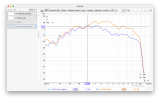
I have measured the two 2405s I got a few months ago, and the frequency response looks something like this at listening position;

Bildschirmfoto 2026-09-09 um 11.18.59.png

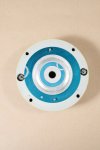
One is playing softer than the other one, and first I thought it’s because there was/is some corrosion on the diaphragm, which I cleaned out (nerve wrecking; felt like what neurosurgery must feel like; had never done this before and felt like I can destroy the thing any second all the time).

This one:
HLGR9368.jpeg


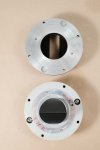
But then I opened the other 2405 to see if there’s any corrosion, too, and saw that it’s a completely different diaphragm? I guess? This:

HLGR9394.jpeg

It didn’t look corroded and the phase plug stuck to it, so I didn’t want to risk damaging it and put everything back together.

Long story short: maybe the blue one is playing softer because it is a different diaphragm altogether? Because of the corrosion? Weaker Alnico magnet?

In the end I’ll probably just ignore that one is softer and go ahead integrating it regardless.
 
I’ve a pair of Flamenco. I picked up a pair of JBL 075 from a massive organ speaker. I’ll mess with caps and a pot to control the output. Should add a lovely sparkle to the sound.
 
I’ve a pair of Flamenco. I picked up a pair of JBL 075 from a massive organ speaker. I’ll mess with caps and a pot to control the output. Should add a lovely sparkle to the sound.
Nice, let me know how it goes! I had a pot connected at first but found I don’t need any attenuation at all so I removed it again.
 
If the blue diaphragm is JBL, it would be from an 077 with the lucite wedge, not a 2405. I don't know that there are any other differences other than the color, but blue diaphragms are made of unobtanium.

There is something else that can and will change the response of these tweeters, and the 075s, and that is the diaphragm installation. The tightness of the screw can have an impact. But even more so, when the screw is put in and the phase plug tightened, if there is ANY twisting of the diaphragm, the impact can be huge.
 
If the blue diaphragm is JBL, it would be from an 077 with the lucite wedge, not a 2405. I don't know that there are any other differences other than the color, but blue diaphragms are made of unobtanium.

There is something else that can and will change the response of these tweeters, and the 075s, and that is the diaphragm installation. The tightness of the screw can have an impact. But even more so, when the screw is put in and the phase plug tightened, if there is ANY twisting of the diaphragm, the impact can be huge.
Those blue diaphragms in the 077 are just the color applied to the outer ring? The rest of the 077 is the same. The sound is the same. Right?

Thanks!


ddf613ec-c16e-4fdd-8d31-cb8c5c49665e.jpg

The LE-5 (from an L100) and 077 on the way to being checked out.
 
Last edited:
If the blue diaphragm is JBL, it would be from an 077 with the lucite wedge, not a 2405. I don't know that there are any other differences other than the color, but blue diaphragms are made of unobtanium.

There is something else that can and will change the response of these tweeters, and the 075s, and that is the diaphragm installation. The tightness of the screw can have an impact. But even more so, when the screw is put in and the phase plug tightened, if there is ANY twisting of the diaphragm, the impact can be huge.
Interesting! So no 2405 ever came with a blue diaphragm from factory? I did pay attention to holding the phase plug tightly while fastening the screw to avoid any twisting, but having no experience with this I don't know if I did it correctly. Nothing changed significantly from before opening it up – neither to the better nor the worse – so I assume the person who messed with it before me did the same mistake, or maybe more likely, the two small dents and the damage from the corrosion (which I cleaned up and tried to prevent from spreading further) are at fault for the softer output compared to the other 2405? Maybe just a weaker Alnico magnet?

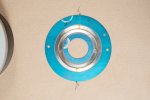
Here, by the way, is the other side of the blue diaphragm:

HLGR9375.JPG
 
I don't know that there were any differences, other than color, one way or the other. That would be a question for the JBL forum, but even there you may not get a valid answer. I do think that the parts sheet specs the 2405 diaphragm as the replacement, but replacements are not always exact and subject to change over time (e.g., 2420/2421/2425 diaphragms).

It is interesting that the replacement diaphragm for the 2402 is listed as the 075, but I guess this makes sense as 075s were made long before 077s, 2402s, and 2405s.

BTW, the two dimples are typically from careless handling of the lead wire horseshoe clips. These are ferrous and are drawn to the magnet if they get close, and if the diaphragm just happens to be in the way..., voila. This is a common sight on the horn driver diaphragms and the two ends of the clip leave a pair of "vampire bites" in the aluminum, though typically not audible. Be careful here!

You get the idea! These are expensive diaphragms (original 375 in first pictures).
4054843-f651f101-jbl-375-driver-original-diaphragm.jpg

5281216-0bf7a053-jbl-3752440-original-diaphragms-nos-one-pair.jpg


OIP.02mMADu9fbR7Dyp21kOMEAHaNL
 
Back
Top Bottom