radioactive
tube gear fanatic
Any markings on the output transformer ?



200w each amp nice

Any markings on the output transformer ?
Does anyone know how the output transformer should be wired for 4,8,16 ohms? I am wondering what impedance the amp is set up for now.

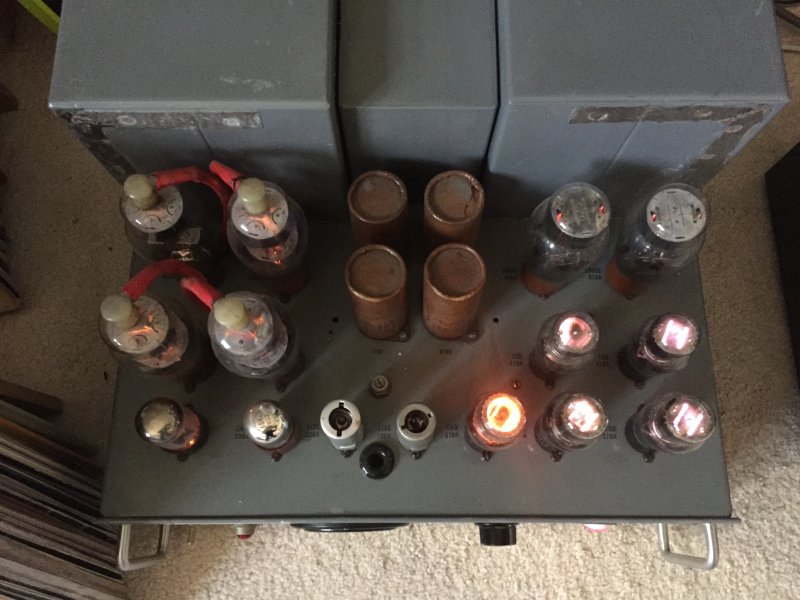
Looks like you have selium rectifiers that should be replaced before they let out the magic (and toxic) smoke.
Hello Radioactive - no no markings on the transformer. There are numbers next to the pins to identify them but nothing else. I have found only two other pairs of this amp in all of the Internet. None have labels on the transformers. I read a posting where supposedly 4 (pair?) were ordered by someone in Florida back in the day. All of my leads have run cold though.Any markings on the output transformer ?
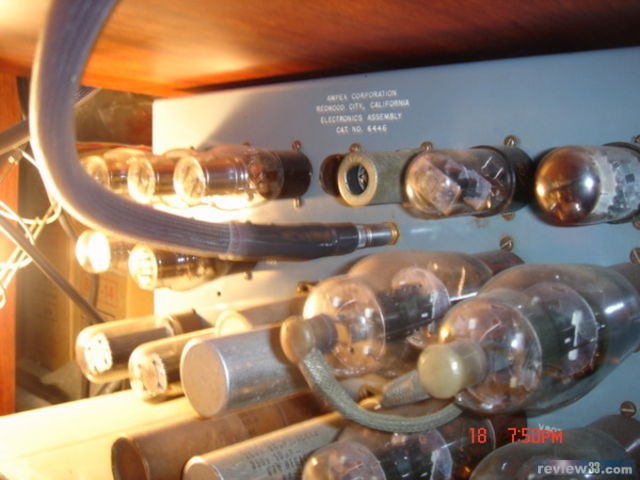
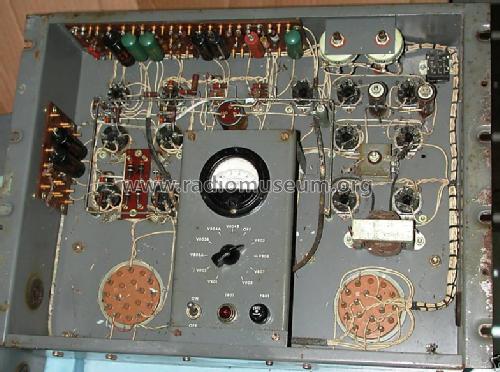
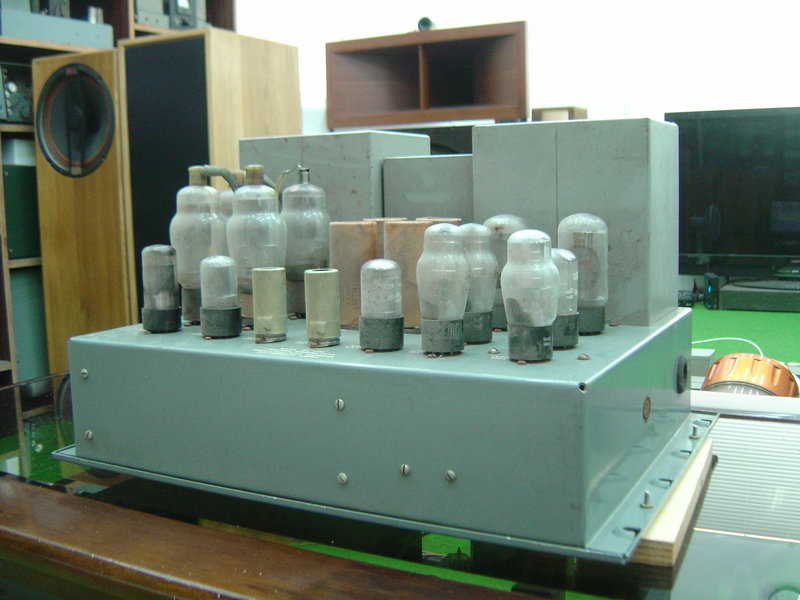
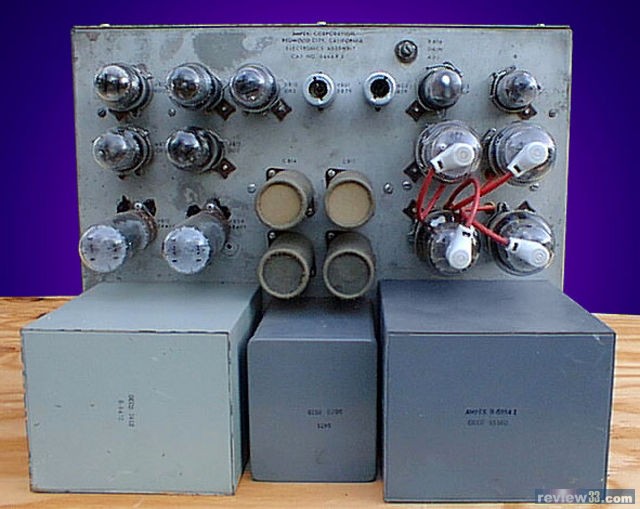
Does anyone have any information on the Ampex 6446 Cinemascope amplifiers?
I just found two. They sound good but I need to know what impedance they are for better speaker matching.
Thank you
Hello Soundmotor - thank you for the information and tips. The 6446 on the Antique Radio website has tan based transformers. The picture is too lo res to be very helpful. I did just find other examples tonight on a Japenese and a Taiwan site. I can see the numbers on the transformers but again the images are lo res and I can't make out the numbers. If I was familiar with the Ampex numbers I might be able to make a guess. I'll try to post the pictures later in case someone else can help.Ampex often used Triad in their tube amps. The output terminal style looks like that of their HSM type but not the usual color.
Those tend to be dark brown, sometimes black or a mint green. I may have seen a tan one before but would not place a bet on it.
Hello Palustris and MIke567 - I agree. While the amps have been relatively quiet, one is starting to make that 60 cycle hum more loudly. I should have my 1958 Pioneer amp mid week. I'll then be looking to get these recapped. I'll probably be in search of 2 sets of quad matched 807 tubes. I'm thinking that all four are biased together.Yes, you are very brave to power those up with the selenium rectifier and old caps. If those coupling caps leak DC then the output tubes can draw enough current to destroy the output transformer.
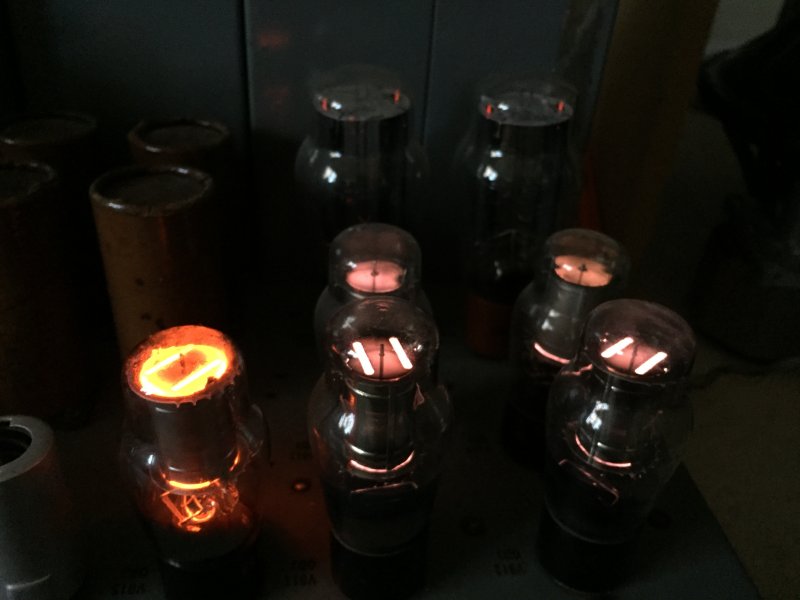
Hello Drummerboy2 - the bright red tube and the 4 violet tubes are for voltage regulation. The red one uses Neon gas and the Violet ones use Argon. Bright discharge is dissipating excess voltage. When there is a low bass note that requires more power you will see the rear two violet tubes dim. If the volume is too loud all four violet tubes dim - not good sound then.Wow, that rectifier is bright! Is that normal?
Hello Arts - I am not sure. Just like the Ampex amps, the previous owner took some liberties with his restorations. I saw an amp that was identical to mine on ebay and a Canadian audio site. The seller was from Vietnam. I posted his pictures in my thread as well. My amp has the perforated cage, side panels and tubular handles deleted. The meter that was center mounted on the cage is now mounted to the bottom chassis. The Stereomaster logo has been relocated from the right side of the cage to now below the meter. I just did a quick search on the web and didn't find anything on a Stereomaster SM-c600. Do you have any pictures or literature on it for comparison?Potato_Head,I was looking at the photo's in you member media and came across a Pioneer that looked awfully familiar. Is that a SM-C800?

Hello Arts - I am not sure. Just like the Ampex amps, the previous owner took some liberties with his restorations. I saw an amp that was identical to mine on ebay and a Canadian audio site. The seller was from Vietnam. I posted his pictures in my thread as well. My amp has the perforated cage, side panels and tubular handles deleted. The meter that was center mounted on the cage is now mounted to the bottom chassis. The Stereomaster logo has been relocated from the right side of the cage to now below the meter. I just did a quick search on the web and didn't find anything on a Stereomaster SM-c600. Do you have any pictures or literature on it for comparison?
The output of my Pioneer amp is dual mono with what I think is a main power switch and then two separate switches for each side. The preamp portion seems combined if I remember correctly.

Hello Arts, Thank you for the model ID. When I saw that I made a typo in my searching (sm-c600) I did a new search. Bingo! The SM-c800 is what I have. I was also able to find the Pioneer books of schematics. Are you going to build the amp? If not send me a PM and let me know what it would take for me to get the parts from you.Unfortunately,I had my SM-C800 a long time ago.It is in fact a true mono design,and a very good one.Mine was so trashed (but complete and still working!) and rusty that I stripped it and scrapped the chassis. I still have the output transformers,chokes,power amp circuit boards,knobs,controls and one power transformer. Believe it or not,at the time I actually got a copy of the schematic (still have that too!) from the old Pioneer Service Center here in Montreal.Today I really wish I had kept it together

If you're getting an increasing level of hum, I wouldn't even put power to those until they're gone through. Rare amps and if you fry an unobtanium transformer, you're going to regret it.
Hello Arts, I received my SM-c800 from the shop yesterday. It sounds very good. there is low level noise. I was told that this is due to the chassis having the same ground as the transformers and tubes. I can live with it though! Do you still have the meter? My meter has a short in it.Unfortunately,I had my SM-C800 a long time ago.It is in fact a true mono design,and a very good one.Mine was so trashed (but complete and still working!) and rusty that I stripped it and scrapped the chassis. I still have the output transformers,chokes,power amp circuit boards,knobs,controls and one power transformer. Believe it or not,at the time I actually got a copy of the schematic (still have that too!) from the old Pioneer Service Center here in Montreal.Today I really wish I had kept it together