
• The move to the new server is done. There are some software and database maintenance updates in process. This has us passing the hat around to help out. We appreciate any donations. Seriously, even a dollar helps. The payment page may be found here - https://www.audiokarma.org/support.html

Ampex 6446 Cinemascope amplifiers

Hello Arts, I received my SM-c800 from the shop yesterday. It sounds very good. there is low level noise. I was told that this is due to the chassis having the same ground as the transformers and tubes. I can live with it though! Do you still have the meter? My meter has a short in it.

I do not agree with your shops statement about the common ground being the cause of noise.Virtually every design of amplifier uses this manner of construction.
Seems like an easy excuse for not being able/willing to diagnose the problem.

Sorry,can't help with the meter,as mine was completely destroyed on the unit I had. Do a search in the AK threads,as there is a company still repairing analog meters.
 
You might start a different thread about that Pioneer meter, with a good pic. Never know when someone might have seen one somewhere. ;)
 
I do not agree with your shops statement about the common ground being the cause of noise.Virtually every design of amplifier uses this manner of construction.
Seems like an easy excuse for not being able/willing to diagnose the problem.

Sorry,can't help with the meter,as mine was completely destroyed on the unit I had. Do a search in the AK threads,as there is a company still repairing analog meters.
Hello Arts,

I may not have described the grounding difference properly. The HK A-500 amp that I have has two grounds. One for the chassis and then a common ground rail that is separate. The Pioneer does not have this separate ground. The noise is a low level "white noise" not a hum.
 
Hello Arts,

I may not have described the grounding difference properly. The HK A-500 amp that I have has two grounds. One for the chassis and then a common ground rail that is separate. The Pioneer does not have this separate ground. The noise is a low level "white noise" not a hum.
That could be shot noise from a tube/tubes, and deteriorating carbon comp resistors.
 
Hello Arts,

I may not have described the grounding difference properly. The HK A-500 amp that I have has two grounds. One for the chassis and then a common ground rail that is separate. The Pioneer does not have this separate ground. The noise is a low level "white noise" not a hum.

In that case,my apologies to your shop:)A very slight background hiss (also known as tube ''blow'') is extremely common in tube type equipment,and is more often governed by tube quality than any other factor.Ground schemes have little or no effect on this spectrum of the noise floor.

Deteriorating carbon composition resistors should not be playing a role here,as the entire unit uses either carbon film or wirewound types.It is very uncommon to see this level of construction and expense in a Japanese unit from this era,but it certainly proved that they were able to produce very high end products when they wanted to.
The build quality,ruggedness and fit and finish of the SM-C800 is truly remarkable.

It is also the only cathode bias EL34 amplifier that I have ever seen. The circuit values for the power amp are exactly as shown in a Sylvania tube manual.I tried to attach the page,but if it is not clear,refer to page #128 here:

file:///C:/Users/User/Documents/Sylvania_Technical-Manual_1970.pdf


upload_2017-2-18_18-54-46.png
 
I have one 6446 in non working but complete condition.

Trying forever to revive it so I stopped my prject a couple of years back.

Terence
 
In that case,my apologies to your shop:)A very slight background hiss (also known as tube ''blow'') is extremely common in tube type equipment,and is more often governed by tube quality than any other factor.Ground schemes have little or no effect on this spectrum of the noise floor.

Deteriorating carbon composition resistors should not be playing a role here,as the entire unit uses either carbon film or wirewound types.It is very uncommon to see this level of construction and expense in a Japanese unit from this era,but it certainly proved that they were able to produce very high end products when they wanted to.
The build quality,ruggedness and fit and finish of the SM-C800 is truly remarkable.

It is also the only cathode bias EL34 amplifier that I have ever seen. The circuit values for the power amp are exactly as shown in a Sylvania tube manual.I tried to attach the page,but if it is not clear,refer to page #128 here:

file:///C:/Users/User/Documents/Sylvania_Technical-Manual_1970.pdf


View attachment 871241
Hello Arts,

Thank you for the info. The hiss seems to be getting louder. The output tubes do have faded getter flashing. Almost clear on two of the tubes. With no active input the hiss will disappear at when the volume control is set to Maximum on one channel. If I choose the MIX setting the hiss almost disappears. Almost as if the hiss is out of phase and when mixed together the hiss from each channels cancels each other out. If I listen to each channel separately the hiss has a slightly different tone.

The preamp section tubes do not seem to have any affect on the hiss. Guess I'll need to get a matched quad of EL34 tubes.

Is there a reason more EL34 amps are not cathode biased?

I just did an experiment and built an open baffle speaker with some Bozak components. The Hiss is unbearable with the 200y tweeters. Thought the Emits in my Infinity speakers would have been more sensitive.
 
I just today, became aware of this amp....the Pioneer SM-C800.
Wow, it looks amazing!

Any update on your amp Michael?

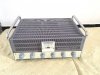
Here's a fuzzy pic of one.
I see there is a thread or two about them here on AK...but very minimal information.

s-l1600-5.jpg
 
Thank you arts and Leland67 for the posts and info.

From what I can tell - all of the resistors are wire wound. They are mounted directly to the tube sockets and other components. replacing them would be a PITA.

The amp now has all new tubes. Quad matched outputs and even quad (octal?) triode halves matched 12ax7's.

The hiss is still there. I have been told that this amp design has a high level of gain that is causing the hiss. This is not the type of hiss that you stick your ear up to the tweets and say I hear noise. This is the level of hiss that your friends ask what is that noise from 10 feet away when the amp starts to warm up.

I am driving a pair of infinity rs 1.5's via the 8 ohm tap. This could be part of the issue since the nominal rating of these speakers is 4 ohms. But damn - other than the hiss they sound great with this amp.

I have done a few experiments though and I am leaning towards trying a new volume pot.

This is a dual mono block with a single volume control and then a single balance control.
The hiss changes with the volume adjustment. Low at the 7-9 o'clock position increasing to maximum level at the 2-3 o'clock position and then dropping to a very low "acceptable" level at full volume. the hiss level is higher on one channel than the other by just a little bit.

The hiss is not constant. I would say that it does seem to act like it is amplifying RF noise like an AM radio might. No regular bursts of noise like from a cell phone or bluetooth but maybe like distance emf.

If I move the bass or treble controls there is no effect on the hiss. If I move the balance control the hiss is still there but I can detect a slight difference in level and tone of the hiss.

If I switch the output selector from stereo to mix the hiss diminishes to nearly zero. If I move the selector to channel 1 only or channel 2 only I get the same hiss level and "tone" as if I had just moved the balance control to just channel 1 or 2.

Luckily my SACD player has a volume control. I have set the volume control on the pioneer to maximum volume and then control the output with the SACD remote. The only downside is that the minimum output on the sacd player is only 4 steps below too loud for relaxed listening.

Again, I am thinking that if the volume control is basically out of the circuit at full volume and that gives the lowest noise floor - then maybe the carbon film or wire wound surface of the pot is contributing to the hiss.

Thoughts?

Michael
 
Michael, I'm interested to know if you initially investigated in any way the risk of turning on your amps for starters, and if you have a better appreciation now about whether you have the same risk? They're your amps, although your posts make me feel like you've found two rare vintage cars and have quickly filled up the tanks and put new rubber on the wheels and are happy to run them around the streets wondering why there are strange noises emanating.
 
Michael, I'm interested to know if you initially investigated in any way the risk of turning on your amps for starters, and if you have a better appreciation now about whether you have the same risk? They're your amps, although your posts make me feel like you've found two rare vintage cars and have quickly filled up the tanks and put new rubber on the wheels and are happy to run them around the streets wondering why there are strange noises emanating.
Hello TRobbins - I get what you are saying. Yes I have done that in the past and have learned the hard way regarding failed capacitors and the damage they can do. Great analogy.

The Pioneer was DOA on receipt so it went straight into the shop for a full rebuild. So it is like the vintage car where all systems have been rebuilt and are to factory specs but there is just that elusive odd noise that might just be due to the design of the trim around the windshield.

There are two approaches I take now. #1 I don't plug the gear in at all. I take it to my tech and he hooks it up to his variac, meters and scope and does various tests before I do anything other than remove the dust! #2 I have my own variac and slowly bring up the power while watching the current draw on my multimeter.Option#1 is what I do 99% of the time for all my vintage finds.

The Ampeg amps checked out "OK" and had only a small amount of hum so I decided to use them for a bit. As soon as I could tell that the sound was changing, they were set aside for complete rebuilds and have not been powered up since.
 
While the one I had was an absolute train wreck from a cosmetic standpoint,it was dead silent and boy,did it have some serious oompf!
The amount of hiss you have described signifies a malfunction.My thought is either a bad tube (tubes?) or an error during the rebuild.

The speakers I was using at the time were JBL 4560's with two Electrovoice 1823M mid horns and two Electrovoice (T-something..?) horn tweeters per channel.
Believe me,if it was hissing I would have noticedo_O
 
While the one I had was an absolute train wreck from a cosmetic standpoint,it was dead silent and boy,did it have some serious oompf!
The amount of hiss you have described signifies a malfunction.My thought is either a bad tube (tubes?) or an error during the rebuild.

The speakers I was using at the time were JBL 4560's with two Electrovoice 1823M mid horns and two Electrovoice (T-something..?) horn tweeters per channel.
Believe me,if it was hissing I would have noticedo_O
Hello Arts,

OK - twice you've pointed to an issue with the rebuild but not offered a solution or idea of further testing.

Tubes are brand new. Quad Matched by one of your home team suppliers and the 6 12AX7's are also matched between their triode halves. An unnecessary step but why not if available?

I'm fairly sure that with my description of how the volume control affects the hiss and how the MIX vs Stereo output mode selection affects the hiss there should be someone here that can offer some next step ideas on how to track down the source of the noise.

Hiss aside - the sound of this amp is very good. Otherwise I would not continue to search for a solution to lower the noise floor.

It is too bad that you chose to scrap your amp. Otherwise we could exchange build and component details that might help me to solve this issue.

-M
 
Michael, you haven't provided a schematic, or elaborated on what test tools you have for noise fault-finding (apart from a variac and multimeter).
 
Back
Top Bottom