• The move to the new server is done. There are some software and database maintenance updates in process. This has us passing the hat around to help out. We appreciate any donations. Seriously, even a dollar helps. The payment page may be found here - https://www.audiokarma.org/support.html

antenna

KFCrosby wrote.

"The main drawback of Rhombics is the space required."

We are talking about indoor FM antennas, yes/ no? Not so - for FM, and if you pin it to the ceiling, it should be effectively invisible.

The picture in the first URL is of an outdoor rhombic and speaks of long-wire antennas a long wire antenna is a good few times longer than the wavelength.

With an indoor FM rhombic the length of each side doesn't even have to reach lambda. Gain will increase as it does approach lambda, but quite small ones will eat any other indoor FM antenna for breakfast.
 
I bet the rabbitn ears would work even better if you put them in the attic.

I tried rabbit ears, as well as a folded dipole, in the attic. Not very good reception. The square loop antenna outperformed both of them, in exactly the same location with the same tuner.
 
was this square loop made using twin-lead / 300 ohm ribbon/ and how long were the sides cf the folded dipole?

and, was the dipole made from twin lead?

I've seen quad antennas with a single active loop and a (slightly smaller) front loop and a rear loop (~ larger) spaced as you would directors and reflectors along a beam. In a loft these can give very good results. A UK company briefly sold a beam quad for exterior use, and it had more than 3 elements.

the value of any wire design for indoor or loft use is its gain and directionality and its very low cost.

:-)!
 
No, this was a single conductor, making a square 30 inches on each side. Therefore it was a full wavelength long. I terminated it directly to 75 ohm coax, and wound a current balun with 3 turns of the coax.

Nicely directional and offers gain over a regular folded dipole. (The dipole it was compared against was the standard twin lead 300 ohm folded dipole.)
 
With an indoor FM rhombic the length of each side doesn't even have to reach lambda. Gain will increase as it does approach lambda, but quite small ones will eat any other indoor FM antenna for breakfast.

Point taken... Most of the Rhombics I have experience with are generally 3/2 wavelengths and such...
 
I have an amplified Terk that I've owned for years...it gives very good FM reception. Looks sort of like a futuristic black skyscraper.
 
I have an amplified Terk tower indoor AM/FM antenna as well, hooked up to my Aiwa bookshelf stereo system. The antenna works very well in this area; I'm 33 miles east of downtown Cleveland, with the FM stations perhaps 10-15 miles further west, making the stations some 40 miles southwest of me. No matter. The Terk antenna pulls in every major FM station in town, and a couple in the next town due east of me, just as well as when I lived in the suburbs.

It's been said in several audio forums on the Web (including this one) that amplified antennas aren't worth the money they go for (mine was $100), because the amplifier brings up the level of signals and noise at the same time. That may well be, but if you are in a reception area where the signals aren't that strong (or if the tuner in your setup isn't that good, like the digital tuner in my Aiwa system), the amplification comes in handy. The only sticking point I've noticed with my Terk tower so far (I've had the antenna since shortly after moving here nine years ago) is that the setting of the amplifier gain is tricky on weak-to-moderate strength stations. If it is set too low, you lose the station; if too high, it overloads the front end of the tuner or receiver, resulting in and all manner of noises. But, as I said, if you have a so-so tuner and/or live in a weak signal area, the Terk antenna is a decent alternative to an outdoor one. I personally had no choice when I bought my Terk, as I live in an apartment building and cannot erect an outside antenna. No matter. As I said in the last paragraph, the antenna works great here, picking up stations in stereo very, very well.

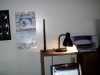
IMHO, Terk has a winner times at least ten in this little antenna, which should be a big hit with apartment dwellers and others who cannot, for any reason, erect an outdoor FM antenna. And it's not bad looking, either. Mine sits on top of my computer desk (the hutch, actually, which also holds my printer and a desk lamp) and, again IMHO, looks very good, with its black housing and the green thumbwheel control for amplifier gain. Not much to look at, perhaps, but it's not ugly, either. The important thing, however, is that it works well in most signal areas (well, at least in my area; I haven't tried it in the suburbs or near-fringe areas) and is well worth the price. :thmbsp:
 

Attachments

  • Img_0350.jpg
    Img_0350.jpg
    31.9 KB · Views: 43
That's the exact antenna I have. I've been very pleased with it over the years. It was first purchased to improve radio reception in a concrete-walled dorm that ate radio signals, and worked like a champ there.
 
Yes Nashvillebill, the full wave loops are top antennas for all frequencies! I have one for the 14 MHz Ham band and it is considerably better than an equivalent dipole, and I also have a one wavelength wire loop cut for the FM broadcast band draped over a wardrobe in my bedroom.

Likewise, it's an amazing indoor antenna. Highly recommended. Regards, Felix (vk4fuq) aka catman.
 
I have an amplified Terk tower indoor AM/FM antenna as well, hooked up to my Aiwa bookshelf stereo system. The antenna works very well in this area; I'm 33 miles east of downtown Cleveland, with the FM stations perhaps 10-15 miles further west, making the stations some 40 miles southwest of me. No matter. The Terk antenna pulls in every major FM station in town, and a couple in the next town due east of me, just as well as when I lived in the suburbs.

It's been said in several audio forums on the Web (including this one) that amplified antennas aren't worth the money they go for (mine was $100), because the amplifier brings up the level of signals and noise at the same time. That may well be, but if you are in a reception area where the signals aren't that strong (or if the tuner in your setup isn't that good, like the digital tuner in my Aiwa system), the amplification comes in handy. The only sticking point I've noticed with my Terk tower so far (I've had the antenna since shortly after moving here nine years ago) is that the setting of the amplifier gain is tricky on weak-to-moderate strength stations. If it is set too low, you lose the station; if too high, it overloads the front end of the tuner or receiver, resulting in and all manner of noises. But, as I said, if you have a so-so tuner and/or live in a weak signal area, the Terk antenna is a decent alternative to an outdoor one. I personally had no choice when I bought my Terk, as I live in an apartment building and cannot erect an outside antenna. No matter. As I said in the last paragraph, the antenna works great here, picking up stations in stereo very, very well.

IMHO, Terk has a winner times at least ten in this little antenna, which should be a big hit with apartment dwellers and others who cannot, for any reason, erect an outdoor FM antenna. And it's not bad looking, either. Mine sits on top of my computer desk (the hutch, actually, which also holds my printer and a desk lamp) and, again IMHO, looks very good, with its black housing and the green thumbwheel control for amplifier gain. Not much to look at, perhaps, but it's not ugly, either. The important thing, however, is that it works well in most signal areas (well, at least in my area; I haven't tried it in the suburbs or near-fringe areas) and is well worth the price. :thmbsp:

I'm sure what you say is correct that the Trek works for you. I had the same experience with it and then tried $10 rabbit ears and they worked better. I would just try the least expesive option first and go from there. In door anetnnas can be tricky.
 
Some follow-up since my original post: I used to get my FM signal through Adelphia Cable, but since Adlephia is kaput, Comcast (succesor) does not provide FM signal.

My tuner is a vintage Pioneer TX-9500 and I'm basically interested in a handful of stations. I live in DuBois, PA which is about 100 miles north-northeast of Pittsburgh, where WDVE is, which is the station I'm most interested in. I cannot access WDVE at all, at the moment. The other FM stations are quite a bit closer and I can get them with not much effort using a dipole antenna.

My stereo is set up in my basement and I have no access to locating an antenna anywhere but in my mancave (SWMBO has dictated all conditions). I can try pinning some sort of antenna on the ceiling or possibly try a powered Terk tower.

T.Z.
 
In my experience, the powered antennas from Terk are a waste of money, but of course you may get different results. I'd try getting the antenna as high as you can. BTW, I'm just down the road from you, in State College - if you're ever headed down this way, give me a shout.
 
Rich,

I'm in State College quite frequently. I'm a graduate of PSU (1974) and my older two daughters are more recent graduates. Any good FM left in State College? Because of the hills between DuBois and State College reception has always been problematic.

Tony
 
Tony? how many is a handful and in what directions are they

If they are all pretty much in one direction then a directional external or attic antenna sans rotor may be all you need. To get good FM basically NEEDS a directional antenna, with gain.

If money is short, or if you like a high ROI, and you do have an attic, or IF an indoor is the only option:- a rhombic or two, or a spread rhombic pair may be the way to go. You have to be able to use maps and scribe onto a plan of your house's rooms or loft plan, the bearings of the relevant desired stations. There are at least two URL's to help you find FM transmitters in the USA.

Go to the tuners group at Yahoo, join it and then go to their antennas repository site and there you will find the rhombic article.

Read it, and then ask me anything you need to.

:-)!

Tim B
 
Purchased a Terk Amplified omni-directional Antenna for $14.99 pus a delivery charge of $9.99 and it is a complete waste of money. Even the very local local stations are not clear.
Just last Saturday I picked up a Radioshack Rabbit Ears Antenna(with a dish for UHF/VHF) from SA for $5.99 and the reception is just amazing. Sometimes the simply things work better than the glorified/hyped ones.
 
Last edited:
Not to get in any kind of debate as I don't have the base science to do that. So I'll just show what I have built and show how it performs and let it go from there:

This antenna is a full band 30" square Modified Cubic Quad antenna. I originally found the basic plans on line that web site is now gone.

officeantenna1web.jpg


officeantenna2web.jpg


This is the signal strenght meter on my unrestored Pioneer TX-9100 tuner in my office system at 1:00pm

officeantenna3web.jpg


The antenna is approx 10' off ground level 38 miles from the transmitter and in the middle of my house directly between the antenna and the outside of my house is my 300 amp split base power service half a dozen 40 watt flouresent tubes in the ceiling of my shop just on the other side of the office wall which carries 2 messes of 1/2" copper water pipe up stairs. My office directly under the atenna has 2 computers an Office stereo system varous wiring in the ceiling about 4' away from the antenna.

Outside my house is the neighbors house about 20 feet way so in a direct line between the antenna and the first open air it see's.

The lay of the land between my house and the broadcast antenna is basically flat with the antenna on a hill high enough to be pretty much a straight line.

The Station puts out approx. 97,000 watts with 2 HD channels on either side of the analog.

I have stations every .2mHz all up and down the dial.
Between about 6:00am and 9:00am this morning the meter was reading approx. 4.75-4.8 it seams to drop a little as the sun comes up higher in the sky we have moutains and foot hills to our East.

You can see great details how I built on of these antennas for my son in the NAVY as well as some detail photo's of this actual antenna in this thread:

http://audiokarma.org/forums/showthread.php?t=215209

works great for me might for you.
 
Rich,

I'm in State College quite frequently. I'm a graduate of PSU (1974) and my older two daughters are more recent graduates. Any good FM left in State College? Because of the hills between DuBois and State College reception has always been problematic.

Tony

Tony, the hills are going to be a problem no matter what kind of antenna you have. I'm not sure that a roof mounted Yagi would help you. Although I can pick up State College FM stations once in a while on my car radio.

If you are in State College say hello to Rich. I visited Rich and his wife a couple of years ago. Nice people and very good music.

P.S. You're not missing much on 'DVE. It almost sounds the same as it did in the early '70's. I know because I was listening way back then. Damn we're getting old!!

Carl
 
Right now I'm doing most of my listening in the basement, so I installed a dipole on the 1st floor of my house, with 300 ohm twinlead ran down through the wall. It gets 5 out of 5 on my KT-7500. I never had much use for amplified antennae. On a good night I can pull DX without even trying!
 
for Tony Z & for the cubical Quad bloke!?

Tony. Don't give up hope quite yet. First off a rhombic CAN outperform most FM yagis, gain wise. but it does depend on how well the diagonals in your attic and rooms align with the direction of a desired station or stations, this will determine how long you can make each of the four equal sides.

And note that if you build one out of 300ohm/TV ribbon you have twice the gain straight away. Two rhombics in the same space!

Have you got the article yet? when you have, and have read it, and begun mapping the bearings onto your home's layout you'll be in a good position to know, but not before! And you still won't have spent any money! :-)!

A whip isn't gonna work over mountains, nor will a dipole, nor rabbit ears! A rhombic just might. NB you can build an external one and might need 4 masts to make it big enough to work. It would have elements as much as 2 x lambda long and would have LOTS of gain.

Get the article, g'warn. 'Ave a GO maaate, as we Aussies say! ;-)!

Now for the guy with the cubical quad?! Ahemmmm!!!!

When you read the article, a while back, did it mention how to mount and point it? Did you keep a copy? Find it.

These are a directional antenna as they are basically a folded dipole pulled out into a square shape, and their gain is similar (low). Their advantage over a dipole is that a cubical quad antenna is capable of picking up most of any FM transmissions, whether mixed/slant (vert+horizontal) which is the most common, or vertical only or horizontal only, and the 'circular' ones using an array of helical antennas around their mast.

So, they can perform a bit better than a horizontal or vertical dipole with similar element lengths. Slanted dipoles have low SAF IIRC. ;-)! But only IF they are mounted with their plane vertical and IF the transmission has mixed or circular polarisation.

Their directionality is perpendicular to the plane of the antenna and in a figure 8 pattern, just like a dipole! :-)!

That is - like this <-|-> when we look at it from its side / With the figure-8 pattern on its side! If it was mounted vertically like it was designed for, you'ld have to aim it.

Most importantly yours is horizontal so its pick up pattern - the figure 8 or two balls - is vertical and you are effectively trying to pick up stations out to the side - in the plane of the f8 pattern's pick-up nulls.

The antenna may be picking up the vertical component of the FM signals surrounding it, which is why it works at all, as an omni.

In other words - to the extent that it is working - is in spite of how you have mounted it. As I understand this stuff.

A DIY indoor FM rhombic looks very like your antenna and mounts the way you have mounted it. But, with much longer sides - approaching 3 metres or longer - and it's not square, <> ? they are directional in the plane of the layout, at the end where you put the loading resistors. As in <>rr-> ?

Most signal strength meters of that type, and the row of LEDs types, are designed to indicate 85% off a gnat's breath. Does it cahneg much on nay station, I'd bet it doesn't. Even the old magic-eye valves were often driven that way.

But WHY? Marketing.

Otherwise the tuner is going to look 'insensitive' in the store, and the 'specs are all types' wouldn't buy it.

Getting your tuner to indicate 95-98% or peg-out will take a whole lot more signal, but IS worth doing. Betcha!

And, if you don't believe me, go ask the guys at the tuner group on Yahoo or read a few of the reviews at TIC.

Truly good FM results in stereo, depend on a directional antenna aimed at the station you want to listen to. They minimise multipath, can help deselect other stations, and they have gain. Simple, really.

Most of the posters here and on the other three current antenna threads at AK should be made to read that para above a few hundred times.

AND, no-one told me any of this stuff, I just found out, because I actually give a ****. I also have a national FM network that makes it worth it.

This one

http://www.abc.net.au/classic/daily/stories/s2494827.htm - try 'listen on line', you'll die of jealousy.

No dynamic range compression, no processing, and regular live direct broadcasts of acoustic music in simple IE 'real', stereo.

Lawrence of Arabia once wrote of the WWI era RR armoured cars - built on Silver Ghost chassis - that 'A Rolls Royce in the desert is above rubies', and so is ABC Classic FM. :-)!

Tim B
 
Back
Top Bottom