• The move to the new server is done. There are some software and database maintenance updates in process. This has us passing the hat around to help out. We appreciate any donations. Seriously, even a dollar helps. The payment page may be found here - https://www.audiokarma.org/support.html

Antiskate force , what is yours

Antiskate force at setting at 2, for 2 gram VTF

  • 0.14 gram or less

    Votes: 7 24.1%
  • 0.15-0.18

    Votes: 5 17.2%
  • 0.19-0.22

    Votes: 4 13.8%
  • 0.23-0.26

    Votes: 7 24.1%
  • 0.27-0.3

    Votes: 2 6.9%
  • 0.31-0.34

    Votes: 0 0.0%
  • 0.35-0.38

    Votes: 0 0.0%
  • 0.39-0.42

    Votes: 1 3.4%
  • 0.43 or more

    Votes: 6 20.7%

  • Total voters
    29
I would imagine excessive anti-skate could be far worse than none at all.
I'd prolly say that either way isn't good. But, only if the setting really places too much stress on one channel or the other.

Anti-skating is an analog compromise, at best. I try to go for as close to "Goldilocks" as possible, and leave it at that.
 
Okay. I filmed what Peter described as part of the Schröder method — dropping the arm onto the run-out in a non-groove area.

[7:40 mark of Ledermann's Part 2 video]


This is with 0.7 A/S on my Technics.

I have no idea if these results are good or bad. But the arm tracks the test record well, and I can't hear any inner-groove distortion.
 
Last edited:
The SME 3009 S2 Improved arm on the Sony. 4.5 gram anti-skate weight on the first ring (closest to the tonearm pivot).

 
Last edited:
I would imagine excessive anti-skate could be far worse than none at all.
No. Without antiskate you will be 100% off, with- in worst case 50% off
Set your antiskate to track 70um and you are just fine. Cartridges that do not track 70 um on Ortofon Record are poorly designed, and should be returned.

It you are serious, get The Shure TTR-103 and Era V. No HighEnd MC cartridge can track as a Shure V15-V. MM are in general trackers better than MC
 
Last edited:
If you increase tracking force to compensate for mistracking in the right channel, you are also increasing stylus/groove friction which, of course, increases skating force which still needs to be corrected.

Doug
 
If you increase tracking force to compensate for mistracking in the right channel, you are also increasing stylus/groove friction which, of course, increases skating force which still needs to be corrected.

Doug
Yes. This is partially a friction issue, too. The stylus tip contacting the vinyl (even if it isn't a groove) causes the tonearm to move inward toward the center.
 
If you increase tracking force to compensate for mistracking in the right channel, you are also increasing stylus/groove friction which, of course, increases skating force which still needs to be corrected.

Doug
Just out of curiosity, does the movement I'm seeing in my tonearms (in the videos) seem normal to you?

Have you tried dropping your arm in the deadwax area (non-groove)?

Thanks!
 
No. Without antiskate you will be 100% off, with- in worst case 50% off
Set your antiskate to track 70um and you are just fine. Cartridges that do not track 70 um on Ortofon Record are poorly designed, and should be returned.

It you are serious, get The Shure TTR-103 and Era V. No HighEnd MC cartridge can track as a Shure V15-V. MM are in general trackers better than MC

Can this really be true of all tonearm designs? I know my Rega RB300 antiskate strength is much stronger than its marked settings. Would you feel like sharing the source of this statement?
 
You can measure the antiskate side force by putting the scale on the side as how in some of my first posts here.
You will find that the arm AS force is usually 10-15% or sometimes more. .This forum has posts with actual sideforce meter from Orsonic that confirm that balanced cantilever requires 12-13%.
If you have VTF of 2 grams your skating force driving towards center is , let say 0.24 gram side force. . If you set your AS to 2 , your actual force may me something between 0.2 and 0.3. An error of 50% or 0.1grams. Without AS your error or unbalance will be more than 0.2. So it is worse to be without AS , than even an inaccurate AS.

The skating force vary by sin(tracking angle) which means it varies at most from 21-25 if you are unlucky. That corresponds to a peak variation of skating force of 15% across the record. 15% of 0.24 in our example is 0.036gram a much smaller error then being without AS at all, which is 0.24gram.

There is simply difficult to find justification where running without antiskate can be better than running even with an inaccurate or wrongly set one.

Check your AS side force, and set til to a value that gives 10-12-15% , pick your poison, of your VTF

Your antiskate force must be off by 100% … twice as much as actual skating force before it is as bad as using no antiskate..
 
Last edited:
Check your AS side force, and set til to a value that gives 10-12-15% , pick your poison, of your VTF
I had a question. Is there a reliable chart showing the skating force changes as the arm travels across an LP at 33 RPM? I kinda remember an old one (maybe from Shure) at a set record frequency, like 1000Hz. :idea:

Thanks!
 
Last edited:
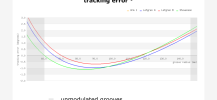
The shape of the skating force across the record is very similar to the tracking angle error you find for tone arms protractors. The variation in force is determined by the change in offset angle + angular variation across the record
IMG_0224.png
 
Last edited:
The only time I sensed inner groove distortion as a problem was on Procol Harum “Grand. hotel” when I put in on my families Garrard in 1973, Apart from then I never really sensed it as problem. Later I go an AT95E , that saw a lot of music ,, nobody cared about the fidelity then. it was all about the music and how big the speakers were.
I now use MicroRidge stylus, which kind of eliminates the issue .. far superior to elliptical,
 
Last edited:
SkatingForce.png


Aside from being a parabola, tracking error is a poor proxy as it gets one key relationship wrong.

An interesting article on inner groove distortion. Why and how to try to fix it.

Aside from the obvious errors. Personally, I become disinterested when the daft trope "complexity" is used, where the game is frequency and amplitude. It's typically the difference between rote regurgitation and understanding - describing the "feeling" of the problem rather than the actual mechanism.
 
The only time I sensed inner groove distortion as a problem was on Procol Harum “Grand. hotel” when I put in on my families Garrard in 1973, Apart from then I never really sensed it as problem. I now use MicroRidge stylus, which kind of eliminates the issue .. far superior to elliptical,
I think if you adjust the tonearm's geometry and anti-skating to the best of your ability, it's about all you can do. I also run smaller line contact and Shibata tips.

The article seems generally correct. Most inner-groove songs tend to be quieter and less dynamic. Or songs that maybe the engineer and masterer guess will be less popular.

I looked through the tunes I uploaded and found that this popular one is the last on one side. A pretty "hot" recording. On top of that, the LP is warped. :)

Just Don't Wanna Be Lonely.
Main Ingredient - "Euphrates River." RCA Victor Records. APL1-0335. Dynaflex. Unipak. Indianapolis pressing. 1974.
Run-out: APL1 0335 A 2 I


The digital sample is cleaner, but still has the "hot" cymbals.
 
Last edited:
Aside from the obvious errors. Personally, I become disinterested when the daft trope "complexity" is used, where the game is frequency and amplitude. It's typically the difference between rote regurgitation and understanding - describing the "feeling" of the problem rather than the actual mechanism.
I guess this means you didn't like the article.

;)
 
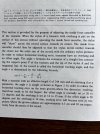
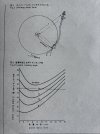
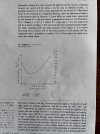
Denon explain the force and how to calculatee it here. The shape of the skating force curve follows the lateral tracking angle for a give arm, right?
IMG_0226.jpeg
IMG_0227.jpeg
IMG_0228.jpeg
Am I missing something? @JP

Not sure I agree with Denon disk method,, I use lower side force
 

Attachments

  • IMG_0226.jpeg
    IMG_0226.jpeg
    184.7 KB · Views: 2
Last edited:
Back
Top Bottom