• The move to the new server is done. There are some software and database maintenance updates in process. This has us passing the hat around to help out. We appreciate any donations. Seriously, even a dollar helps. The payment page may be found here - https://www.audiokarma.org/support.html

Antiskate force , what is yours

Antiskate force at setting at 2, for 2 gram VTF

  • 0.14 gram or less

    Votes: 7 24.1%
  • 0.15-0.18

    Votes: 5 17.2%
  • 0.19-0.22

    Votes: 4 13.8%
  • 0.23-0.26

    Votes: 7 24.1%
  • 0.27-0.3

    Votes: 2 6.9%
  • 0.31-0.34

    Votes: 0 0.0%
  • 0.35-0.38

    Votes: 0 0.0%
  • 0.39-0.42

    Votes: 1 3.4%
  • 0.43 or more

    Votes: 6 20.7%

  • Total voters
    29
What is Fgy at Fg=2.0 gf per wall?
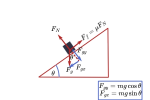
Check the diagram of forces...it's Fg*cos45° = 1,41g (it would be half of that per wall).

you get 6.5% skate force, this is given friction coefficient 0.25
Yes, though it was not I who came up with the coefficient of friction being 0,25.

Measured friction coefficients vary between 0.22-0.6 according to literature. You are still having a force that needs compensation by anti-skate force. This is known and measured since long time ago. Empirically you get between 10-15 % of VTF.
Fine. Why the endless discussions then? And why do manufacturers propose different settings? If the equation is legit, then something is very amiss; either the 10-15% of VTF SF-range, or the 0,22-0,6 μ-range; you can't have both being true: 10 to 15 is 50% up and 0,22 to 0,6 is 173% up!

As mentioned µ has been measured to between 0.22-0.6, and can vary within and between records.
It doesn't vary within one record - the materials (diamond and vinyl) sliding on each other don't change.
 
Check the diagram of forces...it's Fg*cos45° = 1,41g (it would be half of that per wall).


Yes, though it was not I who came up with the coefficient of friction being 0,25.


Fine. Why the endless discussions then? And why do manufacturers propose different settings? If the equation is legit, then something is very amiss; either the 10-15% of VTF SF-range, or the 0,22-0,6 μ-range; you can't have both being true: 10 to 15 is 50% up and 0,22 to 0,6 is 173% up!


It doesn't vary within one record - the materials (diamond and vinyl) sliding on each other don't change.
It does vary within a record. Look at the variation of fundamental resonance f whose main inducer is variation in drag force (warps do as well but is not a main cause!). I’ve looked quite a bit into that and is the cause of the cartridge dance as a reaction to highly modulated grooves/beats. Several videos and measurements can confirm that. Mechanisms are stick-slip effects.
 
Last edited:
It is not mine, it is yours.

Friction force = coefficient of friction * force normal to the surface

The walls of the groove are at a 45° angle, thus the normal force does not equal the VTF.

View attachment 3655337


The coefficient of friction is not affected by modulation. Friction force, on the other hand, is.
the friction coefficient used in litterature on this subject is omitting the modulation angle and simply the relation between vertical VTF and friction force and direction. So I think both you and AI have misunderstood this, in this particular case

The fact is that the side force used in many good arms are 10-15% of VTF.
If you want to relate the friction factor to the 45 wall angle you may do so but the coefficient cannot be replaced with one neglecting the angle. It has do be done consistently.
 
Last edited:
I purchased one of those little digital scales for my Thorens TD150 II but lost it somehow in a move or maybe gave it away when I sold the TT? I guess I need a new one, never used it to measure AS. I always set it slightly less than track weight and do a visual first, see how much pull it has, then a listen. I find that last track distortion can be mitigated via AS adjustment.
 
the friction coefficient used in litterature on this subject is omitting the modulation angle and simply the relation between vertical VTF and friction force and direction. So I think both you and AI have misunderstood this, in this particular case

The fact is that the side force used in many good arms are 10-15% of VTF.
If you want to relate the friction factor to the 45 wall angle you may do so but the coefficient cannot be replaced with one neglecting the angle. It has do be done consistently.

I only consult the AI between my ears, not the binary one. I'm not saying the 10-15% of VTF is wrong, I'm questioning the methods used to determine it. @Thomas_AA has just stated the coefficient going up to 0,6 - that leaves your calculation with 20% as well.

I also think anti-skate should be applied. But I also think that, if the main goal of anti-skate is minimizing uneven/premature wear of the stylus (and records as well), playing wet is a smart thing to do...as is running a linear tracker. Eitherway, cleanliness of stylus and record affects drag/skating/wear and should be kept, as it's the easisest to achieve among the stuff discussed here.

There also may be some confusion about numerical values of VTF and anti-skating - setting AS to 2 for VTF of 2g (with the dial, for example), doesn't automatically mean the AS force is 2g. How do you know which AS force is actually exhibited between different manufacturers?...there isn't a standard/norm, is it?

 
img_9037-jpeg.1158270
img_8836-jpeg.1153079
This is from Denon litterature on Skating force and some other articles below

From Audio on top


source:%20diyAudiohttps://share.google/hM63CBbcH65xchYgt

Link was difficult to do
 
Last edited:
I only consult the AI between my ears, not the binary one. I'm not saying the 10-15% of VTF is wrong, I'm questioning the methods used to determine it. @Thomas_AA has just stated the coefficient going up to 0,6 - that leaves your calculation with 20% as well.

I also think anti-skate should be applied. But I also think that, if the main goal of anti-skate is minimizing uneven/premature wear of the stylus (and records as well), playing wet is a smart thing to do...as is running a linear tracker. Eitherway, cleanliness of stylus and record affects drag/skating/wear and should be kept, as it's the easisest to achieve among the stuff discussed here.

There also may be some confusion about numerical values of VTF and anti-skating - setting AS to 2 for VTF of 2g (with the dial, for example), doesn't automatically mean the AS force is 2g. How do you know which AS force is actually exhibited between different manufacturers?...there isn't a standard/norm, is it?
The reported μ is a summary from what has been published. μ around 0.25 is about the lowest you get and 0.3-0.4 are more real world values. 0.5-0.6 is probably related to low quality vinyl. VTF is also an average due to dynamic variation but variation is small due to modulation ( but can be large if warp f is within the Rf, since the eff mass of the tonearm is huge vs. the cantilever eff mass). Tonearm pivot point and COG is a factor as well. Stick-slip friction adds to the dynamic behavoiur which basically is eliminated by wet play/lubrication.

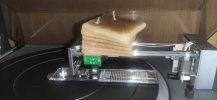
That said this thread was really about measuring the AS force on various tonearms by a simple method. Which is a useful info.
 
Check the diagram of forces...it's Fg*cos45° = 1,41g (it would be half of that per wall).


Yes, though it was not I who came up with the coefficient of friction being 0,25.


Fine. Why the endless discussions then? And why do manufacturers propose different settings? If the equation is legit, then something is very amiss; either the 10-15% of VTF SF-range, or the 0,22-0,6 μ-range; you can't have both being true: 10 to 15 is 50% up and 0,22 to 0,6 is 173% up!


It doesn't vary within one record - the materials (diamond and vinyl) sliding on each other don't change.
You never will make sense of it if you keep oversimplifying what is in actuality a complex problem. The geometric equation doesn't factor in all the individual variables....it doesn't even factor in stylus acceleration, yet @Sleiven 's graphs clearly illustrate the impact acceleration has on skating forces.
 
I have no reason to disagree with your statement, but I'm curious how it was established that force variation due to modulation is rather small. Comparing small and large modulations (of course at the same radius, so presumably different discs) while watching for distortion on an oscilloscope?
Edit: Should have paid attention to the little banner that said that more posts had been made since yours before posting my question. Seems like it is pretty well answered.
 
Off to a good start
The walls of the groove are at a 45° angle, thus the normal force does not equal the VTF.

...and then I ***k it all up with the wrong diagram.

1765977243037.png

The moron: ...and yet the calculation yields a skating force approximately 42% to high.

@Thomas_AA: So 2.0 gf VTF gives 1.41 gf per wall = 2.83 gf total.

The moron: No, now you're off by 100% - it's the other way around.

@Thomas_AA: What is Fgy at Fg=2.0 gf per wall?

The moron: Check the diagram of forces...it's Fg*cos45° = 1,41g (it would be half of that per wall).


@Thomas_AA is, of course, correct!


Note to the moron: You're having a difficult time to translate english technical terms back and forth on the fly - write that chit down, or something, prior to posting!


I'm sorry, gentlemen, for any and all confusion, I might have caused!


I would try everything myself, but I'm in the close-to-zero-skating-force corner, so I'm stuck with exercising my grey cell...if I could only find the bloody thing, that is.

Revox B790 + VMS20EO MKII_stylus position gauge_photo by @borchee_02.jpg
 
Last edited:
Nope, not tangential. The base of the tonearm on your Technics SL-J2 is moved in a linear motion, but the tonearm itself is pivoted/radial, which equals in tracking angle error as stated in the specs of your TT. It is small, but existend.
Essentially you claim that there are no tangential tonearms in existence.
 
I have no reason to disagree with your statement, but I'm curious how it was established that force variation due to modulation is rather small. Comparing small and large modulations (of course at the same radius, so presumably different discs) while watching for distortion on an oscilloscope?
Edit: Should have paid attention to the little banner that said that more posts had been made since yours before posting my question. Seems like it is pretty well answered.
If you are asking me, modulation do cause forces, that is why there is a minimum force for tracking (which perhaps can be between 0.2-0.4 g for the lightest stylii). Relatively small is related to the larger force variations caused at resonance when tonearm is moving, since the tonearm has much higher effective mass. A test for modulation force would e.g. be to test minimum tracking force under ideal conditions (as low stick-slip friction as possible, e.g. wet play) and a completely flat and centered record (to avoid further tonearm mass effects). Forces during lateral modulation change the forces acted per wall - transiently higher on one wall but lower on the other. so any net result would most likely still be ≈ VTF as set.

Now the dance around beats or higher modulation is most likely due to increased stick-slip friction, which cause the cartridge and arm to vibrate, and induce resonance.


And it is not only MJ that cause cartridge dancing.


As known from Luckdogs previous measurements at VE, there is a huge drop in the level of fundamental resonance during wet play
 
Does stick-slip (it's static friction, right?) occur along the whole lenght of the groove or only when the stylus going zig stops and goes zag, and vice versa? Isn't the tone arm's pivot/bearing(s) affected as well, especially with an off-center record?

Essentially you claim that there are no tangential tonearms in existence.
No, I specifically claim your and mine TT doesn't have them...and the Beogram 8002. There are more, but I won't go looking into service manuals of each linear tracker in existence,
Having the arm truest to tangent would be some with linear/air bearings and the similar, such as Dereneville, Kuzma Air, Clearaudio, @Buck Rogers and others, and surely a bunch of old, as well as cheaper ones.
 
Having the arm truest to tangent would be some with linear/air bearings and the similar, such as Dereneville, Kuzma Air, Clearaudio, @Buck Rogers and others, and surely a bunch of old, as well as cheaper ones.
It is not about the TA's tube being tangential to the groove under the stylus, it is about the cantilever being tangential. No matter how low the air-bearing's friction is - the friction is still there, hence - the cantilever's deflection off the true tangentiality.
So my interpretation of your statement holds true: there are no tangential tonearms in existence.
 
How could I possibly make such a statement - besides that I didn't! I obviously am not in possesion (either physical or data-wise) of every linear tone arm out there, am I.
Your interpretation is your interpretation, so it holds true for you. You are welcome to make interpretations, true or wrong, all day long, just don't put words in my mouth!

As far as I know, the Dereneville DTT-03 might be the most precise one, correcting/driving the arm, aided by a laser, with a precision of less than 5 microns.

If you want to discuss the linear/tangential matter further, start a new thread.
 
Last edited:
Usually use half the VTF force for anti-skating. Different stylus tip shapes require different anti-skating settings.
Are you referring to VTF or the anti-skate scale? This thread is about measuring the anti-skate force with a scale. Half the VTF would be too much anti-skate.
 
Back
Top Bottom