• The move to the new server is done. There are some software and database maintenance updates in process. This has us passing the hat around to help out. We appreciate any donations. Seriously, even a dollar helps. The payment page may be found here - https://www.audiokarma.org/support.html

Antiskate force , what is yours

Antiskate force at setting at 2, for 2 gram VTF

  • 0.14 gram or less

    Votes: 7 24.1%
  • 0.15-0.18

    Votes: 5 17.2%
  • 0.19-0.22

    Votes: 4 13.8%
  • 0.23-0.26

    Votes: 7 24.1%
  • 0.27-0.3

    Votes: 2 6.9%
  • 0.31-0.34

    Votes: 0 0.0%
  • 0.35-0.38

    Votes: 0 0.0%
  • 0.39-0.42

    Votes: 1 3.4%
  • 0.43 or more

    Votes: 6 20.7%

  • Total voters
    29
Which doesn't explain why some audiophiles are strongly committed to the underhung thing, while most are not convinced.
The ones unconvinced have never heard one. Those who are commited obviously like what they're hearing, though some of it may be due to the other unconventional features often associated with the designs. I once heard an RS Labs (pivoting shell, 15° elevated unipivot) in a stereo shop. While I wasn't in a position to make comparisons, there was nothing in the sound that screamed distortion, which seems to be what people fear most. Most who've heard one describe an overall sense of ease in the dynamics. While it's true that real records don't routinely reach the high accelerations tested for in the graphs, the musical dynamics may pose challenges that test the limits of the AS system, perhaps exceeding it, leading to the higher distortions seen in the graphs. Removing these limits would certainly explain the sense of ease often mentioned by listeners who've heard them.
 
I'll admit I haven't heard an underhung arm, but I think that to blithely declare that the reason people aren't greeting them with Hosannas is that they haven't heard them is wrong. People hear differently, and people listen for different things, so they may have heard them and not liked them, but failed to be on this thread. There is room for a variety of views in this hobby, and there is no audio truth that doesn't have a bunch of people hotly contesting it.
Furthermore, underhung or offset are not the only issues that might affect opinions - arm quality, stylus shape, type of music, or other variables might actually be driving responses.
 
My 2 cents on anti-skate, I start with matching tracking and AS. Then I use the Shure test record (IV) to fine tune. Using the bells and flute velocity tracks at level five. Moving anti-skate left or right introduces distortion on left or right channels so I try to establish L & R boundaries and find the center. Depending on the cartridge, there may be no distortion to be found. Often my AS is slightly less than tracking force and I’m sure every arm and cartridge combo dictates what it wants. I’m pretty blessed that I never have inner groove distortion regardless of cartridge and I use this method because it works for me. May be something worth trying if someone wants a procedure beyond guessing or hoping they’re “in the zone”.
 
Again, overhang is not setting the skating force. It only affects the tracking angle error which is what is causing the VARIATION of the tracing force across the record. The skating force is F= u* sin (A +B) * VTF where A is the arms offset angle and B is the tracking angle error, where B depends on arm length and overhang and the position of the arm across the record . u is the friction coefficients , latest sources indicate a value about 0.3. The formulas are given in the standard texts/articles.

Since a typical offset angle A is 22 degrees and tracking error less than 2 degrees across the record , The variation in skating force can then be calculated.
Setting overhang to 0 does not eliminate the skating force , it just alters the variation in skating force across the record. A for a given arm there is ONLY one optimal overhang depending on your choice of alignment . ( pick your poison L or B or S)

Using sin(20)=0.342 and Sin(22)=0.375 and Sin(24)=0.407 we see that the variation of skating force is about +- 10% across the record

The offset angle is a function of (computed from) the overhang, no?
 
I would guess that both are dependent on arm length and pivot position, and I would guess that since off set angle is a fixed value (except in things like the Garrard Zero arms), the overhang, which is easy to adjust, is the last thing specified. But I'm no engineer.
 
I'll admit I haven't heard an underhung arm, but I think that to blithely declare that the reason people aren't greeting them with Hosannas is that they haven't heard them is wrong
Is it , though? When a radical concept is proposed it is more likely the followers of the concept who are reticent in voicing their approvals for fear of reprisal, ridicule, etc. Those behind the status quo are far more likely to state their opinions, comfortable in the knowledge they are with the majority and safe from rebuttal.

I take no issue with the rest of your post (though stylus shape rarely enters the discussion on skating force even though it is demonstrated to be a factor), merely conjecturing on the inspiration for underhung arms based on the graphs @Sleiven posted earlier.

Incidentally, did you read Korf's latest blog on why he chose Stevenson over Baerwald for his new arms? It's another multipart post yet to be concluded, but the distortion graphs he posted show that the distortions generated by the dynamics of a moving stylus swamp out geometric ideals; you'd be hard pressed to tell which alignment he's using in any of the graphs.
 
Used to set them up only with the test LP on the scope 1KHx modulated with a 10KHz wave scoped, the adjustments were quite touchy, but there is an optimal point where it visually looks as good as one will ever get it. Until getting to the ideal point the 10KHz visually looks pretty messy.
 
To give this thread a push...

Mathematical the skating force is u* VTF*sin( offset ange+ tracking error)

So...coefficient of friction is constant...vertical tracking force is constant...offset angle is constant...influence of the changing tracking angle error can be neglected...and yet the calculation yields a skating force approximately 42% to high.

The vertical tracking force is the normal force to the blank disc, but not to the groove walls!

Using glass, or any other material than vinyl, is pointless at best, because the coefficient of friction is unknown...well, guessing what it is for vinyl doesn't help much with the precision either.
 
I doubt the friction is constant across multiple records, or even across a single one if it isn't virgin vinyl. Pegging down a number is confounding. Then there's the problem of stylus shape, as it's known that ellipticals need higher AS than conicals. Is it because of a smaller contact area exerting more force per unit area, equivalent to a higher VTF? What does that say for extended line contacts like Shibata and MR? They should need less than conicals but is it actually so?

Clearly, skating is not solved satisfactorily by a simple geometric equation.
 
Clearly, skating is not solved satisfactorily by a simple geometric equation.

Definitely not, nothing will, but the equation represents at least something resembling a common ground for discussion. The contact area is irrelevant for friction...well, this might bring up the incredible heat created at it, thus changing the coefficient of friction. Of course multiple records won't share the exactly same vinyl recipe, but they are more simmilar to each other than to glass or polycarbonate...likely.

Then there's the problem of stylus shape, as it's known that ellipticals need higher AS than conicals.

I don't think so. It can't even be agreed on whether anti skating is actually needed; neither do all TTs have such a contraption.
 
To give this thread a push...


So...coefficient of friction is constant...vertical tracking force is constant...offset angle is constant...influence of the changing tracking angle error can be neglected...and yet the calculation yields a skating force approximately 42% to high.

The vertical tracking force is the normal force to the blank disc, but not to the groove walls!

Using glass, or any other material than vinyl, is pointless at best, because the coefficient of friction is unknown...well, guessing what it is for vinyl doesn't help much with the precision either.
?? What do you mean?
The friction coefficients for a 45/45 modulated groove about 0.3 ,,, Sinus to 24 degree offset is about 0.4 soo that given 0.2x0.4 of VTF or 12% , this between the SME value and the Orsonic max value of 15% at high modulation…where does your “42% too high “mean/come from?
 
Somebody mentioned Kort I believe,,, slight off topic but about tracking errors
index.php
I get the same results as Korf when plotting distortion across a 15 minute record. … tracing distortion as a function of tracking error is not detected, the distortion increase towards centre…( third curve)
The top plots show phase difference between channels which change with radius as expected, Note phase difference value is not the same as angular error..

End off topic
 
Last edited:
where does your “42% too high “mean/come from?

It is not mine, it is yours.

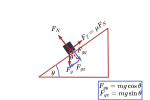
Friction force = coefficient of friction * force normal to the surface

The walls of the groove are at a 45° angle, thus the normal force does not equal the VTF.

1765835020039.png

The friction coefficients for a 45/45 modulated groove about 0.3

The coefficient of friction is not affected by modulation. Friction force, on the other hand, is.
 
I don't think so. It can't even be agreed on whether anti skating is actually needed; neither do all TTs have such a contraption.
You better tell Dual as their arms have separate AS scales for the different stylus types. And the inclusion or not of AS devices has nothing to do with whether it's needed or not. Cost/budget, complication, incorrect use/abuse. At most they'll suggest raising the VTF to compensate but they're not paying for the replacement needles.
 
While it is clearly true that skating force is generated by the walls of the groove so a flat surface can only suggest the correct anti skating force, I suspect that it is more complicated than a simple 45 degree vector diagram encompasses. Obviously there are two sides to the groove, so a fuller vector diagram would show both sides, with the downward force split between them.
But the groove is modulated, and in a stereo record, each side's modulation is different, so not only is the stylus accelerating madly back and forth, but it is also probably at times sliding up and down on one side of the groove as a large modulation on one channel lifts and drops the stylus when there isn't such a modulation on the other. So, since acceleration is force times mass) the force exterted on each wall of the groove is dramatically changing as the stylus is accelerated in one direction and then another, and in both the horizontal and vertical axises (axes?).
I suspect that groove modulation affects the required antiskating force very significantly, so the best we can do is a very rough estimate, one which will be too high much of the time, but too little when it is needed the most.
Which is why I think it is okay to throw up your hands and do what the manufacturer suggests (of course, not all makers even offer suggesting settings - wimps!).

 
It is not mine, it is yours.

Friction force = coefficient of friction * force normal to the surface

The walls of the groove are at a 45° angle, thus the normal force does not equal the VTF.

View attachment 3655337
So 2.0 gf VTF gives 1.41 gf per wall = 2.83 gf total. Stylus drag at µ=0.25 ≈ 0.70 gf. Skate force around 0.26 gf or 13% of VTF.
 
You better tell Dual as their arms have separate AS scales for the different stylus types.

You better tell every other manufacturer that doesn't have two separate scales.

You are missing my point. I'm giving food for thought by pointing out the flaws, not claiming how, or even if, anti skating should be set. @Nat get's it.

So 2.0 gf VTF gives 1.41 gf per wall

No, now you're off by 100% - it's the other way around; VTF = Fg and you're looking for the Fgy component. The skate force is 6,5% of VTF...with a 22° offset.

Now, if this is true, why even bother with 6,5% - why not just set it to zero/ignore it and call it a day. The coefficient of friction is affected by humidity, so it is not equal in Louisiana and Arizona. No clue about the magnitude of the difference, bet there is one. Temperature also plays a role.

Regardless... the formula only accounts for friction/skating caused by VTF and disregarding, as @Nat points out, that modulation causes the stylus to a funky


When the blank-record method is used, does the stylus leave a groove?
 
You better tell every other manufacturer that doesn't have two separate scales.

You are missing my point. I'm giving food for thought by pointing out the flaws, not claiming how, or even if, anti skating should be set. @Nat get's it.


No, now you're off by 100% - it's the other way around; VTF = Fg and you're looking for the Fgy component. The skate force is 6,5% of VTF...with a 22° offset.
What is Fgy at Fg=2.0 gf per wall? And even if you say VTF is halved divided per wall, you get 6.5% skate force, this is given friction coefficient 0.25. Measured friction coefficients vary between 0.22-0.6 according to literature. You are still having a force that needs compensation by anti-skate force. This is known and measured since long time ago. Empirically you get between 10-15 % of VTF.
 
Last edited:
While it is clearly true that skating force is generated by the walls of the groove so a flat surface can only suggest the correct anti skating force, I suspect that it is more complicated than a simple 45 degree vector diagram encompasses. Obviously there are two sides to the groove, so a fuller vector diagram would show both sides, with the downward force split between them.
But the groove is modulated, and in a stereo record, each side's modulation is different, so not only is the stylus accelerating madly back and forth, but it is also probably at times sliding up and down on one side of the groove as a large modulation on one channel lifts and drops the stylus when there isn't such a modulation on the other. So, since acceleration is force times mass) the force exterted on each wall of the groove is dramatically changing as the stylus is accelerated in one direction and then another, and in both the horizontal and vertical axises (axes?).
I suspect that groove modulation affects the required antiskating force very significantly, so the best we can do is a very rough estimate, one which will be too high much of the time, but too little when it is needed the most.
Which is why I think it is okay to throw up your hands and do what the manufacturer suggests (of course, not all makers even offer suggesting settings - wimps!).
Force variation due to modulation is rather small. There are secondary effects however and µ is not entirely free from modulation effects, while they should be in principle. As mentioned µ has been measured to between 0.22-0.6, and can vary within and between records.
 
Back
Top Bottom