• The move to the new server is done. There are some software and database maintenance updates in process. This has us passing the hat around to help out. We appreciate any donations. Seriously, even a dollar helps. The payment page may be found here - https://www.audiokarma.org/support.html

Antiskate force , what is yours

Antiskate force at setting at 2, for 2 gram VTF

  • 0.14 gram or less

    Votes: 7 24.1%
  • 0.15-0.18

    Votes: 5 17.2%
  • 0.19-0.22

    Votes: 4 13.8%
  • 0.23-0.26

    Votes: 7 24.1%
  • 0.27-0.3

    Votes: 2 6.9%
  • 0.31-0.34

    Votes: 0 0.0%
  • 0.35-0.38

    Votes: 0 0.0%
  • 0.39-0.42

    Votes: 1 3.4%
  • 0.43 or more

    Votes: 6 20.7%

  • Total voters
    29
Checked it vertically with weight, and then you must zero it when on the side, —-measure a couple of times to make sure results are repeatable and consistent ,it then matches quite well the result when using the Wally tractor method( hanging pendulum) .
I could have checked side force directly by pendulum and math , but forgot that option. I was satisfied to se similar results with both methods
 
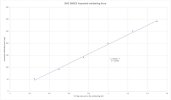
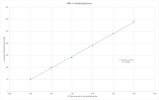
I have two SME arms on two different turntables. Their antiskating force calibrations are quite different, one being two times the other. The SME 3009/II Improved AS is 20% of the VTF. The SME V AS is 10% of the VTF. A 15% for both would have been fine for me


SME 3009.jpg

SME V.jpg
 
I'm now with 0 antiskating since i'm using a tonearm with no AS right now. Jelco SA-100 variant.

No problem with mistracking/etc. In theory needle life gets shortened because the two sides of the stylus tip aren't worn equally, however in practice considering the skating force is probably 0.1-0.2% of the VTF, maybe it doesn't make any difference at all.
 
I'm now with 0 antiskating since i'm using a tonearm with no AS right now. Jelco SA-100 variant.

No problem with mistracking/etc. In theory needle life gets shortened because the two sides of the stylus tip aren't worn equally, however in practice considering the skating force is probably 0.1-0.2% of the VTF, maybe it doesn't make any difference at all.
The Jelco has no anti-skate option?

A/S does make a difference. How is the tracking on the inner groove?
 
Last edited:
The thing is, whether or not you can hear mistracking in either channel, the wear difference is going to be there. Physics is physics. No anti-skate, more wear on the inner stylus and groove wall. Too much anti-skate, more wear on the outer stylus and groove wall.
Of course, anti-skate is an approximation but any correction is better than none.

Doug
 
The Jelco has no anti-skate option?

A/S does make a difference. How is the tracking on the inner groove?

The Jelco I have has no antiskating mechanism.

Theory tells you that inner groove tracking should have nothing to do with AS as long as VTF is sufficient.

In practice: I have no problems with tracking at the inner grooves.

The thing is, whether or not you can hear mistracking in either channel, the wear difference is going to be there. Physics is physics. No anti-skate, more wear on the inner stylus and groove wall. Too much anti-skate, more wear on the outer stylus and groove wall.

Yes, physics is physics, and 3.9999 is different to 4.0000 in science, but:

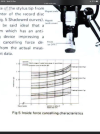
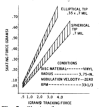
Consider this graphic from the famous Kogen (Shure) article, 1967:


1780110315119.png

Look at "modulation velocity = zero" on this graphic; i'm going to get back to this later.

a. If we happen to believe that AS force is about 10%-15% of the VTF, that is like going from 1.0g to 1.15g, it ought to make a very small difference on wear.

b. Antiskate changes with radius, the amount of force vs radius follow a parabollic curve. Thus the tonearms that apply a linear compensation will always have some error: undercompensation or overcompensation at some points.

c. The friction coefficient, used for calculating the skating force, depends on record material, amount of groove modulation (velocity), surface roughness, and quality of the polish of the tip. Even assuming that the vinyl material has identical friction coefficient at all times, and even assuming the same perfectly polished tip, modulation velocity will change. Since modulation velocity is not constant nor fixed... Antiskating will seldom be correct as well.

All in all, antiskating is always a guess. If I set antiskating to zero, i'll have compensation error of about 10%-15% or maybe. If i apply antiskating, perhaps I will also have similar errors, for some conditions of groove radius and record modulation.

Don't get me wrong, I do set antiskating on all my tonearms that support it. But I do it with the illusion that it will reduce stylus tip wear. However, as you say, "Physics is physics", and Physics show that antiskating WILL be wrong, probably most of the time...
 
Theory tells you that inner groove tracking should have nothing to do with AS as long as VTF is sufficient.

In practice: I have no problems with tracking at the inner grooves.
As long as you are not getting any inner groove tracking problems, don't worry about it.

However, the theory that "inner groove tracking has nothing to do with anti-skating" is wrong. It may be minor in your case, but it exists.

 
However, the theory that "inner groove tracking has nothing to do with anti-skating" is wrong. It may be minor in your case, but it exists.
I'm sorry, i can't watch a video of 279 seconds when a simple answer would suffice; i have been working all day and my spare time is short. Props to the Soundsmith corporation for reviving (and then abandoning) the strain gauge cartridge, though.

As you know, i'm well acquainted with vinyl playback. Perhaps you should better define "inner groove tracking". Because tracking is really to make sure the stylus stays put in the groove and does not jump or loses contact (mistracking).

As long as the VTF is high enough to let the (moving mass of the cantilever+stylus tip system) accelerate the acceleration corresponding to the signal being tracked, the stylus will stay put. With the modern cartridges I have, say, the AT-VM540ML for example, the moving mass is very low, and VTF of 2.0 is plenty high to track things.

Now, perhaps you meant "inner groove tracing"? Tracing is how closely the movement of the stylus tip follows the actual modulation on the groove. As long as the groove is not damaged and the side radius of the stylus is low enough, tracing will be fine at the inner grooves.

I haven't had inner groove tracking or tracing problems since long, long ago. Whenever there are problems, it's either a worn record (problem solved through the use of an ML stylus), dirty record (solved through cleaning), or there's a problem with the tonearm bearings (solved through servicing). I fail to find any relationship to antiskating, again, as long as VTF is sufficient.
 
AR used to argue that their X turntable's lack of antiskating (other than the twisted arm leads) wasn't an issue since increasing tracking force by a quarter of a gram accomplished the same thing. Given that the AR turntable was very carefully thought through, and it's continued widespread use three quarters of a century later, I'd not dismiss this as simply corporate flummery.
Having said that, I use the suggested antiskating settings and don't worry about it.
 
One can certainly increase tracking force to increase tracking ability. Antiskate is there to get a more even force on left and right walls and on the stylus. When tracking tests are done it is usually the right channel that mis-tracks first due to skating force. This is just evidence that the force is less on the right wall. You can either increase tracking force to or antiskate force to make it track the right wall.
 
All in all, antiskating is always a guess. If I set antiskating to zero, i'll have compensation error of about 10%-15% or maybe. If i apply antiskating, perhaps I will also have similar errors, for some conditions of groove radius and record modulation.
If you set antiskate force to 10-15% of VTF you will certainly not get similar errors the other way. Record modulation will always increase skating force, and groove radius has a minor effect, and varies between 90-100% of its maximum value. 90% reduction will be 9-13.5% of VTF, which is a negligible drop.
 
If you set antiskate force to 10-15% of VTF you will certainly not get similar errors the other way. Record modulation will always increase skating force, and groove radius has a minor effect, and varies between 90-100% of its maximum value. 90% reduction will be 9-13.5% of VTF, which is a negligible drop.
Ok, i like this.
It makes me feel better for the tonearms that have AS (and, as mentioned, i do use AS when available.)
 
I use the Tacet Test record, part 6, to check the anti-skating settings. Unlike what Soundsmith's Peter Ledermann said in his second video about anti-skating (A/S), the Tacet has several volume steps (modulation) levels in its track. I think Peter is talking about one of the Shure Test Records that only has a very high A/S modulated test track. I have not tried his suggestion (Schröder method) near the middle of video #2.

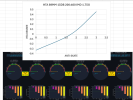
I set the A/S so that I can get through most of that Tacet test track. Since the Technics has a dialed-in A/S, I can set it to complete that track without any mistracking. The SME has the more primitive hanging A/S weight. It slightly mistracks on the loudest part of that test track.

Part 2.
 
Last edited:
Back
Top Bottom