Thomas_AA
Well-Known Member
Quite clever.I start as the same as VTF then i fine tune by sound. If there is no sound when lifting off with the cue, that's where I set it


Quite clever.I start as the same as VTF then i fine tune by sound. If there is no sound when lifting off with the cue, that's where I set it


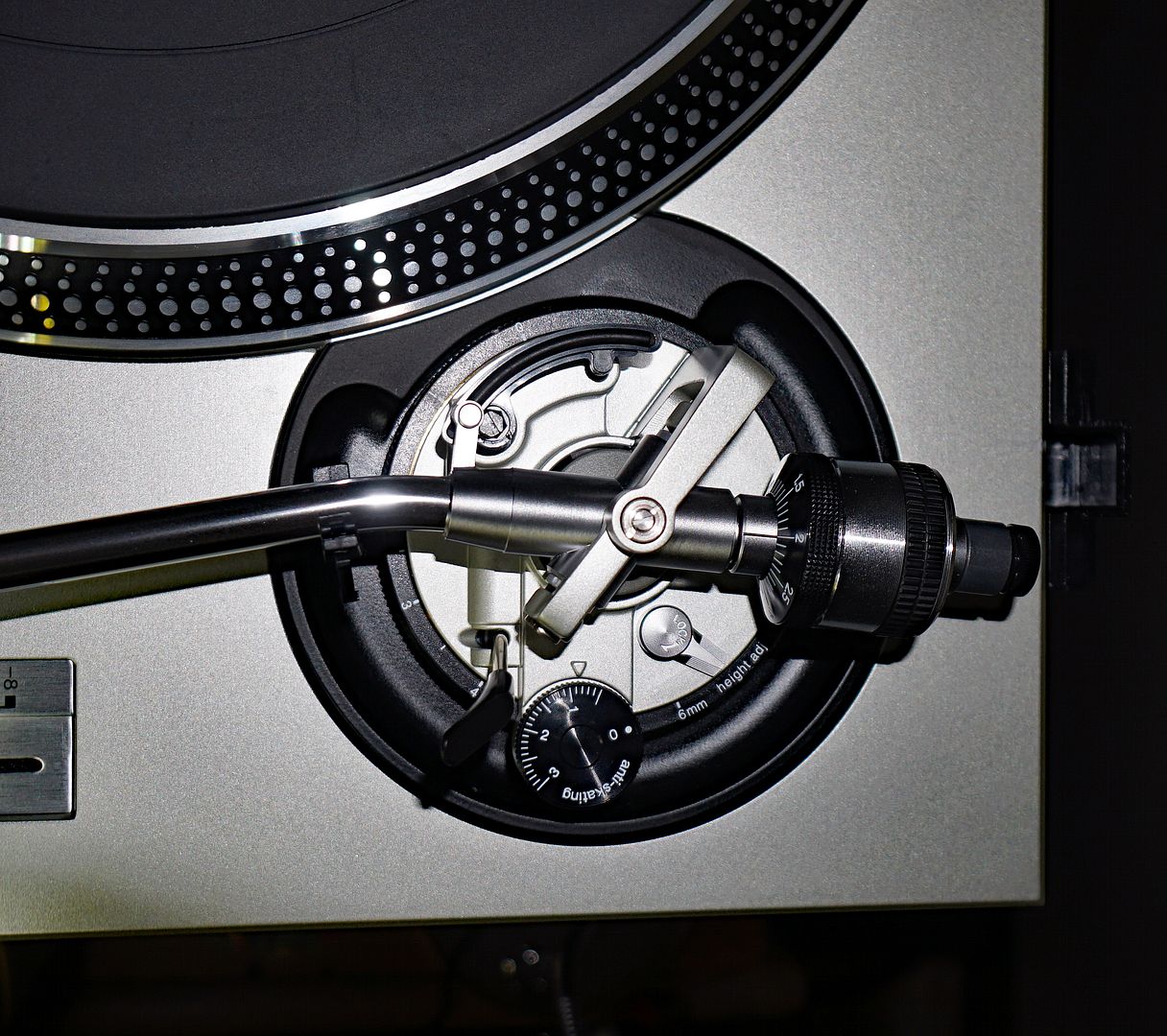
My PL-41 didn’t have it either. My AR-XA doesn’t have any provision other than a slight twist and loop of the wiring. Neither of the arms on my current turntable have it, and again, I don’t miss it. My main cartridge is a Denon DL103 tracking at 2.5g on an ATP 12T. It makes beautiful music and tracks beautifully with no sense that the rock is favoring one side of the groove. I have owned turntables/tonearms with AS and my last four tonearms didn’t/don’t have AS, yet delivered better sound so I don’t see the point.We need an option for "Zero" or "None". My 1968 Pioneer PL-41 doesn't have anti-skate.
"Usually, most folks use far too much antiskating, as evidenced by the thousands of cartridges I have rebuilt over the last 40+ years – as evidenced by observation of the outer edge (right channel) of the diamond to be worn far more than the inner, or left channel."I thought I read (Peter Lederman?) saying too much antiskate causes wear on the Left channel, and too little causes wear on the Right channel?
Harry Weisfeld heard better sound when no antiskate mechanism was used and tracking force was kept near the manufacturer's suggested maximum vtf, but he did acknowledge the shorter stylus life, replacing the stylus in his M97xE every 500 hours rather than the up to 800 hours suggested by Shure. For him, the better sound was worth the reduced stylus life. My turntables have antiskate devices, and my ears don't hear a difference between zero antiskate and the reduced antiskate setting suggested by Soundsmith and Sumiko (that I mentioned in a post above), so I go ahead and use it.The points are:
1. avoid uneven wear and shorter life of stylus
Blackdog61 is hearing even performance without the need for antiskate.2.even performance in both channels,
Tracking can be just as good without antiskate by simply increasing tracking force a bit. Edgar Villchur referenced a study by F. V. Hunt when he wrote, "In short, the beginning and the end of the virtue of anti-skating compensation is that it decreases by a small amount the stylus force required for proper tracing. Hunt's analysis indicates the range of this decrease as between 7 and 19 per cent, the lower figure applying to the better-designed arms of low inertial mass and greater length. Side-thrust compensation does not change the final performance." Villchur rigged an antiskate device for the arm in his AR turntable, and found that without antiskate he needed to increase tracking force from 1 5/16 grams to 1 1/2 grams to get the same distortion-free performance.3. Better tracking ( 20-25% improvement.

Good to hear I’m not the only one. I’m also running a Denon 103, re-bodied by Zu on a fairly heavy Ortofon LH-9000 headshell at about 2.5g. Sounds great to me.My PL-41 didn’t have it either. My AR-XA doesn’t have any provision other than a slight twist and loop of the wiring. Neither of the arms on my current turntable have it, and again, I don’t miss it. My main cartridge is a Denon DL103 tracking at 2.5g on an ATP 12T. It makes beautiful music and tracks beautifully with no sense that the rock is favoring one side of the groove. I have owned turntables/tonearms with AS and my last four tonearms didn’t/don’t have AS, yet delivered better sound so I don’t see the point.
I heard the same effect with my Schiit Sol, so the use of AS might affect unipivots audibly more than regular arms. I was able to design one for the Sol (also a unipivot) that doesn't negatively affect sound but it's not as convenient to use or set, so it is possible to have transparent AS if it's done properly.Harry Weisfeld heard better sound when no antiskate mechanism was used and tracking force was kept near the manufacturer's suggested maximum vtf, but he did acknowledge the shorter stylus life, replacing the stylus in his M97xE every 500 hours rather than the up to 800 hours suggested by Shure. For him, the better sound was worth the reduced stylus life. My turntables have antiskate devices, and my ears don't hear a difference between zero antiskate and the reduced antiskate setting suggested by Soundsmith and Sumiko (that I mentioned in a post above), so I go ahead and use it.
There was already a sugeestion in the thread which I have not tried yet but interesting.Wondering if there's a way to measure stylus lateral deflection/offset with active electronics (turn cartridge into a sensor)?
The deflection would be 0.05mm according to some sources can anyone se that?Totally swamped by record eccentricity I thinkThere was already a sugeestion in the thread which I have not tried yet but interesting.
Deflection of a stylus from cue up to cue down requires a good loupe or microscope. Going the other way, from cue down to up would result in a lateral sudden movement if the stylus is deflected in one or the other way. If not there would be no lateral movment.
This would in theory be very sensitive method. Will try it with measurements and be back.

With a microscope yes, but measurements could be another. If perfect, cueing up from a groove should give no lateral signal. Will do some tests.The deflection would be 0.05mm according to some sources can anyone se that?Totally swamped by record eccentricity I think


Retipping I can tell who does not have enough amateur and who has too much.Zero. I haven’t had a tonearm with AS in years and don’t miss it.

The reason I have a Rabco linear arm on my Thorens TT is because the MC cartridges at the time didn't track very well using a pivoting arms at the recommended 2.0 gram pressure by Ortofon. I didn't know at the time Europeans and British users were tracking anywhere from 3 to 4 grams to prevent mis tracking. I tried a linear arm at work and notice a significant improvement and why I removed the SME MK II arm back in the middle 70's. The linear arm made a significant difference when tracking challenging LP's especially the famous Telarc 1812 Overture LP. The results weren't perfect but at least the needle didn't hop out of the groove as when using a pivoting tone arm.
Today I am using modern Dynavector Mc coil cartridges whether using a linear arm on my Thorens or Fat Boy pivoting arm on my Mark Levinson/ VPI turntable I have never experienced any sign of mis tracking.at a 2 gram pressure with either cartridge or arm.