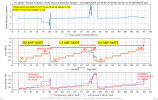
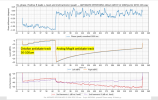
The nice thing about the Schroder/Ledermann method is that you don't need a blank disk; you just use the space available in the run-out groove of a normal record. Some of my records have a wider flat space between the run-out grooves than others, and that makes the method a bit easier to use.Yes Lederman/Schrøder/blank disk method.
I have the Denon XG-7001 test record with a blank area specifically for this purpose.
With your blank area at a different radius than the run-out area, would that affect what type of arm motion a person would look for? That is, would enough antiskate to make the arm stationary on your test disk also result in a slow inward movement in the run-out area?My 3 TT vary AS force. But force wise 12-14% of VTF makes the arm stationary..
Sadly, a 0.1 change in antiskate settiing has a rather large effect on my turntable, at least down in the area I need to set mine at (the Ledermann method has my dial at 0.5 to track a cartridge at 2.1 grams). Makes it kind of fiddly to adjust, but the force does stay constant once it has been set.A 0.5 change in AS setting can be required to make arm start/stop moving..which gives a large margin for error