
Exactly, and the original transformer hardware will be used, so the only difference will be the windings, and maybe the bobbin.It wasn't "original" ever since the first component was changed.



Exactly, and the original transformer hardware will be used, so the only difference will be the windings, and maybe the bobbin.It wasn't "original" ever since the first component was changed.

 .
.
ALL speakers have varying impedance curves.I hope the rewinding works out. It's an ideal solution if it breathes new life into a damaged or faulty transformer.
When I first owned the 719, maybe 7 or 8 years ago, the power protection would sometimes cut in, usually at window rattling volumes but especially when driving KEF LS50s vs. old Wharfedale floorstanders. Mind you, I was still able to drive them hard enough to accidentally damage one of the Uni-Q drivers, despite their 100W rating. I used to think it needed a DC-Offset & Bias adjustment but I never did.
Bad boy
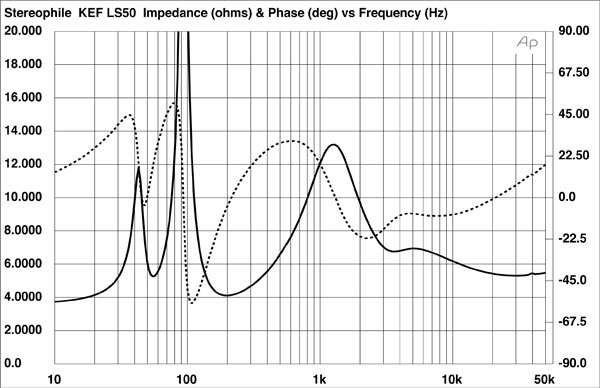
The LS50s are rated nominally at 8ohms but their impedance drops to around 4ohms for much of the mid and high freq ranges and as low as 3.2 ohms. I have used the AU-719 with the LS50s exclusively for the last 7 years. I noticed the power protection seemed to kick in earlier over the last year or so, which suggests a slow degradation of the transformer rather than a fault in manufacturing. I wonder if the AU-719 really ought to be paired with LS50s ? I'd hate to choose between them. I love listening to female vocalists and these sound perfect together.
From Stereophile "I would go so far as to say that the LS50 is one of the finest speakers at reproducing female voices that I have heard—for less than what you can pay for a set of high-end interconnects" "In 13 years of working at Stereophile, I have not seen another component that offers such a radical combination of value and performance"
The graph is from measurements of the LS50 Anniversary edition (taken from https://www.stereophile.com/content/kef-ls50-meta-loudspeaker-measurements)
And I take zero stock in any of these "audiophile reviews" since most are paid reviews, and/or advertising bait. Yes they use fancy graphs and technical speak to convince you, but none of that equates to your own ears, and your own perceptions of music. Most people can maybe hear the same thing with their ears, but their minds will perceive something different. I played drums for years so I naturally tend to key in on percussion. I dabbled in guitar, trumpet, and a few other instruments (poorly I may add  ) but all allow me to key in on everything. The hard part is to take in the entire composition and perceive it as a whole. Sitting or standing behind an instrument is entirely a different sound than standing or sitting in front of it. But for the audience, all they hear is from the forward perspective. Every speaker has it's own strengths and weaknesses. So if you love a female voice (I do too), then the LS50 might be your optimum choice. But how do they do with a male voice? The graph might convince you they do great, but your ears may disagree, at least somewhat. I run 3 pairs of speakers and will combo them differently in pairs depending on what I want to listen to. Sometimes a single pair is near "perfect" for a certain piece of music, sometimes a "hole" needs filled and add a pair.
Skywatcher, it seems you misunderstood me entirely. My comments were questioning the 719's ability to handle low impedances. I was worried the impedance of my LS50s may have dipped too low too often for the 719 and might in some way have aggravated the damage to the transformer. I just put that out there for discussion, as I'm no an expert on the 719 or amplifiers generally. I suppose if I was I wouldn't have asked Hyperion to restore it for me.ALL speakers have varying impedance curves.
 It's OK, I sometimes do the same.
The speakers had nothing to do with the transformer. Otherwise a bazillion transformers would be damaged by a mere 4 Ohm momentary impedance curve. My first sentence addressed that... Your transformer was defective from day one, and nobody took notice until @Hyperion discovered it. And I apologize for touching your "audiophile nerve"...
.
I personally don't think the use of the LS50s including their use at high volume was a reason specific to them for apparently causing the transformer fault to worsen, I think it would have got worse with any speakers, given time. The protection circuitry on the AU-719 is sufficiently sophisticated to complain very noticeably when it thinks the amplifier is being abused - so this would have happened much sooner, and more regularly had the speakers themselves been the stimulus for worsening the transformer fault.My reason for posting the comments and the graph of the LS50s was to draw the attention of Hyperion, or anyone else with an open mind, to my concerns that I may have been placing an unhealthy current load on the amplifier.
I personally don't think the use of the LS50s including their use at high volume was a reason specific to them for apparently causing the transformer fault to worsen, I think it would have got worse with any speakers, given time. The protection circuitry on the AU-719 is sufficiently sophisticated to complain very noticeably when it thinks the amplifier is being abused - so this would have happened much sooner, and more regularly had the speakers themselves been the stimulus for worsening the transformer fault.
Occasional spurious tripping of the protection circuit can and does happen with this, and other models of Sansui amplifier that use the troublesome 2SF656 thyristor in the protection circuit, which is why I replaced it during the restore.
I'll be fascinated to find out exactly what is ailing this transformer, if the repairer can tell me, I'll be sure, as I think Tony will be too, to let you know what the issue is/was.
It is very possible there was a small batch of defective transformers. One possibility is a "new trainee" winding them, or a bad batch of thermal fuses, or the "newbie" wasn't making secure connections on the fuses. When brand new the connections were "fine", but as the years went by they deteriorated. Akin to resistors drifting high over time. Your speakers were not the cause. The fact that others have had similar experiences with a transformer going south in these points to a batch of defects of whatever initial cause. Either way, it was from day one and slowly progressed.The idea of it leaving the factory with faulty windings just didn't make sense with what we know. The fault clearly worsened with time and use, and that's why I thought, no matter how improbable, I ought to put it out there for consideration. I don't know all the quirks of the 719 but I'm confident you do.
I tend to agree with you that it would have worsened ovet time with any speakers but I don't like mysteries. And you're dead right, I will be fascinated to see what the repairer finds. Let's hope we can share one of those "aaaah, that makes sense" moments.
Post #39 is where the clues began, and @AUD101 mentions his discrepancy. Plus your own "search" for a transformer revealed more have been affected. A "pair" of transformers installed doesn't mean they are out of the same batch/lot numbers either. Especially when production is spread over several lines. Lots tend to get scattered about and the part number is all that matters during assembly. Yes, I'd like to see if the "transformer guy" can shed some light on it. It's too bad there is no way to compare any other defective units to find any similarities to point to the initial cause. I thought about the enamel on the copper (like you suggested), but if a winding shorted even for one turn, it would cause more current draw. Although I don't believe that was individually tested for so it could still be something as at least a partial cause. I'm still leaning towards a splice/connection issue on the thermal. It just seems the most logical at this point in time.It'd be interesting to know more about the other 719 transformer failures that Skywatcher referred to. How old were they when they failed ? How did the failure manifest ? Was the same channel affected ? That might tell us something.
Hopefully the repairer can tell us more. For now I'm staying with the wait and see camp.
Good possibility.. Although I have transformers much older that have nothing wrong with them too. Different wire manufacturers, different methods, and many times different coatings. Nichicon had a terrible batch of electrolyte a few years back and had lots of failures.Interestingly, I spoke to my dad, who used to be an armature winder, lift mechanic and even wound his own home made arc welder. He thinks it's a winding gone s/c
He posted this
"The windings are probably insulated with shellac or a similar substance and with heat the insulation tends to breakdown overtime. The layers only have a small voltage difference between each other but depending on how the windings have been laid down it's possible that adjacent layers have more voltage difference than they were intended for. Test the resistance with high voltage tester such as a megger."
I hope so. It would save some money and a whole lot of hassle. It's frustrating that Hyperion's done all the hard work to refurbish the amp and I still haven't had the chance to hear it.Good possibility.. Although I have transformers much older that have nothing wrong with them too. Different wire manufacturers, different methods, and many times different coatings. Nichicon had a terrible batch of electrolyte a few years back and had lots of failures.
It can just as easily be your good transformer is from a different batch and has absolutely nothing wrong with it now, and won't in another 40 years from now.

Fully agreed!Your speakers were not the cause.

That seems not far out. In 1980 my AU-919 was listed at £440 and I paid £400 (about £2000 in today's money).<snip> I believe they [AU-719] sold for around £400 new back then [1979]. <snip>
Now we all agree then. I'd agreed that was unlikely with Hyperion back in post 108 & 109.Fully agreed!
Thanks. That suggests the AU-719 might have been more like £350 rrp.That seems not far out. In 1980 my AU-919 was listed at £440 and I paid £400 (about £2000 in today's money).
I don't think one faulty transformer necessarily means the other is at risk. Sansui build wasn't perfect; for example John discovered that a resistor had been omitted from one side of the MM Head Amp in my AU-919. (This may explain why I had to constantly play around with speaker balance and tone controls for the first 37 years, whereas they aren't needed at all now.)
 I also read it wrong, I thought it was going to be a brand new replacement but it will be the original one but repaired so it won’t look different anyway. That will teach me to read audio karma whilst working.