• The move to the new server is done. There are some software and database maintenance updates in process. This has us passing the hat around to help out. We appreciate any donations. Seriously, even a dollar helps. The payment page may be found here - https://www.audiokarma.org/support.html

AU-719 on the bench

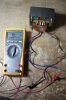
With collection of the transformer expected very soon (Wednesday), I decided to remove it and see what I could discover, as you can see no need for any more guessing, this says it all.

IMG_3374a.jpg

So just the excitation of the mains in one lead seems to have been enough for the transformer to work partially. (assisted perhaps by the effect of the 220V primary tap of the good transformer also being connected to its 220V tap). But without the ability to create a stronger magnetic field provided by the extra current of an intact primary winding, this explains the severe current limiting effect of even the lightest loads on the secondary.
 
Last edited:
With collection of the transformer expected very soon (Wednesday), I decided to remove it and see what I could discover, as you can see no need for any more guessing, this says it all.

So just the excitation of the mains in one lead seems to have been enough for the transformer to work partially. (assisted perhaps by the effect of the 220V primary tap of the good transformer also being connected to its 220V tap). But without the ability to create a stronger magnetic field provided by the extra current of an intact primary winding, this explains the severe current limiting effect of even the lightest loads on the secondary.

Interesting, does that suggest the thermal fuse has blown ?
 
Interesting, does that suggest the thermal fuse has blown ?
Very likely.

I think the kind of thing that causes this may be someone accidentally blocking the cooling vents in the top cover with something - an album sleeve? - maybe during a party where volume levels would be higher, and consequently heatsink temperatures are higher. The single overheated capacitor on one of the driver boards (picture shown in post #1 of this thread) may have been a clue to a historic overheating event. :idea:
 
Last edited:
It seems to me it might also explain why you measured additional voltage (95v - post 29) on the good transformer when both ought to be 88v, like GrisPato's is. (post 40)

Might be interesting to read the secondary voltages of the good transformer with the bad one out of circuit. Just please be very careful.
 
Last edited:
I think that's more likely to be the effect of somewhat lower mains voltage at his location? 241V here yielded 94.4V (on the good transformer) this morning.
 
Very likely.

I think the kind of thing that causes this may be someone accidentally blocking the cooling vents in the top cover with something - an album sleeve? - maybe during a party where volume levels would be higher, and consequently heatsink temperatures are higher. The single overheated capacitor on one of the driver boards (picture shown in post #1 of this thread) may have been a clue to a historic overheating event. :idea:

You mean the one LWB referred to as an old relative dressed in a tight top ?

I confess the amp didn't have a lot of headroom above sitting on wooden shelves for about 3 years now. I wasn't concerned because it never felt particularly hot and I always turned it off when not in use. Still...maybe it's not a coincidence.

Just tried that, same input voltage, (241V) same output voltage. (94.4V) ;)

Is that with the switch set to 220 or 240 ?
 
Of course the big question is can the thermal fuse be replaced ? I think I know what the answer's going to be but I felt I should ask.
 
Does it matter if it's going to be rewound anyway ? Best case, fixed without needing a rewind. Worst case, rewound as planned. I'd love to be able to pick up the amp on Wednesday rather than just the transformer but if it's a huge amount of work I will understand. Your call.
 
Your call.
The thermal fuses are not the usual kind of fuse, so I wouldn't even attempt trying to fit one, I would always send a transformer with a failed thermal fuse to a transformer repair outfit. So, the transformer almost certainly must be re-wound, I would hope that our repairer would do his utmost to keep the costs as low as possible, avoiding a rewind if this is possible. All we need to do is task him with 'repairing' the transformer, then he shouldn't take it that we are asking him to rewind the transformer no matter what. We can tell him what we are expecting as a result (i.e. 95V out of the secondary winding with 240V input). And that if a rewind is necessary, we expect him to match the current capability as closely as possible to the original spec' by measuring the thickness of the wire, its resistance, and the number of turns originally wound - and we should get the desired result. ;)

We've made his job easy (for someone who does this for a living), providing the original hardware, which isn't burned to a crisp due to catastrophic failure - and we can pass on crucial information about the requirements for the transformer. ;)

Sometimes all they get is a blackened lump, and are told to get on with it. :D

So, it will have to be collection of the transformer only on Wednesday... ;)
 
Last edited:
Thanks John. They haven't sent me the job sheet they mentioned in their email yet, which is supposed to go in with the transformer. If it doesn't come tomorrow I guess I'll have to call them and check that I can still drop it in on Wednesday or I'll have to make a special trip.

From their email....

Dear Tony,

Thank you for submitting a repair request with Surrey Amps.
Once your request has been processed you will be emailed a Job Sheet.
Please sign the sheet and send in with the unit to be repaired.

Please do not send in your item before you receive the Job Sheet.

Many Thanks.
 
Last edited:
That seems not far out. In 1980 my AU-919 was listed at £440 and I paid £400 (about £2000 in today's money).

Thanks. That suggests the AU-719 might have been more like £350 rrp.

Your original estimate of £400 for the AU-719 in 1979 could be near the mark after all...

Elsewhere on AK, Moefuzz uploaded a Sansui press release of 26.7.1979 that said "[AU-919] is recently available in the U.K. retailing around £504", and Classic Hi-Fi says "Cost new: £480 (in 1979)".

I bought my AU-919 on 27.9.1980, and the RRP may have reduced by that time. Or maybe the £440 was the dealer's NSP (normal selling price) rather than Sansui's RRP.

Apologies to Hyperion for the thread drift. :oops:
 
With collection of the transformer expected very soon (Wednesday), I decided to remove it and see what I could discover, as you can see no need for any more guessing, this says it all.

View attachment 2140859

So just the excitation of the mains in one lead seems to have been enough for the transformer to work partially. (assisted perhaps by the effect of the 220V primary tap of the good transformer also being connected to its 220V tap). But without the ability to create a stronger magnetic field provided by the extra current of an intact primary winding, this explains the severe current limiting effect of even the lightest loads on the secondary.
John, I picked up an AU-719 on the auction site here in the US that was billed as having a bad transformer, and was sold with a pair of replacements (which turned out to have been pulled from an AU-717 and are not the same). It did indeed have a bad transformer, and the paper was dark brown and crispy. And although I'm sure it would work and no one would notice if I fitted the 717 transformers I won't do that.

So I've been watching for a spare to come up, and they are apparently just as hard to find on this side of the world. I thought about rewinding, but haven't explored it yet.
 
Thanks for this Ray, Tony ('sansui au719') and I weighed this up, and I was able to tell him that his amplifier would work just as well as before, but - and this is a big 'but' - he wouldn't be able to listen at high volume, and the amplifier was in effect 'crippled'. The time it would take (years probably) to find a known good replacement transformer (of the right model), was the trigger for seeking out rewind/repair services for the faulty transformer. I investigated complete replacement using new toroidal transformers, but to satisfy the current requirements made them too big to fit in the space available. So, that's where we are - Tony is coming over today to collect the faulty transformer, and will hand-deliver it to the repairer with some information and notes from me about what we are expecting from his service. The repair guy actually repairs and reconditions amplifiers of all kinds (including vintage I think), as well, so I think he will know what we expect from him, but I'll be overseeing this as much as I can. ;)
 
Last edited:
Nice to have a good chat while picking up the transformer, enjoying some windy spring weather. For the benefit of others, I'll fill in the story. I got the transformer from John (Hyperion) but my initial call to the Surrey Amp Hospital guy was not encouraging. I asked if I could drop the transformer in without waiting for the job sheet to be sent. "Stan's not sure if we have the parts for this type of transformer". "It probably just needs a thermal fuse" "Err.., I'll get Stan to call you back". He didn't. He told me he had my number from the caller display. As I got closer to Surrey I called them, several time. Each time I called it would be diverted then drop out. I wasn't that easily deterred. I knew the road name but had no house name or number. Luckily I found a postman "Where would I drop something off for Surrey Amp Hospital". Postman know everything about their rounds. He led me to a driveway tucked behind a wall and some big black gates. He showed me the small bell button, sitting high on the wall of a nondescript garage or storeroom off the side of a small house. I thanked him and rang it. Eventually someone poked their head out. I explained who I was. "Oh, yes the Sansui". Inside was stacked full of guitar amps in various states of repair. Perhaps the Sansui is a little out of their usual line of work. At least we knew they had a winding machine and probably the experience to repair the transformer properly, if they could only be motivated. I exhanged a few words with Andy, who tests the guitar amps on completion, but Stan, the mysterious tech guy, was not there. Finally the transformer was signed onto a job sheet and went into the system.

it may seem a strange situation for non-Brits. Certainly as an Aussie, coming from a service culture heavily influenced by our proximity to SE Asia, such reluctant service seems alien, even to me after more than 10 years here. Paying customers regarded as a bother, especially if there's already a bit of work for the week. And being British, they cannot simply tell you they don't want the work. You have to read the subtle clues or guess. Aussies prefer to be blunt, a bit like the Dutch, but in a customer service regard the Dutch are more like the Brits. Over several years living in Amsterdam, I found the Dutch may have the characteristic forthrightness of Australians, but on top of that bluntness they also seem to despise expectations of customer service. The first time my wife and I were living in the Netherlands we had a beautiful 16th Century apartment on the Keizersgracht, courtesy of my wife's employer, completed with a grand piano and rare antiques. I wanted to find a key to an old desk in the master bedroom. There were lots of antique stores around the corner on Nieuwe Spiegelstraat. One shop was full of antique desks, dressers and wardrobes. Their keys seemed to beckon me in. It was about 3:30pm, an hour before the 4:30pm closing, advertised on the door. I asked if the manager could help me. "No" "Why ?". "I'm closing". "But your sign says 4:30pm". "I'm going home". The next day I returned at 2pm, hoping to give him no excuse. To my surprise an Australian guy was in his place. "I want to find a key to fit an old desk" "Sure". He leapt up, emptied a pencil jar onto a desk and filled it with every type of key he could find, from all their antiques "Try these" he beamed, handing me the jar. I soon found one that fitted, returned the rest and asked him if I could get a copy made. "Take that and drop it back later, anytime, or tomorrow if you prefer".

Now I don't want people to think I'm not fond of the Dutch or the English, quite the contrary. but customer service is just not their thing. Of course John (Hyperion) is one of the rare exceptions to the rule.

For now all we can do is hope these guys come through and soon. John prepared a dossier of helpful information for them to work off, stopping only short ot the actual winding instructions "Knit one, pearl one". Filling in all the necessary bureaucracy might be enough to carry it through to a repair, however slowly. The Brits love their bureaucracy and it might help erase the stain of (some might consider) a bit of "pushing in" before the job sheet was issued, Queue jumping is considred a social crime in Britain, ranked just behind regicide for its undesirability.

 
John, I picked up an AU-719 on the auction site here in the US that was billed as having a bad transformer, and was sold with a pair of replacements (which turned out to have been pulled from an AU-717 and are not the same). It did indeed have a bad transformer, and the paper was dark brown and crispy. And although I'm sure it would work and no one would notice if I fitted the 717 transformers I won't do that.

So I've been watching for a spare to come up, and they are apparently just as hard to find on this side of the world. I thought about rewinding, but haven't explored it yet.
Ray, for info the 719 transformer part number is 4003124
 
Back
Top Bottom